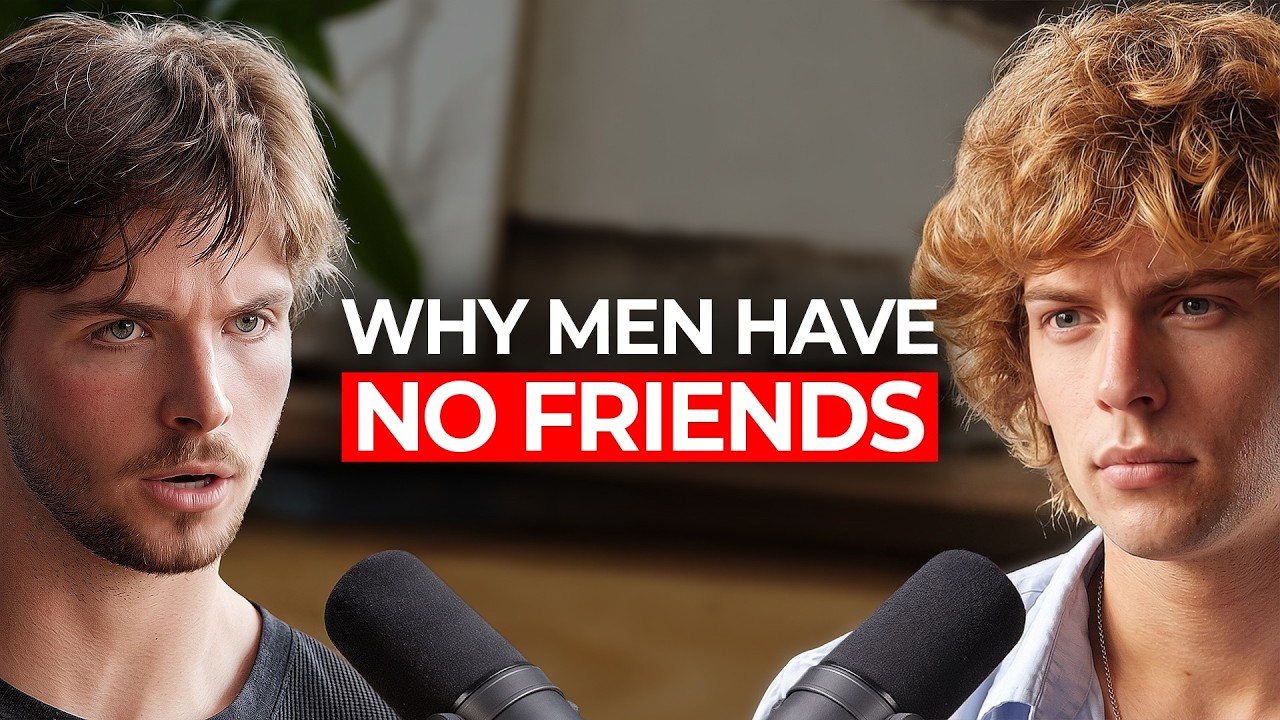
Jett Franzen, a 22-year-old Gen Z content creator with 1.5M+ followers, argues that algorithms and nonstop marketing have created a “marketing holocaust” that hijacks identity formation, leaving young men resentful, passive, and lonely; he traces his own six-year isolation, the seven cultural sins he sees destroying his generation, and the practices — creating more than consuming, positive affirmation, faith — that pulled him out.
The Core Problem: A Marketing Holocaust That Steals Identity
We entered a “marketing holocaust” around 2020 where algorithms flood every space with curated identities, so people unconsciously adopt beliefs, aesthetics, and grievances fed to them rather than developing their own.
The gap between the highlight reels people consume (Bruce Wayne, Marlin, Andrew Tate) and their private reality breeds resentment, entitlement, and a victim mindset that hardens into rigid ideological tribes.
Critical thinking atrophies because the sheer volume of information makes discernment nearly impossible; most people outsource their worldview to whichever creator first validated their pain.
The Seven Deadly Sins of Gen Z Men
Consumption over creation — Average screen time dwarfs productive output; Franzen cites Jim Carrey: “The opposite of depression is expression.” He committed to creating more than consuming daily since October 2023 and says it rebuilt his identity and erased resentment.
Conformity — Evolutionary tribal pressure makes deviation feel like social death; suppressed shadow traits then unconsciously drive life decisions for decades (Jung).
Entitlement — Feeling owed a certain life simply by existing, fueled by success-porn content that delivers dopamine without effort.
Victim mentality — Online communities validate grievance, turning oppression into identity and discouraging agency.
Resentment — Jung: “People suffer the effects of their unlived lives.” Watching others execute dreams you never chased breeds bitterness disguised as critique.
Passivity — Following the prescribed school → internship → 9-to-5 script yields “viciously mediocre” lives; quiet quitting becomes the norm because peer validation replaces purpose.
The woman in the red dress (distraction) — The path of least resistance (drinks, scrolling, low-stakes socializing) crowds out the hard work of self-definition.
Six Years in Isolation: How Franzen Cracked the Code
Popular athlete-student through 7th grade; cut ties with friends who started drinking/vaping; became “the asshole” of the jock group, uninvited to homecoming, then fully friendless sophomore–senior year.
College (University of Arizona): dorm “dungeon,” zero texts for seven months (not even family), failed side hustles, parents urged therapy.
Prayer: “Either take away my loneliness or give me someone to be with.” Numbness set in; expectations dropped, suffering eased, but ambition dulled — a slippery slope he warns against.
Turned isolation into a laboratory: read classics, studied philosophy, lifted obsessively (218 straight days, 65 lbs gained), launched videos from parents’ basement.
First two followers felt like proof; “0% chance I don’t hit 100k” — belief preceded evidence. Now 1.5M+ followers, high-value network, moving out of Nebraska to travel and collaborate.
Identity, Truth, and the Algorithm’s Endgame
Truth requires curiosity stronger than the desire to feel good; total objectivity is impossible, so triangulate sources and detach from emotional priors.
Algorithms are the “most dangerous threat”: they hijack attention (the new real estate) by hooking native interests (e.g., Chicago sports) then incrementally curving the feed toward extreme, identity-defining narratives — all to create passive, purchasable consumers (Brave New World pleasure-control).
Dead Internet Theory — >50% of online actions are bots; trajectory worsens with AI.
Grand conspiracy — Franzen sees a spiritual war (Christ vs. Satan); every sub-conspiracy serves division. Epstein files proved “nothing is off the table” for evil.
Empathy, Shame, Faith, and Mental Health
Selective empathy — Gen Z empathizes intensely inside tribal boundaries, performatively outward (C.S. Lewis: “cast hatred onto neighbors, thrust empathy to the outer circumference”).
Shame as teacher — Not to ruminate on, but to internalize once, then let it reshape behavior.
Faith — Grew up Christian, became anti-natalist at 17–18, stripped faith to zero, rebuilt alone in Arizona via Scripture and felt the Holy Spirit. Dostoevsky: “If truth is outside Christ, I still choose faith.” Faith is a leap, not a logical conclusion; certainty kills daily dependence.
Mental health — Diagnosed bipolar/manic, depression, anxiety; refused medication (faked compliance), calling pharma corrupt given U.S. prescription/illness correlation. Conquered OCD-like rituals (7x door walks, 3-hr night routine) by sheer will; credits raw suffering for current clarity.
Vanity, Looksmaxxing, and Virtue
Greeks saw beauty as virtuous; modern looksmaxxing (Clav) takes a truth (looks matter) to vanity — optimizing appearance for its own sake, not character development. Inevitable aging then collapses self-worth.
Mogging has limited nobility; grooming and fitness are virtuous when they reflect discipline, not when they are the end goal.
Practical Wisdom
Book every young man should read:Sickness Unto Death by Kierkegaard.
Best advice (religious): “Pick up the cross and follow Jesus.”
Best advice (secular): “Everything regresses to the mean. The mean is your identity. Build identity by taking so much action it creates overwhelming evidence against self-doubt. You materialize life by controlling thoughts → beliefs → actions.”
Worst advice: “Hard honest work inside the system guarantees happiness.” False unless the work aligns with genuine belief; otherwise deathbed regret.