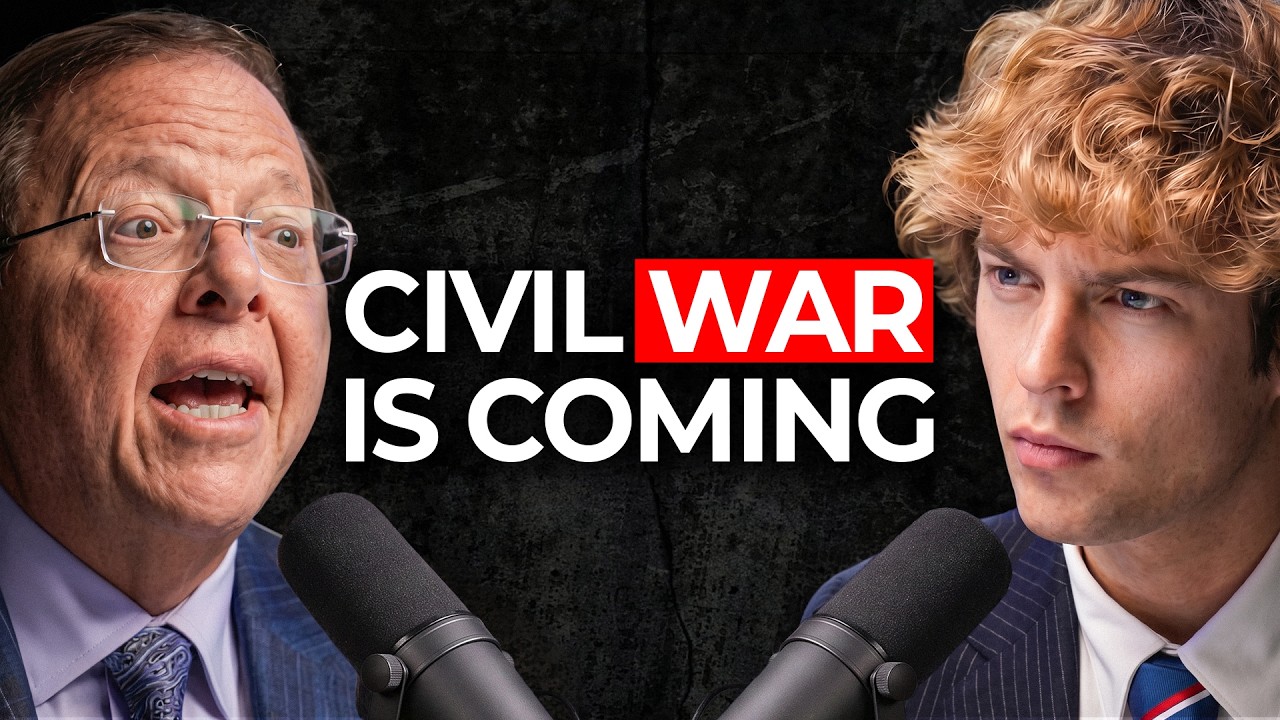
Robert Pape, a political science professor at the University of Chicago who has studied political violence, suicide terrorism, and war strategy for decades, argues that the current Iran war is the most consequential conflict since 9/11 — and one that could fundamentally damage the American economy, reshape global power, and deepen domestic political instability. He has been running simulations of this war for over 20 years and says the U.S. is now caught in a strategic trap with no easy exit.
Why Young Americans Should Care
Unlike the post-9/11 wars in Afghanistan and Iraq, which were fought by volunteers and had limited economic impact on most Americans, the Iran war is already producing economic consequences — rising gas prices, inflation, unemployment — that will disproportionately affect young people entering the workforce or trying to afford college.
Universities are under compounding financial pressure: the Trump administration’s war on higher education, the loss of international student tuition, and now war-related economic fallout are all shrinking financial aid and raising costs.
AI is simultaneously threatening job prospects, meaning young men face a convergence of worse employment, higher education costs, and now a war-driven economic downturn.
The Economic Costs Are Staggering
Pape estimates the war is costing $1–2 billion per day. Two weeks in, the Trump administration requested $200 billion from Congress to cover six months of operations.
He does not trust official accounting, noting the administration eliminated oversight offices (“the umpires have been removed from the game”) and the national debt is already at $40 trillion.
The leading indicator to watch is bond/interest rates, not the stock market. When the government must pay more to borrow, it rapidly cascades into higher costs for ordinary people — mortgages, car loans, credit.
He uses the 1973–74 OPEC oil embargo as a benchmark: that embargo lasted 151 days, removed about 6% of world oil supply, and led to doubled inflation and unemployment within 12 months, with mortgage rates eventually reaching 16%. The Strait of Hormuz handles 20% of the world’s energy — nearly four times that impact.
Iran’s Strategic Objective: Wreck the Trump Administration
Pape believes Iran’s number-one objective is not to surrender or close Hormuz permanently, but to damage the Trump administration politically and economically — keeping it hobbled and distracted for the remainder of its term.
Iran does not want Trump replaced with a more effective leader. A weakened, internally consumed Trump serves Iran’s interests better than a strong successor.
Iran has little incentive to fix the global economic disruption because global blame is falling on Trump and America, not on Iran — especially since the war began on February 28 with a U.S.-Israeli strike, not an Iranian provocation.
The Strait of Hormuz Is the Most Dangerous Chokepoint on Earth
The Strait of Hormuz is a narrow waterway between Iran and the Arabian Peninsula. It handles 20% of the world’s oil, 30% of its natural gas, and 30% of its fertilizer. There is no practical alternative route — pipelines bypassing it carry only a few percent of the total.
Iran has approximately 5,000 naval mines and can blockade the strait using drones, fast attack boats, or by mining the channel.
The U.S. has 13 bases in the Persian Gulf, roughly 30,000–40,000 personnel (mostly logistics, not combat), and has added carrier groups, destroyers, and land-based fighter-bombers (including F-35s) since January.
The War Started From a Negotiation Strike
On February 28, the U.S. and Israel bombed Iran during what was supposed to be a diplomatic negotiation session, killing the Supreme Leader and approximately 20 senior officials who were meeting at the time. Iran had been weeks away from a deal.
Iran had enough enriched uranium at 60% to produce material for an estimated 10–16 nuclear weapons once enriched to 90%. At the rate of enrichment (roughly 3 months per stage), Iran was 5–6 weeks from 90% and an estimated 6–9 months from a working weapon at the time of the strike.
The new Supreme Leader is the son of the killed leader, a former frontline Revolutionary Guards fighter with personal grievances — wounded in the bombing, his father, wife, and some children killed. He is more dangerous and more aggressive than his predecessor.
Why Regime-Change Bombing Always Backfires
Pape’s core finding from decades of research: bombing a regime never produces the political outcome the bomber expects. Killing a leader does not install a more compliant successor — it selects for someone more aggressive, because no one in the leadership circle can survive politically by advocating surrender to the power that just killed their predecessor.
Pre-war public opinion (e.g., 80% of Iranians opposing their regime) becomes irrelevant once a foreign power intervenes. The intervention unifies society and regime against the external enemy, closing the gap that existed before.
This pattern has held for over 100 years of modern warfare — it is not a personality dynamic but a political-structural one.
Trump’s “Project Freedom” Bet Failed
Trump launched Operation Project Freedom — an attempt to run ships through the Hormuz blockade through a narrow, mine-cleared channel, betting Iran would not fire back.
Two ships got through. Iran then attacked a South Korean ship, fired missiles at U.S. destroyers, and struck the Fujairah oil facility in the UAE — the endpoint of the only pipeline bypassing Hormuz. Oil prices spiked to $115.
Within 24 hours, Trump pulled the plug. Saudi Arabia and Kuwait immediately told the U.S. they did not want their airspace used for attacks on Iran.
The Escalation Trap
Pape modeled a multi-stage escalation trap over 20 years, and the war has followed it almost exactly:
Stage 1: Air campaign → regime does not collapse, instead strengthens and lashes back.
Stage 2: Iran controls Hormuz → U.S. faces a ground-power dilemma.
Stage 3: U.S. moves Marines and ground forces → which is now beginning.
The key indicators to watch daily: number of ships passing through Hormuz (was 140/day before the war, now near zero), logistics flights (C-17s, KC-135 tankers), and troop movements.
Iran Is Becoming the Fourth Center of World Power
Pape argues Iran is on track to become an emerging fourth center of global power (alongside the U.S., China, and Russia) because it now controls the economic fate of Gulf states, Japan, and others.
Iran’s incentives are to modulate oil prices — high enough to profit and hurt political rivals, but not so high as to incentivize the massive 5-year investments needed to develop alternative energy sources.
Within 18 months, Pape estimates a 90%+ probability Iran will have a working nuclear weapon, even if it shipped out all its current enriched uranium, because it has the raw materials, knowledge, and underground facilities to rebuild.
Domestic Political Consequences
Trump is already losing support among independents and some Republicans due to the war. But Pape cautions this may be a mirage — Trump will likely pivot back to social issues (immigration, cultural issues) that won him the 2024 election.
The real danger is the convergence of the international crisis with an existing era of violent populism in American politics — a concept Pape has developed from years of survey research at the University of Chicago.
40 million American adults (21%) believe the use of force is justified to remove Trump from office. Of those, about half mean assassination. On the right, 16% support using the military to suppress democratic protesters.
Pape’s research shows the U.S. is not heading for a civil war in the traditional sense (that requires organized armies of tens of thousands), but is deep in an era of violent populism — normalized political violence, lone-wolf attacks, and collective violence — the third such era in U.S. history after the 1920s and 1960s. What makes this one distinct is that it is happening on both the left and right simultaneously.
The Roots of Violent Populism
The fundamental driver is demographic change: the U.S. is transitioning from a white-majority democracy to a white-minority democracy for the first time in its history. Because the parties have different demographic compositions, this creates a realistic fear on the right of permanent political exclusion — Republicans may never win another presidential election.
This fear is driving efforts to restrict immigration, change voting rules, and redefine citizenship — which in turn provokes a counter-reaction on the left.
Social media is an accelerant, not the root cause. Deplatforming Trump and Tucker Carlson did not reduce political violence. The demand comes from social change; social media supplies the audience.
Pape’s research on suicide terrorism shows that foreign military presence on sovereign soil is the primary driver of radicalization — not religious ideology. Only about 5% of suicide bombers in his database were religiously radicalized; many were motivated by witnessing atrocities or having family members killed.
Could the Draft Return?
Pape says the draft is between “highly unlikely and plausible.” The trajectory of long wars is nasty, and if there is a major terrorist attack on the U.S. homeland — for example, Iran putting chemical weapons on drone missiles — public pressure for escalation could make conscription politically viable.
His recommended strategy: accept that Iran is becoming a fourth center of world power and pursue containment — strengthening allies like Saudi Arabia and the UAE to limit how far Iranian power spreads, rather than pursuing a direct military solution that has no stable endpoint.