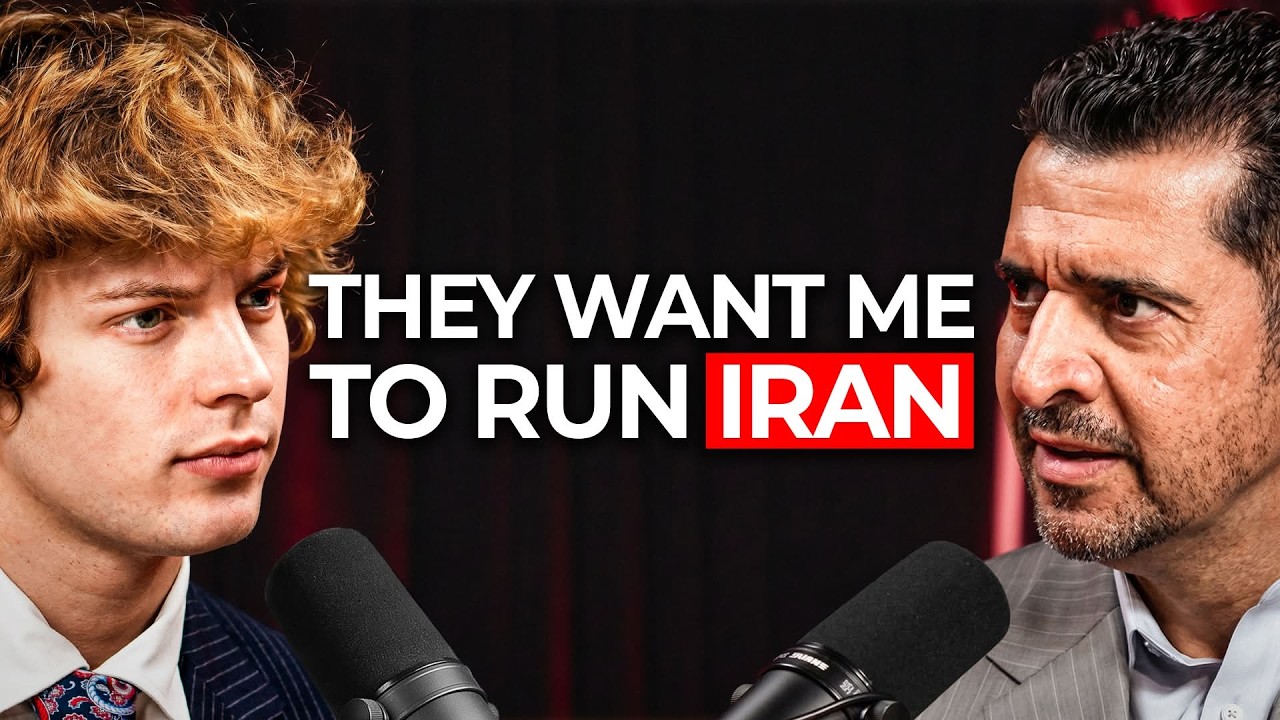
Patrick Bet-David (PBD), Iranian-born entrepreneur and host of Valutainment, shares personal and geopolitical reflections after the US and Israel bombed Iran in 2026, drawing on his childhood fleeing war in Tehran, his family’s trauma, and his unique position as a Persian-speaking American media figure who has interviewed Trump, Netanyahu, and the co-founder of Iran’s Islamic Revolutionary Guard Corps (IRGC). The conversation moves through the Iran war’s power dynamics, his own brief consideration of leading Iran, how AI is transforming his business, and his views on fear, leadership, and legacy.
The Iran War: Who Is the Eagle and Who Is the Crow?
PBD revisits his metaphor about the eagle and the crow to dissect the roles of the US, Israel, and Iran in the 2026 conflict.
He argues the US is the eagle — the dominant power — but Israel is the proxy most invested in the fight, because Israel’s top priority is regime change and the elimination of the IRGC, not just Iran’s nuclear program.
The US relies heavily on Israeli intelligence about Iran, which creates a risky dynamic where the intel could be shaped by Israel’s own agenda.
PBD says Iran’s IRGC has killed its own people repeatedly and that the chaos in the Middle East largely began after the IRGC took control in 1979, contrasting it with the era when Iran and Israel coexisted under the Shah.
He notes Trump’s public stance — refusing to make a deal until Iran agrees to stop bombing, including threats to take over Kharg Island, which controls Iran’s oil exports — and calls the situation “very nasty.”
How the Iran War Will End
PBD initially tweeted that Iranians had waited 47 years for this moment, but nine days later admitted no one knows how it ends.
He explains the shift: the Trump administration moved away from talking about regime change or regime collapse because there is no trusted Iranian opposition figurehead to rally the people behind.
He interviewed the co-founder of the IRGC, who expressed regret, saying he thought the revolution would be noble but it turned bad — which reinforced PBD’s view that the IRGC is a net negative.
Trump, he says, is being pulled between non-interventionist advisors (like JD Vance, Tulsi Gabbard, Charlie Kirk) and those pushing for action, and must make a fluid decision as the situation evolves.
Without a face for regime change — unlike Argentina’s Javier Milei or El Salvador’s Nayib Bukele — PBD believes the war’s goals narrow to nuclear containment, oil, and the Strait of Hormuz.
Why PBD Entertained — and Rejected — Becoming Iran’s Leader
In July 2025, PBD was approached in the Hamptons about the possibility of leading Iran, and major financial backers raised the idea in the United States.
He spent roughly 80 hours discussing it with his family before deciding against it in October 2025.
His primary reason: he is “America first,” has four young children who need him present, and does not want to relocate to Iran.
He says he believes he could grow Iran’s economy from under half a trillion dollars to $2–2.5 trillion by opening markets, removing sanctions, and leveraging Iran’s educated population and natural resources — potentially surpassing Gulf states like UAE and Qatar within a decade.
He also notes the personal cost: his father was opposed, and the role would require thick skin against accusations of being a puppet.
PBD’s Reaction to the Bombing of His Birthplace
Born in Tehran during the Iran-Iraq War, PBD has vivid memories of escaping bombings — first to Karaj, then to Bandar Pahlavi (now Anzali) near the Caspian Sea, then fleeing Rasht before eventually leaving Iran at age 12.
He says he did not celebrate the 2026 bombing, because he remembers the innocent children caught in war, regardless of religion.
He supports action against a regime that kills its own people — whether 3,000 or 100,000 protesters — but emphasizes war is ugly and ideally avoided.
His mother initially celebrated Khomeini’s rise in the 1970s because of communist family values and promises of free rights, but later changed her opinion; she and PBD’s father, who supported the Shah, still cannot be in the same room.
Geopolitics: Proxies, NATO, and Trump’s Leverage
PBD assesses other global players: China and Russia have been hurt by oil disruptions and drone supply chain issues; Ukraine is exploiting Russia’s distraction; NATO allies were “exposed” for refusing to help when the US asked.
He argues the war revealed who truly supports the US, using the analogy of a bar fight to identify real friends.
He believes Trump can end the war today but won’t without a deal, because pulling out with nothing would be politically damaging.
He speculates on Trump’s top three priorities: a nuclear deal better than Obama’s, control of Kharg Island, and possibly oil pricing — and on Iran’s: nuclear sovereignty, income from oil transit fees, and sanctions removal.
He suspects Israel’s top priority is regime collapse, meaning Israel has an incentive to sabotage any deal by continuing to kill Iranian officials during negotiations.
Trump vs. Netanyahu: Chess, Leverage, and Leadership
PBD says Netanyahu would beat Trump at chess because of his deep study of history and Middle Eastern strategic culture, while Trump would win at golf.
He calls Trump the best salesman he has ever met — constantly driving, poking, and trying to win people over — and notes Trump’s unmatched media experience, which stems from America’s freedom of speech teaching him to handle public humiliation and criticism.
He describes Netanyahu as “duplicitous” — polished and polished on camera but with hidden motives — and says Trump’s leverage has been weakened after the Supreme Court ruled against his tariffs and the SAVE Act failed in the Senate.
Fear, the Biggest Lie of 2026, and Fatherhood
PBD identifies the biggest lie of 2026 as the monetization of fear — fear used to sell products, medicine, votes, and life decisions like delaying marriage or children.
He distinguishes between preventative advice (insurance, estate planning) and manipulative fear, arguing that filtering the two prevents being controlled by media and government.
His own biggest fear is not maximizing time with his four young children while building his business, and he wants to build a company where his kids want to be close to him for the rest of his life.
He advises having children as soon as you find the right partner with shared values, rejecting the modern idea of waiting until financial milestones are met.
AI, Business Scaling, and Hiring
PBD says AI has allowed him to scale without hiring — doing the work of what would have been three additional employees ($180,000 in savings) — while working the same 60–80 hours per week.
His company uses AI across every division: for resume screening, interview scoring, employee calibration, and performance tracking.
They built “Interview AI,” a tool that scores candidates on experience, skill, and culture fit from a 5-minute video, filtering 33,000 applicants down to a manageable pool.
Employee calibration tracks five metrics — effort, attitude, innovation, leadership, and results — scored 0–10, making raises and promotions data-driven rather than subjective, and holding managers accountable for developing their people.
Notable Guests, UFOs, and Final Advice
PBD says the guests he was most proud to interview were Andrew Tate, Alex Hormozi, Kobe Bryant, and Donald Trump; the most entertaining was John McAfee, who conducted the interview with a gun, a cigarette, and a drink while his security team interrogated PBD’s military background.
Off camera, a guest showed him pictures and text communications that the guest claimed were evidence of real extraterrestrial contact, which PBD found fascinating but not conclusive.
The best advice he would leave the world: get the right people around you and, when you are alone and no one is there to help, faith will play a critical role — get those two right and you have solved 80% of life’s problems.
The worst advice he ever received: “Marry a girl with three kids because she’ll do anything for you.”