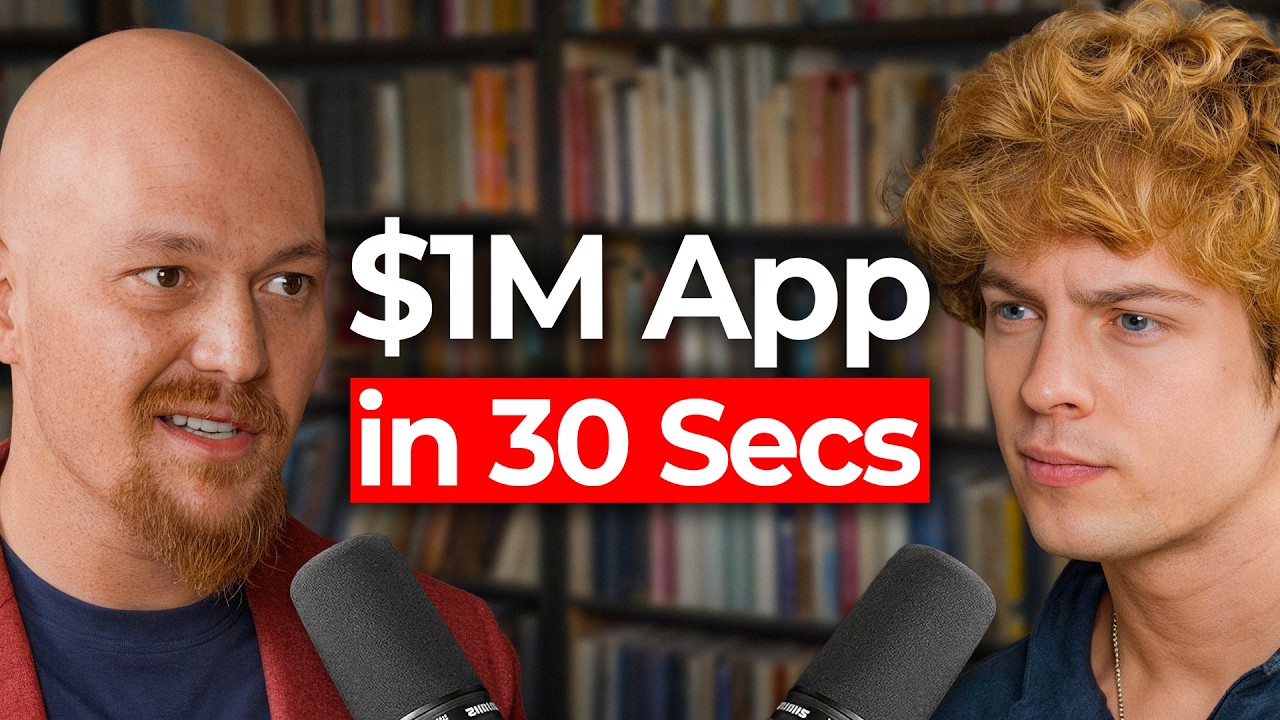
Amjad Masad is the founder and CEO of Replit, a platform that lets anyone build software by describing what they want in natural language, no coding required. Replit reached a billion-dollar valuation, and Masad turned down acquisition offers because he believes the company can become a trillion-dollar business by democratizing software creation. He grew up in Jordan in a lower-middle-class family, discovered programming as a teenager, and built his first product, an internet cafe management system, at age 12 or 13. His core mission is to turn the tech industry from a monopoly controlled by elite engineers into a democracy where anyone can build and own software businesses.
How Replit Lets Anyone Build Apps in Minutes
Replit now functions as an automated software engineer comparable to a mid-level engineer at Facebook or Google. Users type a prompt describing their idea, and the AI goes through a planning phase, builds a working minimum viable product in about 10 minutes, then iterates based on user feedback. The AI can write code, fix bugs, test the app using a built-in browser, and integrate external AI models like image generation.
A finance professional on a plane overheard an investment banker complaining about building spreadsheets and decks. He went home, built an app overnight using Replit, pitched it the next day, and left with $500,000 in letters of intent. He’s now raising at a $35 million valuation.
A teacher during COVID used Replit to build AI tools for grading and creating assignments. He grew the company to $10M, then $20M in annual revenue, and it’s now worth around half a billion dollars.
Another user built anybrand.co, a brand kit generator where you enter a product name, pay around $40, and get a complete brand identity generated with AI.
Masad argues that not having a coding background is becoming an advantage because coders get lost in implementation details, while product-focused people concentrate on solving real problems, marketing, and user experience. He predicts that within the year, non-coders will have an edge as entrepreneurs using these tools.
The 5 Steps to Building a Life-Changing App
Step 1: Find a good idea tied to a trend. The skill that matters most in the AI era is idea generation, because the cost of implementing ideas is approaching zero. Masad recommends being deeply plugged into social media, Reddit, TikTok, and online communities to spot what people are talking about and what problems they’re facing. He cites the example of a “looksmaxing” app that tracks facial progress and suggests interventions, or an app that tracks hairline changes over time.
People who are “terminally online,” ADHD-prone, or novelty-seeking actually have an advantage because AI rewards those who can rapidly try many ideas.
Masad uses Twitter to float ideas and gauge reactions, but increasingly skips that step and just builds the app to test demand directly.
Step 2: Break the idea down into a short, specific description. Write a paragraph with bullet points describing the core user experience. For a looksmaxing app, that means specifying the camera integration, the AI analysis, the lines drawn on the face, and the feedback given. The goal is to identify the single key use case and the “aha moment” a user should reach within about five minutes.
Step 3: Build it with Replit or a similar tool. Enter the description into the prompt box, let the AI work for about ten minutes, review the preview, and iterate by telling the AI specifically what it got wrong. Masad emphasizes talking to the AI like a person, being as specific as possible, and using screenshots for feedback.
Step 4: Test it on a real person immediately. Show the MVP to a classmate, friend, or target user before over-engineering it. Good products can market themselves, but getting that first external feedback is critical.
Step 5: Find early users in niche communities. Post the app in relevant Reddit communities, Discord servers, and forums. For scaling beyond the first hundred users, use Instagram and TikTok, either by creating short-form content yourself or by partnering with influencers through revenue-sharing deals or flat payments.
Why Masad Rejected $1 Billion and Fights Big Tech
When Replit was very small, around six people, a competitor offered $1 billion to acquire it. Masad refused because he believed the company could become a trillion-dollar business and because selling to a competitor likely meant the product would be killed or absorbed.
He frames the decision as a bet on himself: he asked which he would regret more, selling and becoming just another rich person, or not achieving the company’s full potential. He chose to keep building.
Masad sees a pattern in how incumbents respond to disruptive tools: first they dismiss Replit as a toy for kids, then they try to buy it or compete on the margins, and finally they build competing products once the growth becomes undeniable. Replit grew its revenue 100x in roughly one year, from $2.5 million to $250 million, which forced big tech to take it seriously.
He draws a direct parallel to the Gutenberg printing press. Just as literacy was once gatekept by priests and the printing press broke that control, leading to revolutions, democracies, and mass education, Replit is breaking the gatekeeping of software creation. He points to Substack as a similar pattern in media, where people earn anywhere from $2,000 to millions of dollars without needing a traditional publisher.
He argues that programmers and big tech have benefited from artificial scarcity, and that the democratization of coding threatens not just engineers but also the VC model that depends on high capital requirements to build software companies.
How AI Will Transform Jobs and Create New Roles
Masad sees AI not as a job replacement but as a tool that empowers the most ambitious and creative people to create enormous value. He references David Graeber’s book Bullshit Jobs to argue that much of the economy consists of repetitive, easily automatable work like data entry, copy-pasting between systems, and sending templated emails.
In companies, the most obvious automation opportunity is any process where someone regularly copies data from one system to another, such as pulling data from Salesforce into a spreadsheet or data lake. He gives the example of a “deal desk” person who used to manually generate quotes by pulling data from Salesforce, converting it to PDF, and posting it to Slack. One person automated all of that with Replit, replacing what used to require entire teams and expensive quote-configurator software costing hundreds of thousands of dollars.
In personal life, Masad built himself a sleep-tracking app. His doctor gave him a paper sheet to log food, medications, exercise, and sleep times. He automated it by taking photos of meals and activities throughout the day, pulling sleep data from his Eight Sleep mattress, and having the AI compile everything each morning. He notes this could become a consumer app since many people struggle with consistent health tracking.
He identifies a new emerging role: the “generalist automator” or “vibe coder,” someone who holds the context of an entire business in their head, finds inefficiencies, and builds AI-powered solutions without being a traditional engineer. These people are less parochial than specialized engineers and can move across sales, marketing, and operations.
Masad argues that being lazy about manual work is actually a virtue in the age of AI because it drives you to automate. He also recommends that anyone wanting a promotion at their company should look for copy-pasting workflows and build bots to automate them.
How to Communicate Well with AI
Masad dislikes the term “prompting” and says the real skill is just being a good communicator. If you can manage an intern well, you can manage an AI well. The key is breaking ideas into small, precise components and giving specific, contextual feedback including screenshots.
He recommends public speaking, improv classes, and storytelling workshops as ways to improve communication skills. He personally took improv classes in New York to overcome stage fright, which he says directly improved his ability to explain complex ideas simply and work effectively with AI.
The Highest-Paying Job in the Age of AI
Masad’s answer is unequivocally “entrepreneur.” He believes wealth comes from ownership, not salary. His framework for building wealth in order of priority: start a business, join an early-stage business and get equity, or invest capital in assets.
When he took his first job in the US at Codecademy, he negotiated for minimum salary and maximum equity. He was paid $70,000 in New York City, which he describes as extremely painful, but the equity was what mattered. Many early Replit employees and investors who got in at a $6 million valuation have already become very wealthy as the company’s value grew by orders of magnitude.
He advises young people to live below their means, build equity aggressively, and think about settling down only after accumulating enough wealth to be financially free. He describes a “dead zone” where someone earning a few hundred thousand a year isn’t dramatically happier than a student having fun on $20, so the real goal is to push through to genuine wealth.
How Billionaires Think About Money
Masad’s core financial principle is that cash is a depreciating asset and the dollar is continuously being printed, so holding cash means losing wealth. He emphasizes understanding inflation, debt, and quantitative easing at a basic level. The rich hold assets, not cash.
He bought Bitcoin when he left Facebook to start Replit, selling his Facebook shares to do so. Both investments did well, but he emphasizes that the lesson is about holding appreciating assets rather than any specific product recommendation.
He describes his investment approach as the “Grok brain” method: buy stocks of companies whose products you genuinely love and use. He bought Tesla stock early because he liked the car. He also invests in startups and works with a money manager for wealth maintenance.
His broader advice is to form predictions about where the world is headed, stay plugged into tech news and trends, and bet behind those predictions. He warns against cynicism when encountering new technologies like Bitcoin, because understanding them early is where the wealth-building opportunity lies.
Why AI Won’t Kill Us All
Masad holds a minority view among AI billionaires: he does not believe AI will lead to human extinction or subjugation. His argument has both philosophical and technical dimensions.
Philosophically, he rejects the mechanistic view of humans as “meat robots.” He believes there is something special about human consciousness, creativity, and the mystery of life that cannot be reduced to input-output processing. He points to the fact that history’s greatest scientific discoveries, from Pythagoras to Newton to Tesla to Einstein, came from what the discoverers described as spiritual experiences, dreams, or sudden inspiration, not from methodical processing of prior data.
Newton spent most of his life on religious texts and alchemy, with physics as a side project. Tesla said all his ideas came from dreams. Einstein described dreaming while sitting in his chair. Masad argues that the increasingly mechanistic and bureaucratic nature of modern science may actually be degrading the quality of discovery.
Technically, he explains that current machine learning models are trained on large corpora of existing content and learn to simulate responses. They fail on “out of distribution” queries, meaning problems they weren’t trained on. AI excels at coding because code has binary outcomes (it works or it doesn’t), but struggles with tasks requiring genuine reasoning beyond prior training data.
He argues that self-recursive improvement, the idea that AI will continuously improve itself beyond human control, is a fallacy for non-binary problems. AI companies have to keep buying proprietary data and hiring humans to generate training material for each new domain like accounting, biotech, and science. This is a repeatable process for automating existing jobs but does not produce general intelligence.
He draws a distinction between AI that is very good at doing jobs people currently do and a general intelligence that can be dropped into any environment and learn efficiently like a human. He does not believe the latter is achievable without solving the problem of consciousness.
On a personal level, Masad practices cold plunges to create mental stillness and openness to inspiration. He believes physical shock to the body, whether through cold exposure or exercise to exhaustion, creates state changes that allow new ideas and perspectives to emerge.
The Decentralization of AI and the Waning Influence of Doomers
Masad argues that AI technology is decentralizing so rapidly that even if intelligence agencies or militaries have access to more advanced models, the gap is shrinking to months, not years. Open-source models from China, such as Kimi 2.5, can now match what were cutting-edge proprietary models from Anthropic and OpenAI just a few months earlier. He believes attempts by big tech to create oligopolies around data and compute have so far failed.
He addressed AI doomerism at length in his interview with Tucker Carlson, arguing that the effective altruism movement and its associated doom narratives about AI are self-serving and manipulative. He believes their influence is waning as more people in tech push back against their thesis.
He also notes that people with naturally depressed or pessimistic dispositions tend gravitate toward doomer mindsets, and that having an optimistic outlook is important because intentions and beliefs can become self-fulfilling.
One Piece of Advice for Success
Masad’s single most important piece of advice is to start with intention, focus, and perseverance. He believes that if you genuinely visualize success, put your mind to it, and refuse to quit, you will achieve it regardless of your background. He emphasizes eliminating limiting beliefs and recognizing that there is no fundamental difference between yourself and any billionaire, the skills can all be learned.
He acknowledges that scaling from a billion to a hundred billion to a trillion dollars is a fundamentally different challenge that requires delegation, team-building, and new skills. But getting to the initial escape from the rat race is about mindset, self-belief, and relentless persistence.
He adds a caveat: once you achieve material success, you may find that the things you thought you wanted aren’t what life is really about. He has bought enough things to know that material accumulation has diminishing returns, and he wishes for everyone to reach that realization. But if you’re starting from zero, fix your mind on a goal and drive toward it with everything you have.