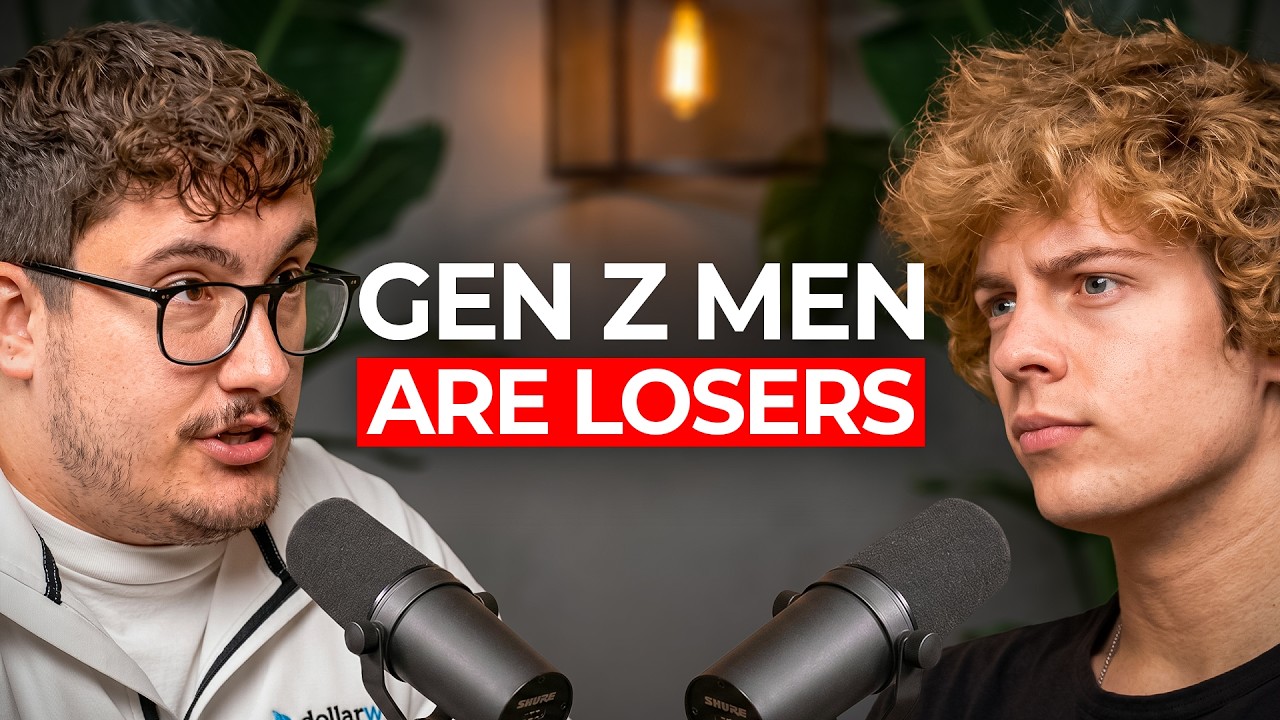
Caleb Hammer, host of the YouTube show Financial Audit, audits people’s spending habits and calls out the financial decisions keeping them broke. He grew up lower-middle class in Kentucky, went $70,000 in debt pursuing a music composition degree, and turned his life around through financial education. Now he uses his platform to expose the purchases quietly destroying Gen Z and millennials, arguing that while systemic forces are real, personal responsibility and self-education are the only way out.
How Broke Gen Z Really Is
Gen Z is entering one of the worst job markets in a generation, with AI disrupting hiring, interest rates still high, and companies holding off on new hires.
Average Gen Z has roughly $400 in emergency savings and $94,000 in debt, making it the poorest, most indebted generation in American history.
The three systemic cost categories crushing every generation — housing, education, and healthcare — are all worse now than for previous generations, and Gen Z faces all three simultaneously upon entering the workforce.
Student loan burdens are especially severe because the cost of college keeps rising, and the federal loan system lets anyone borrow any amount for any degree at any institution with no questions asked.
Buy now pay later services (Afterpay, Klarna) have layered on top of credit cards, enabling Gen Z to finance small purchases like Coachella tickets and food delivery that previous generations would have had to save for.
Food delivery has shifted from an occasional treat to an expected norm, with Uber Eats, DoorDash, and TikTok Shop making impulse spending frictionless.
The Psychology Behind Gen Z’s Spending
The most common excuse Caleb hears from guests is “no one taught me about money,” but he pushes back — the information is freely available, and the real issue is a lack of personal responsibility and self-education.
Social media fuels lifestyle inflation: people see vacations, nice cars, and designer clothes on Instagram and TikTok and feel pressure to mimic that lifestyle the moment they get their first job.
Many guests go on expensive international trips (Europe, Japan) immediately after landing their first post-college job, financing the trips on credit cards despite having $70,000+ in student loan debt and a new car loan.
Gen Z views instant gratification spending — vacations, new clothes, going out — as a reward for reaching adulthood milestones, rather than prioritizing an emergency fund or debt payoff first.
A growing subset of Gen Z and millennials have adopted a nihilistic mindset: “I’ll never own a house or retire anyway, so why not spend now?” This hopelessness, compounded by AI anxiety, drives reckless spending.
The Worst Degrees and the Student Loan Trap
Caleb’s list of the least marketable degrees includes psychology, history, art, and social work — not because these fields lack value, but because far more people want to pursue them than the market demands.
Women now make up the majority of college enrollees, and many are concentrated in lower-ROI degrees, which contributes to the gender wealth gap when controlling for degree and job type.
The student loan system is structurally broken: every time the government raises borrowing limits, colleges raise tuition to match, capturing the extra money for administrators, facilities, and sports programs rather than education.
Only about 10–30 college sports programs actually turn a profit; the rest are subsidized by tuition and student loan dollars.
Caleb does not think student loans should be illegal, but he believes the system must be reformed before any forgiveness is considered — otherwise the same cycle will repeat.
He proposes that before a student clicks “accept” on federal loan paperwork, the government should show them their expected monthly payment, their most likely first-year salary for their chosen major, and the total amount they’ll be borrowing.
What Gen Z Men Are Spending Money On
OnlyFans is nearly universal among single men on Caleb’s show. He estimates the vast majority of young men subscribe, often to multiple platforms, spending $10–25+ per month per subscription.
AI girlfriends are a newer phenomenon. Caleb had one guest who was paying $25/month for an AI companion and engaging in explicit chat with it behind his real fiancée’s back — a relationship-breaking expense even if not a finance-breaking one.
Energy drinks (Celsius, Monster) are a daily ritual for many young men, who stop at gas stations on the way to work. Caleb partnered with Gamer Subs partly because of how common this spending is.
Sports betting and prediction markets (Polymarket, Kalshi) affect a small minority of guests, but when someone is involved, they go hard — hundreds to thousands of dollars. Caleb personally enjoys prediction markets in moderation and believes they’re fine if you can self-regulate.
Meme coins and crypto gambling appear on some guests’ statements but are less common than expected, and the amounts are usually small.
Get-rich-quick courses are a recurring disaster: guests finance $10,000 day trading programs on credit cards, which encourages them to then lose even more money day trading. Caleb contrasts this with affordable, legitimate financial education programs like his own.
The SEC recently removed the pattern day trader rule that required $25,000 in an account to make more than three day trades per week, meaning anyone with any amount of money can now day trade unlimitedly — which Caleb sees as dangerous for financially vulnerable people.
The Car Trap
Cars are a uniquely American financial trap because the U.S. is car-dependent: you need a car to get a job, but you need a job to afford a car.
Used cars that cost $2,000 when Caleb started his show now cost $10,000+, and even those require multiple mechanic inspections.
People justify new car purchases with safety concerns, but Caleb argues cars from 2017–2019 are perfectly safe and that the safety marketing is a gimmick to sell more expensive vehicles.
The car-spending problem crosses all income levels: poor communities have $100,000 lifted trucks, middle-class buyers stretch for luxury brands, and even wealthy people like Togei (who lost a house and cars in coin flips) overspend on vehicles.
Caleb assumes someone with a nice car and designer clothes is probably worse off financially than someone dressed plainly, because the wealthiest people he knows (Silicon Valley, Austin) dress for comfort and utility, not status.
Food Delivery and Eating Out
It is standard on Financial Audit to see someone making $40,000/year spend $1,500/month on food — a combination of delivery apps and eating out. This represents roughly a third to half of their gross income.
95% of guests spend more per month than they earn, funding the gap with credit cards, personal loans, or 401(k) withdrawals.
TikTok Shop has become a major source of impulse micro-purchases: every other TikTok is an ad, and people click and buy without thinking, with items arriving at their door in days.
These small purchases individually seem harmless but collectively add up to hundreds or thousands per month.
The Gender War and Why Gen Z Men Are “Losers”
Caleb is blunt: Gen Z men are “losers” by the numbers. Dating rates are record low, marriage rates are record low, and virginity rates are record high.
He places responsibility on both genders: cancel culture overcorrected and now men fear being blasted online for a single awkward text or approach, while women on dating apps are flooded with messages and men get almost none.
Dating app data (from Hinge/OkCupid analyses) shows the top 20% of men get the attention of roughly 80% of women, leaving the vast majority of men with almost no matches.
Men are staying inside, consuming porn and OnlyFans, and not cold-approaching women in person. Drinking among Gen Z has fallen dramatically, which Caleb sees as partly negative because it removes the social lubricant that facilitates in-person connection.
He argues it is genuinely not hard to have sex or find a relationship if you go out, cold approach, and have normal conversations — but the fear, online toxicity, and comfort of staying home have created a generation that won’t take the risk.
The loneliness feeds directly into spending: Uber Eats, OnlyFans, video game micro-purchases, and other dopamine-chasing behaviors are coping mechanisms for isolation.
Looksmaxxing: Good Investment or Waste?
Caleb breaks looksmaxxing into “soft maxxing” (working out, grooming, hair) and “hard maxxing” (plastic surgery like double jaw surgery).
He strongly endorses working out: it builds discipline that transfers to budgeting and career, increases energy, reduces depression, and leads to better life outcomes overall.
On plastic surgery, he’s more ambivalent. He jokes that double jaw surgery might have a better ROI than an art degree, and notes that research suggests each additional inch of height correlates with roughly $10,000 more in annual earnings.
Dating is increasingly superficial, and people’s expectations are inflated — even people who are not objectively attractive often expect only ”10s” to match with them.
Clav (another creator) has advocated spending student loan money on plastic surgery instead of tuition, which Caleb thinks is probably illegal but acknowledges might have a better return on investment than certain degrees.
Pets, Girl Math, and Other Spending Traps
Pets can absolutely keep people broke if managed poorly. Without pet insurance, a single emergency surgery can cost $10,000–$30,000, and people put it on care credit cards they can’t afford.
Caleb’s own Great Pyrenees has had three life-saving intestinal blockage surgeries (she ate candy wrappers, furniture stoppers, and other objects), costing him around $30,000 for the worst one. He has pet insurance but still has to pay upfront and get reimbursed.
He’s seen guests spend tens of thousands on pet surgeries and even thousands buying shares of French bulldog breeding dogs as an “investment” that lost money.
“Girl math” — the trend of rationalizing spending with flawed logic like “if I return something, the money I spend is free” — is half-joke, half-genuine cope. Caleb sees it as the female equivalent of men justifying Pokémon card ripping or PC upgrades: a way to avoid facing consequences.
People convince themselves that vacations, trinkets (Labubus, Pop Mart collectibles), and luxury purchases are “investments” because they’ll resell them or because “I’ll be happier and make more money.” Caleb says these rationalizations never hold up.
What Caleb Doesn’t Judge
Caleb admits he judges everyone on everything, but there are a few spending categories he gives a pass to:
Health and fitness: gym memberships (even Equinox at $300/month), Pelotons, and wellness spending are fine if you can afford them and actually use them. Health is the foundation everything else is built on.
Taking care of a sick relative: when family dynamics and genuine need are involved, he doesn’t push back hard.
Tithing and religious giving: even when it doesn’t make financial sense, he recognizes it’s embedded in people’s identity and moral fabric, and fighting against it is nearly impossible. He tries to make the logical case that sacrificing temporarily to improve your financial position will let you give more over a lifetime.
Funerals: similar to tithing — family dynamics and grief make it hard to say no.
He does NOT give a pass on: birthdays (“everyone has one, it’s not unique”), birthday months (“the dumbest trend I’ve ever heard”), or Christmas overspending. If you can’t afford it, say no.
The Richest Broke People and the Youngest Guests
The worst financial situations on Financial Audit tend to be higher-income guests, not lower-income ones. A couple making $400,000/year had nothing left because they lifestyle-inflated into an unaffordable house, ate out for every meal, had two $60,000–$70,000 car loans, and stopped at gas stations daily.
Lower-income guests are often in easier-to-escape situations because they simply couldn’t access as much debt.
The youngest guest was 18, but Caleb generally doesn’t allow guests under 21 because they haven’t had enough time to mess up badly enough to be interesting. At that point, the damage is usually limited to student loans and maybe a small credit card balance.
He thinks there should be a show aimed at 18-year-olds to prevent financial mistakes before they happen, but he admits he’d be bored making it.
The Coming Crisis for Gen Z
AI uncertainty is the defining crisis. No one knows whether AI will boost productivity and create jobs or eliminate them entirely. This makes it nearly impossible for Gen Z to choose a degree or career path with confidence.
Caleb positions himself in “AI-resistant” fields: trades, healthcare, finance (due to regulation), teaching, and cybersecurity — though even cybersecurity is being challenged by AI tools like Mythos.
Student loan catastrophe is inevitable without reform. Balances keep growing, repayment assistance programs keep payments low but never reduce principal, and debt-to-income ratios are wrecked for an entire generation.
Cars are getting more expensive and will continue to be a crushing expense.
Caleb believes we may be in a private credit bubble and possibly an AI bubble, but acknowledges you can’t reliably identify a bubble from inside it.
He personally feels financially secure now — if his income dried up tomorrow, he could live comfortably for years. But he remembers feeling intense anxiety three years ago and thinks that anxiety is completely reasonable for the average person.
Spiritual and Emotional Roots of Financial Problems
Caleb sees a direct link between loneliness and overspending. The collapse of “third places” (community gathering spots) and men’s spaces has left young men isolated, and they fill the void with dopamine-chasing spending: OnlyFans, Uber Eats, video games, energy drinks.
Religion can help by providing community and social connection, which generally leads to better financial and life outcomes. But it can hurt through tithing when people give 10% of their income even when they can’t afford it.
He doesn’t believe money problems come from spiritual problems per se, but he acknowledges that emotional voids — loneliness, trauma, depression, lack of purpose — are the primary drivers of overspending.
On the question of whether happiness comes first or actions first, Caleb says he was always generally content, even when poor. His financial turnaround was driven by behavior and ambition, not by a quest for happiness. He hit milestones (first house, first million) and was happy for a moment, then moved on to the next goal. His baseline happiness never changed.
Caleb’s Personal Financial Philosophy
He grew up lower-middle class with foreclosure notices. His father was a gas station attendant and his mother worked front desk at an eye clinic. Everything he got as a kid was bought on debt.
He went to Western Michigan University for music composition, maxed out credit cards, took federal student loans, and had a car loan — all while building a self-employed composition career that was actually doing reasonably well. The debt held him back from going full-time.
He paid off his debt, built a quarter-million-dollar net worth before ever making a YouTube video, bought his first house, and then started Financial Audit.
His worst financial advice ever received: at 18, his parents told him to max out a credit card to buy a piano. That first debt set him back for years.
His best financial advice: build a six-month emergency fund. It changes everything. It lets you take risks, survive job loss, and handle almost any expense without panic.
He loves buying new tech (maxed-out MacBook Pro, Plaid Model X, Apple Watches, iPhones) and admits it’s unnecessary but affordable for him. He also spent $250,000 renovating his office, which he calls “stupid but good for recruitment.”
He doesn’t compare himself to others much, though he remembers a competitive moment when his autistic friend told Tony Hinchcliffe that Caleb had more subscribers, and Caleb was motivated to beat him on the podcast charts.
Practical Steps to Spend 30% Less
Step one: Download a budgeting app (Caleb’s is DollarWise). You cannot make progress if you don’t know where your money is going by category and individual purchase.
Step two: Categorize spending into needs, wants, and investments/savings. Then rank each want by the actual level of joy it provides. Cut the low-joy wants first.
Step three: Pay off any high-interest debt above 7% APR as fast as possible — nothing else competes with that return on investment.
Step four: Build a six-month emergency fund (twelve months if self-employed or a contractor).
Step five: Live on the 50/30/20 rule — 50% on needs, 30% on wants, 20% on saving/investing. If you’re hitting 20% savings, you can enjoy your wants guilt-free.
Caleb’s core message: “I’m the dumbest [person] you’ve ever met, and I did it. If I can do it, any dumbass anywhere can do it. Just sacrifice a little now.”