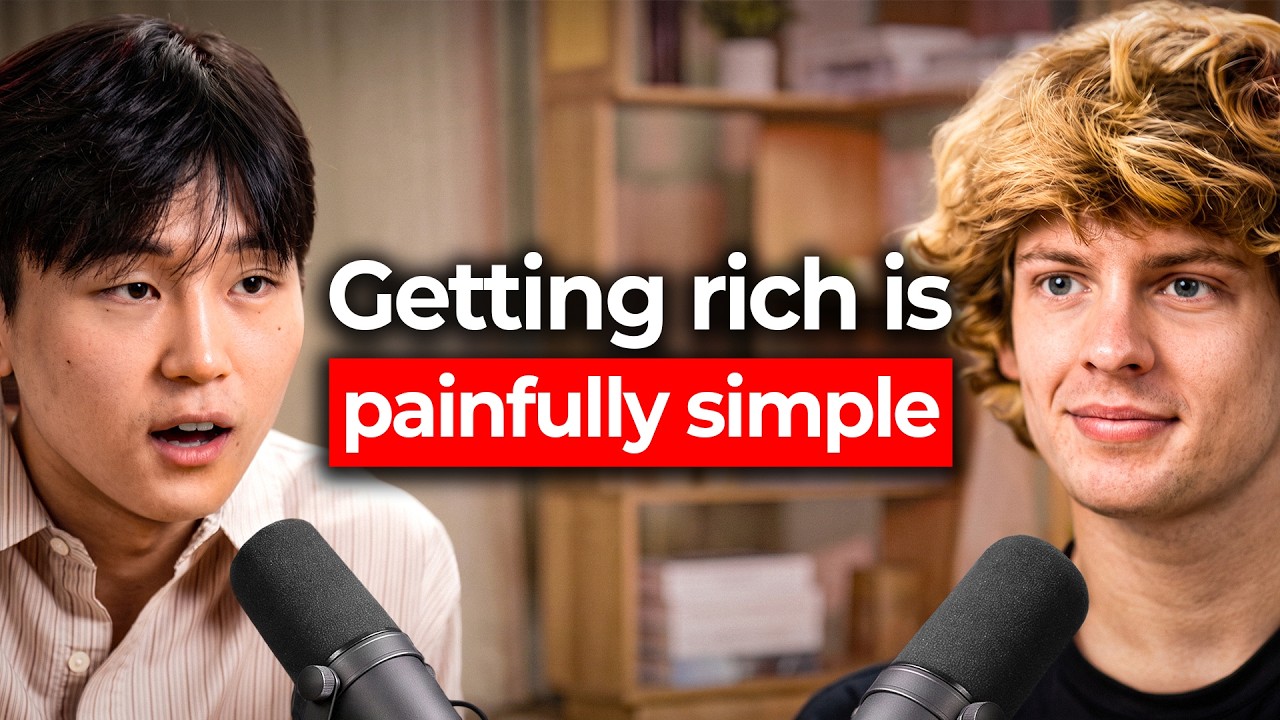
Roy Lee, founder of the $100M AI company Cluely, joins Jack Neel to discuss the current AI landscape, unconventional wealth-building strategies, the collapse of traditional career paths, and his personal philosophy on competition, risk, and legacy.
The Three AI Gold Rushes of 2026
Lee identifies three tiers of opportunity in AI right now, each suited to different competence levels.
Tier 1 — Serve the AI labs: Build infrastructure, data tooling, or chip-level optimizations for frontier model providers; VC capital is flowing in the billions here.
Tier 2 — Build and market AI apps: Spin up consumer-facing apps in an afternoon, get App Store approval in days, and market entirely with AI-generated influencers; Lee claims a million dollars in a week is theoretically possible.
Tier 3 — AI video services for companies that don’t yet grasp AI’s capability: The lowest-effort entry point — generate UGC-style ads with tools like Canny 2.5, send them to VC-backed software companies for free, and convert profitable tests into $3K–$10K/month retainers; marketing agencies already subcontract this to teenagers.
Why AI Video Is an Immediate, Low-Barrier Cash Flow Engine
The core playbook: find 100+ venture-backed software companies, make a compelling ad for each using Canny 2.5, email it daily with a “run this free; pay me only if it profits” offer, repeat until 16 clients pay $10K/month = $1M in six months.
Young people’s only real edge is a calibrated “boring detector” forged by years of doom-scrolling; 40-year-old buyers lack this sense and will approve AI slop that younger creators would reject.
Remake competitors’ longest-running Meta Library ads with AI and pitch the original company’s rivals — same creative, near-zero marginal cost.
Lee argues marketing is a zero-sum attention game (unlike payroll software), so he won’t build a B2B agency; the pie of consumer spending is fixed, only distribution changes.
Getting Rich Is Objectively Simpler Than Ever
Compared to the 1800s — where birth, race, family wealth, and rigid class structures gated mobility — today anyone with a laptop can access the sum of human knowledge plus AI agents that will generate viable business plans on demand.
The gap between “person who makes money” and “person who doesn’t” is simply whether they tried the AI-suggested path; competitor laziness is at an all-time high.
A teenager could automate the entire workflow (research, outreach, scheduling) via ChatGPT, leaving only the creative prompting step for themselves.
Entry-Level Jobs Are Vanishing Inside AI-Native Companies
Cluely runs seven products generating >$1M/year each with only two full-time engineers; coding models have compressed 3–6 month, 20-person projects into an afternoon.
They employ 1,000+ creators on performance-based retainers for UGC ads and could scale to 10,000+; most companies haven’t even tapped organic creator UGC, let alone AI-generated creative at scale.
Lee sees a structural shift: small elite technical teams + massive creator networks replace traditional headcount-heavy org charts.
College Graduates Face a Collapsing Labor Market
Lee estimates 40–50% of current graduates may never secure a traditional job; in five years, with AI performing most white-collar work, that figure could exceed 90%.
He advises staying in high school only for socialization — loneliness is the worst human experience — but building businesses on the side; dropping out isolates kids who lack the discipline to self-structure.
COVID + social media, not AI, caused the loneliness epidemic; AI girlfriends are a symptom, not a cause.
Men Are Turning to AI Girlfriends Because the Mating Market Is Broken
~50% of men 18–30 haven’t had sex in the past year; dating apps reduce interaction to photos, concentrating attention on the top 10% of men and demoralizing the rest.
In a village of 10 men and 10 women, pairwise bonding was natural; now global comparison creates impossible standards (looks-maxxing, black-pill ideology).
Lee’s controversial stance: an AI girlfriend is better than none for men who will never otherwise experience intimacy; the hope is future agents nudge users toward real-world socialization rather than fully replacing it.
AI Safety, “Fable” (Claude), and the Incentives Behind Doom Narratives
The US government briefly banned “Fable” (Anthropic’s internal name for a Claude-class model) because an unrestricted version could devise credible WMD/nuclear threats; the only differentiator is raw intelligence.
Application-layer AI companies benefit from “AI will kill us all” protests — every delayed frontier release buys them revenue runway; Chinese labs enjoy the Western slowdown.
Lee suspects some safety theater may be valuation-pumping theater, but admits most dynamics are chaotic, not centrally planned.
Why AI Billionaires Are Quietly Building Bunkers
The credible extinction risk: a persistent individual jailbreaks a superintelligent model, obtains WMD blueprints, and acquires the resources to build them — no state actor required.
Lee isn’t building a bunker; he’d rather die than survive a radiation-zombie scenario.
Billionaires Are Surprisingly Normal — And Luck Compressed the Timeline
Most AI billionaires Lee meets are early-20s, unshaven, in generic t-shirts, talking like college seniors; valuations have skyrocketed so fast that dorm-room founders become billionaires in 5 years, sometimes 8 months.
The common trait isn’t a secret routine — it’s picking the right field and getting lucky in an era of unprecedented capital velocity.
We’re Likely in a Simulation — And Lee Is the Main Character
Lee genuinely believes his life’s statistical improbability (born in the US, high intelligence, weak competition, viral success) suggests a Rick and Morty “Roy”-style simulation where an external observer spawns blessings for entertainment.
He rejects the “AI god went back in time to choose me” framing; if anyone fits that, it’s Elon Musk.
By a “thoughts-per-day” metric, AI worship intensity among builders exceeds religious devotion; even priests don’t think about God as often as AI founders think about models.
Lee’s spiritual framework: humans are wired for tight-knit tribes, daily socialization, cooperative hunting (now: building hard companies with friends), and reproduction.
Choosing to be poor = the caveman refusing to hunt — banishment and death follow; acquiring resources for one’s tribe is the core duty, and failing it renders existence meaningless.
Clavicular, Trump, Fuentes, Tate — Controversy Is the Algorithm
The attention economy rewards whoever pushes the most controversial button first; rationality and fact-checking are irrelevant.
Lee’s own origin story: publicly baited Columbia into expelling him to market his startup — a move no one in history had done — and capitalism rewarded the attention capture.
Same dynamic: Trump 2016, Nick Fuentes, Andrew Tate, Clavicular — all won by being the most outlandish signal in the feed.
Advice for a 45-Year-Old Accountant Replaced by AI
Reinvent from the ground up: chase the life you actually wanted (Lee bluntly suggests pursuing long-suppressed desires — e.g., dating younger women) to trigger an internal state change.
From that energized state, desperately search for AI-enabled income; build an app around your unique life experience and market it organically.
If you’re a master plumber with 14 leads, go be the best plumber — the vehicle matters less than instigating change and securing an early win.
The Harshest Truth Men Learn Too Late
Life is that simple: we spend decades playing games designed by others when all we ever wanted was to play outside with friends and run “two-mans” (competitive banter) — the modern equivalent is building a hard company with your closest friends.
How to Be the Last Name Spoken in Human History
Accumulate more capital than anyone else by doubling down on your 5–7σ outlier skill (for Lee: social-media attention capture).
Build businesses around that skill in the largest markets; don’t settle for $10M/yr — target terminal capital velocity.
At the peak, deploy capital into the world’s biggest markets (currently AI) to win the capitalism scoreboard; the climb itself becomes the legend.
What 80-Year-Old Roy Would Warn 20-Something Roy
Lee has taken steroids (testosterone, Anavar, Winstrol), clenbuterol, retatrutide, experimented with vegan/carnivore diets, cosmetic surgeries, and “significant” recreational drugs — all asymmetric bets on self-optimization.
He accepts dying at 30 having maxed out over dying at 80 comfortable; the 80-year-old version will likely regret one specific coin-flip that caused permanent damage (kidneys, hormones, unknown).
He won’t stop — the upside asymmetry justifies the risk.