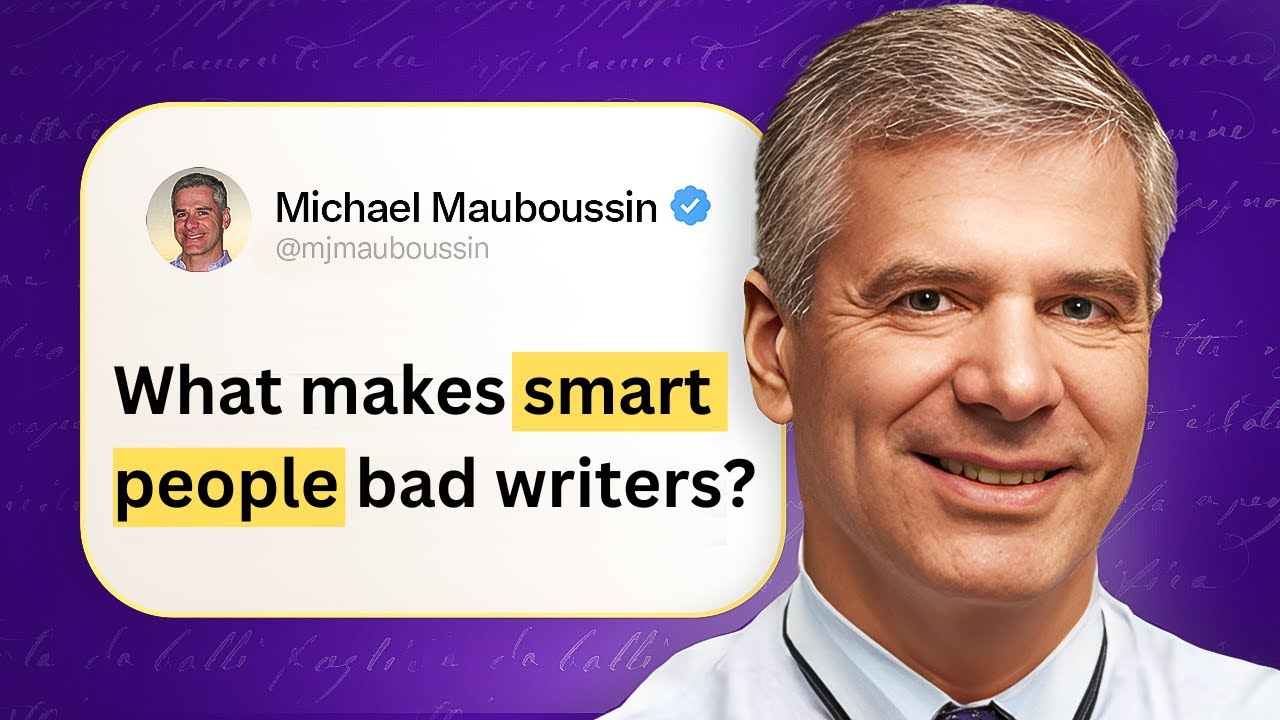
Michael Mauboussin is a 32-year veteran professor of security analysis at Columbia Business School, a former head of global counterpoint research at Credit Suisse, and a prolific writer on investing, decision-making, and complex systems. He is also a former chairman of the Santa Fe Institute. This episode explores his philosophy of writing, research, and communication, centered on the idea that writing is fundamentally about understanding—and that the deepest understanding comes from a constant cycle of learning and then communicating. He draws on decades of experience writing for elite investors, teaching MBA students, and collaborating with editors and thinkers across disciplines.
Writing is understanding, not just expression
The foundation of good writing is deep understanding, not stylistic flair. Mauboussin emphasizes that you cannot write clearly about something you do not truly understand.
Writing forces you to confront gaps in your own understanding. He describes the humbling experience of thinking he understood something, sitting down to write about it, and realizing he had to go back to first principles.
This applies to all communication—verbal and written—but writing is harder because you cannot read the reader’s reactions in real time.
His teaching at Columbia Business School, which traces back to Ben Graham’s original 1927 course, reinforces this: Graham was a prolific writer (plays, translations, investment classics) who used writing as a vehicle for understanding.
The curse of knowledge and how to fight it
Steven Pinker’s concept of the “curse of knowledge” is central to Mauboussin’s thinking: smart people are often bad writers because they cannot imagine what it is like not to know what they know.
The iceberg analogy: a writer may have deep knowledge below the surface but must communicate only what is useful and accessible above the waterline.
The goal is to make writing accessible to a high schooler while still offering something of value to a finance professor—avoiding jargon and acronyms, using concrete examples, and showing the derivation of numbers rather than just stating them.
Mauboussin tests his writing with people outside finance, such as his longtime editor Lawrence Gonzalez, who flags when a technical term could be replaced with a simpler one.
Classic style: the writer and reader as peers
Mauboussin advocates for what Pinker calls “classic style”—the writer puts an arm around the reader and says, “Let’s look at the world together and talk about what we see.”
This is distinct from a “practical style” (teacher to student) or academic writing (written for other specialists).
The key is concreteness: use specific examples, small derivations, and tangible illustrations rather than abstractions. People remember concrete things more effectively.
He uses sports frequently—golf, tennis, the US Open—because skill acquisition in sports is a discrete, relatable domain that illustrates broader ideas about practice, intuition, and performance.
The paradox of skill and other one-liners as intellectual tools
Mauboussin values distilling complex ideas into memorable one-liners or frameworks. His concept of the “parox of skill” (borrowed from Stephen Jay Gould’s Full House) is a prime example: as the overall level of skill in a competitive domain increases, luck becomes a larger determinant of outcomes because the skill distribution narrows.
These one-liners serve as razors during editing—if a section doesn’t relate to the core idea, it gets cut.
He also draws on the Grossman-Stiglitz paradox (1980): if markets were perfectly efficient, there would be no incentive to gather information, so some inefficiency must always exist to compensate those who do the work. This is liberating for writers: there are always new things to say because the “market for information” is never perfectly efficient.
Research as a disciplined rabbit hole
Mauboussin’s research process is driven by genuine curiosity about a topic he feels he needs to understand better. He confines himself to that topic rather than wandering aimlessly.
Research projects tend to have a beginning, middle, and end—they are structured as stories with a narrative arc.
Loose ends from one project often become the seed of the next. His book The Success Equation grew out of a single chapter on luck and skill in his earlier book Think Twice that readers kept telling him deserved more attention.
He cites Nassim Taleb’s description of his own books as being “born out of the ribs” of the previous one—each book opens new questions that take years to explore.
Finding your edge as a writer
Mauboussin frames writing advice in investment terms: your edge comes from two things.
Having something interesting to say—which requires deep research, synthesis, and observation. The world is always changing, so old ideas applied to new contexts are perpetually valuable.
Communicating it effectively—which requires craft, structure, and ideally a good editor. Many people have great ideas but cannot articulate them; many others suffer from the curse of knowledge.
He tells aspiring writers: get an editor. A good editor is worth their weight in gold, not just for line editing but for structural feedback and for asking the naive questions a reader would ask.
Outlining and the craft of structure
Mauboussin outlines deliberately, thinking carefully about the flow of ideas—how each section builds on the last and reinforces the central theme.
The outline is where most “killing” happens: ideas that seem interesting but don’t fit the flow are cut early, before they waste writing time.
For books, chapters are sub-outlines that must connect to each other—each chapter should lead naturally into the next, giving the reader a reason to keep going.
He describes a useful writing formula: start with familiar territory (where the reader has a firm grip), then take one leap to new ground. This is analogous to rock climbing—establish your position, then reach.
The world of synthesis
Mauboussin sees his primary contribution not as original theory but as synthesis—combining ideas from different fields into frameworks that are useful for investors.
His paper “Measuring the Moat” (written over 20 years ago) synthesized strategy literature from Michael Porter, Clay Christensen, and others into a practical checklist for assessing competitive advantage. It was one of the hardest pieces of synthesis he ever did.
He encourages others to do the same: take ideas from different thinkers (e.g., Brian Arthur on increasing returns + Michael Porter on competitive strategy), find where they agree and disagree, and build a new framework.
He draws a parallel to neurobiology: the brain’s learning process involves an initial explosion of synaptic connections followed by pruning—the same pattern appears in industry development (Steven Klepper’s work), where many competitors enter a new industry and then consolidate. This recurring pattern across domains is the kind of insight that makes synthesis powerful.
Learning by doing and the role of hard work
Writing improves through practice, not just study. Mauboussin compares it to “learning by doing” in economics—you get better by doing it, not by reading about it.
He cites Stephen King’s On Writing: King is not just talented but extraordinarily hardworking, producing consistently through discipline.
The Beatles started as a cover band; even the greatest practitioners began by imitating others before finding their own voice.
Good feedback is essential—whether from an editor, a peer, or a trusted reader. Iteration with feedback is what separates good writing from mediocre writing.
Editing: polish, flow, and knowing when to stop
Mauboussin works with a partner, Dan Callahan, to edit their research reports. They iterate repeatedly, focusing on polishing language, checking analysis, and ensuring structural flow rather than cutting large sections.
For books, external editors are used, and larger cuts are sometimes necessary. Mauboussin tries to write more measuredly—he does not write 150,000 words and cut two-thirds.
He lets drafts sit for a while before returning to them with fresh eyes.
Cormac McCarthy’s standard for knowing when you’re done: pull the manuscript out of the drawer and don’t want to change a single word. Mauboussin acknowledges this is a far higher bar than he typically meets, but it reflects the level of craft McCarthy brought to his work.
Injecting personality into later drafts
Mauboussin and the host both emphasize that personality and personal anecdotes are added in later drafts, after the structural and analytical foundation is solid.
The host’s editor tells him, “I need more of you in the piece”—a common note for smart, analytical writers who suppress their personality.
Personal stories make abstract ideas concrete and relatable. The host’s example of studying four verses of the Book of John at a Schlotzky’s in the Texas Hill Country evokes a sense of place and personality that a dry theological discussion would lack.
Mauboussin opens The Success Equation with a story about how he got a job through a completely random event—people remember it and call him “the trashcan guy.”
The investment writing world is full of smart people with great insights who are afraid to talk about themselves. Suppressing personality makes writing dry and stale; injecting it creates “huge alpha.”
Lessons from Cormac McCarthy and the Santa Fe Institute
As chairman of the Santa Fe Institute, Mauboussin spent time with Cormac McCarthy, one of the greatest American novelists.
McCarthy was brilliant, widely read across scientific disciplines, and an incredible reader—reinforcing the idea that great writers are almost always great readers.
McCarthy was reluctant to discuss his writing process, but his sense was that ideas came to him and he was essentially transcribing what was happening in his mind—a subconscious process he explored in a nonfiction essay on how the mind works.
McCarthy wrote the Santa Fe Institute’s mission statement, which includes a line paraphrased as: “Every now and then someone shows up who’s crazy, and that makes us really happy”—capturing the institute’s tolerance for unconventional thinking.
Mauboussin notes that writing fiction is a wholly different game from nonfiction; he does not consider himself a writer in McCarthy’s league and is humble about the distinction.
The value of intellectual history and etymology
Mauboussin has a deep interest in the intellectual evolution of ideas—understanding where concepts came from, why we are where we are, and where they might go.
He gives the example of John Burr Williams, who wrote a profoundly important book on investing in the 1930s that most Columbia students have never heard of.
The host shares a fascination with etymology—tracing the evolution of words like “innovation” (which originally meant going against God’s created order and was a negative term) and “inspire” (from the Hebrew ruach, meaning breath or spirit, connected to the name of God).
This kind of X-ray vision on words and ideas is a rich source of material for writers and a way to find fresh angles on familiar topics.