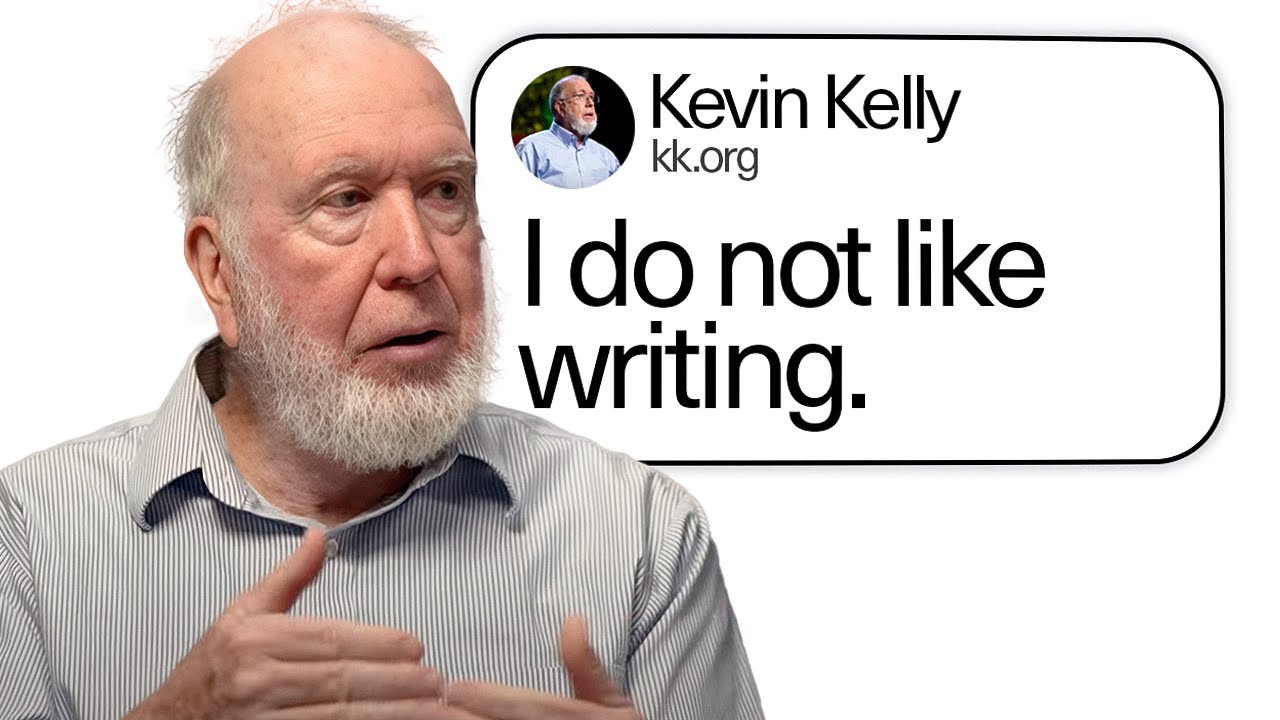
Kevin Kelly, founding editor of Wired and author of works like What Technology Wants and The Inevitable, reflects on a career built around curiosity, reluctant writing, and a deep commitment to sharing ideas that matter. Despite not identifying as a natural writer—he describes himself as slow, grumpy during drafts, and someone who procrastinates—he has produced influential books, a 20-year daily blog, and shaped tech culture through editorial leadership. His philosophy centers on writing as a tool for thinking, not just communication, and on creating work that surprises, challenges, and ultimately gives back to the commons.
Writing as discovery, not expression
Kelly doesn’t write to express pre-formed ideas—he writes to discover what he thinks.
He begins writing without knowing his conclusion; the act of writing generates the idea.
Compares this process to Picasso’s sketches: you can’t reach the essence without going through iterations.
Describes it as “being channeled”—ideas emerge only when he attempts to articulate them.
This makes writing painful but essential: “I love having written. Way better than writing.”
Reluctance, discipline, and volume
He is a self-described reluctant writer who dislikes drafting but loves editing.
Editing is where shaping happens—like pottery, through contraction and expansion.
He edits constantly, not in a separate phase: “It’s write, edit, write, edit… a back-and-forth dance.”
Uses both digital tools and printed drafts with a red pen for final passes.
To produce impactful work, he believes in writing a lot—even if most of it fails.
“The only recipe I’ve ever seen for writing great stuff has been to write a lot of stuff.”
Success comes from volume, not perfection.
Honesty and originality as editorial filters
In revision, he asks two key questions of every sentence:
Do I really believe this?
Has this been said before—word for word—anywhere else in the universe?
Aims for sentences that have never existed prior, forcing authenticity and novelty.
This “retreat to honesty” increases the chance of provoking reaction—which he sees as a sign of impact.
Impact over output
Measures success not by word count but by whether his words “land.”
Wishes he had more cultural impact, not more publications.
Values writing that changes minds or enters public discourse.
Believes practical, helpful writing tends to succeed more than abstract or clever work.
Structure as invisible architecture
Spends most of his editorial energy on structure—not phrasing.
Good structure is graceful and unnoticed; bad structure causes confusion or distraction.
At Wired, 95% of editorial feedback focused on structure.
Cites John McPhee as a master of structural craft.
Curating scenes and staying close to the edge
Follows Brian Eno’s concept of “scenius”—collective genius emerging from creative communities.
Seeks out “senuses” (scenes): groups like Xerox PARC, Yosemite climbers, or YouTube innovators where peer-driven creativity thrives.
These scenes have porous boundaries—more open than corporations, more intense than casual networks.
Applies this to his own life: positions himself at frontiers (e.g., early crypto, AI) before they have names.
“Try to work where there’s no name for what you’re doing… that’s where breakthroughs happen.”
Play, generosity, and long-term payoff
Advocates doing “crazy,” unprofitable things in your 20s—they become your touchstone.
Playfulness without agenda fuels future success.
Believes in the paradox of generosity: “The more you give, the more you get.”
Creating for its own sake—even if unseen—is “the most selfish thing you can do” because it compounds over time.
Feels a duty to share art: otherwise, “you’re kind of cheating us with your life.”
Fame, influence, and the burden of attention
Rejects fame as a goal—it’s a burden, like extreme wealth.
In China, he sometimes needs bodyguards; in the U.S., he avoids celebrity circles.
Prefers notoriety over fame: being respected, not recognized.
Uses attention as an opportunity to meet diverse people and learn from them.
Marketing as half the work
Now sees marketing as 50% of any book’s effort—equal to writing.
Publishers no longer own audiences; authors must bring their own.
Developed creative marketing tactics:
Offered talks to groups buying 25+ books within driving distance.
Did global video calls for small groups who purchased copies.
Appeared on podcasts (6–8 per day for months) via self-scheduling.
Finds podcast audiences more intimate and engaged than TV/radio.
Ideas belong to the commons
Rejects the myth of the lone genius—most inventions are simultaneous.
Einstein, Bell, Rowling—all stood on shared cultural ground.
Believes ideas should return to the commons quickly; copyright terms are too long.
Rewards innovation with temporary monopolies (e.g., 20 years), not generational control.
Reading widely to think differently
Cultivates an “allergy to average”—reads books, not just content.
Reads authors his favorite writers read.
Also explores forgotten bestsellers from past decades to see what resonated then (and why it faded).
Grew up without TV, surrounded by books—his daughter still reads voraciously.
Why writing?
Writing lets him think clearly and fulfill his mission: expanding opportunities for everyone to express their genius.
Started as captions for photos; grew into a lifelong practice of learning in public.
Sharing is part of the process—feedback sharpens thinking.
Ultimately, writing is how he accesses his own mind and contributes to human possibility.