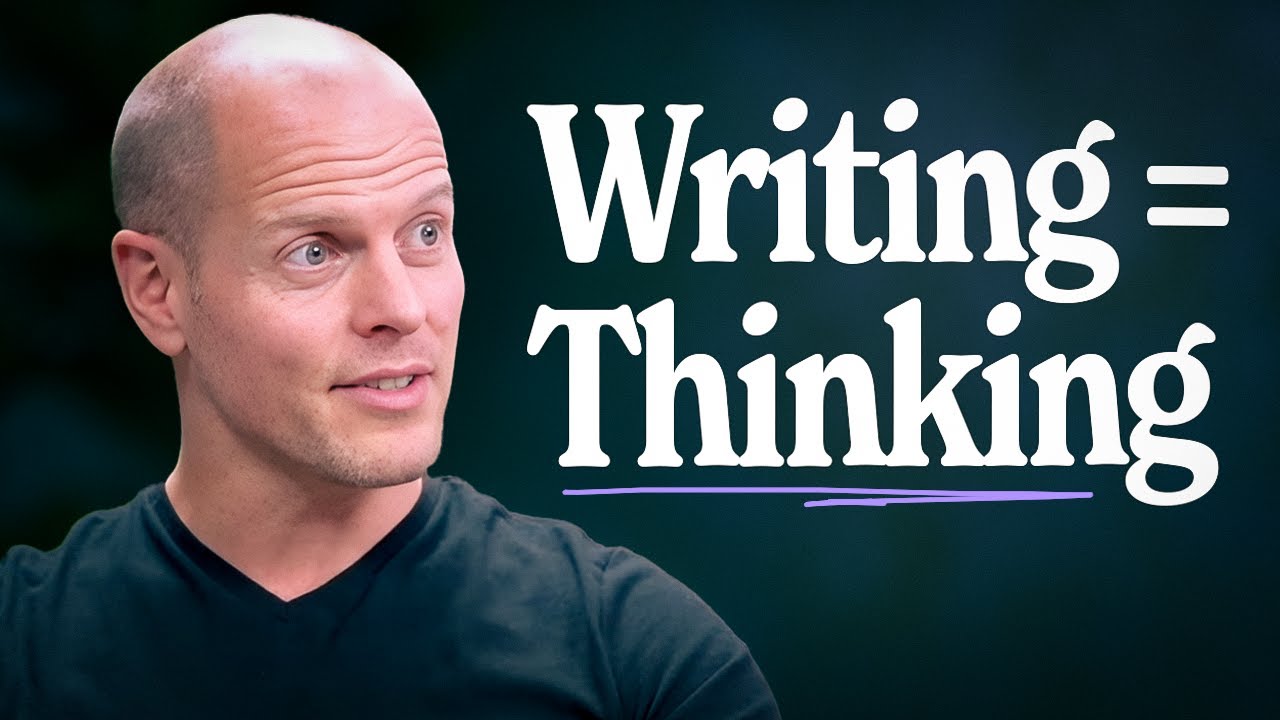
Tim Ferriss argues that writing is the most powerful tool for sharpening thinking, acting like a “doctor’s checkup” for the mind. He traces his own development as a writer from a pivotal college seminar with Pulitzer Prize-winning author John McPhee through five bestselling books, a long-running podcast, and a newsletter with over two million subscribers. The conversation covers his research methods, editing philosophy, creative process, and the tension between fame and deep creative work.
Writing as Thinking
Writing exposes gaps in your thinking that are invisible until you try to articulate them clearly.
Revising writing is revising thinking — McPhee’s redlining of Ferriss’s prose made his thinking crisper across all subjects, even unrelated ones like learning Chinese.
Ferriss still uses the core lesson from McPhee: if something is unclear on the page, it’s unclear in your mind. Remove or rewrite.
McPhee used shorthand like “pea soup” in the margins to flag writing that was amorphous or ill-defined — a reminder that trying to sound fancy usually backfires.
The McPhee Seminar at Princeton
Ferriss took John McPhee’s “Literature of Fact” seminar his senior year at Princeton, which was a game changer for him.
The class had two components: a weekly lecture where McPhee taught structure and craft, and weekly one-on-one sessions where he would redline student papers with more red ink than original black ink, then walk through every note.
What made McPhee a great teacher:
He was an A-plus practitioner — a Pulitzer Prize-winning writer with decades of experience.
The class was small (about 12 students), and the caliber of peers pushed Ferriss to raise his game.
He had refined the course over many years, like a comedian workshopping material for a year.
He knew when to inject humor to make lessons memorable.
The one-on-one feedback was transformative — not just the redlines, but the rationale behind them.
Ferriss still applies the McPhee method with his own employees: he redlines their writing and then walks through the reasoning via screen share or Loom video.
How Ferriss Writes
The 4-Hour Workweek drafting process:
First draft: tried to sound smart — didn’t work.
Second draft: tried to be funny — didn’t work.
Third draft: wrote it as if explaining to friends after a few glasses of wine, composing in an email box rather than a formal Word document. That was the breakthrough.
Scrivener as his primary tool:
Originally designed for screenwriting or playwriting.
Lets him maintain a drag-and-drop table of contents on the left, with research below and the active chapter on the top right.
The low-friction structure encourages experimentation with organization — he can move sections around in seconds and revert just as easily.
This shapes his writing by making him bolder about restructuring.
Research process:
Historically used Evernote’s web clipper to collect studies, interviews, and articles.
Immediately highlights the most important passages with three asterisks and bold, so he can search and review quickly later.
His best work leans heavily on personal experimentation or interviews with people doing firsthand experiments, not secondhand book research.
Reason: depersonalized research makes readers’ attention wander, and anyone can digest books — it offers no competitive advantage. Personal experimentation is harder to imitate.
Brand and Credibility as Strategy
Ferriss treats reputation and credibility as his most scarce and valuable resource — “the new gold.”
He has strict policies about what he recommends and partners with, turning down roughly 80% of sponsorship offers, including deals worth millions.
The goal: if someone asks “Do you trust Tim’s recommendations?” the answer should be yes as often as possible.
He views being a “category of one” as both an artistic challenge and a competitive moat — he’d rather not compete at all than compete on volume or price.
Voice and the “What” Before the “How”
Ferriss advises aspiring writers to worry about content (the “what”) before style (the “how”).
Example: 50 Shades of Grey sold tens of millions of copies despite poor writing because the premise was compelling. Great subject matter can carry B-minus writing; the reverse is much harder.
His cheat code: “Do something interesting first.” Interview someone fascinating, explore an overlooked topic, or do something weird. A-plus material with B-minus writing beats B-minus material with A-plus writing.
He references the David McCullough “look at your fish” exercise: a teacher puts a fish on the table and makes students write about it for an entire semester. The lesson is that material is always there — you just have to look more closely.
Voice develops over time by leaning into your idiosyncrasies rather than hiding them. Ferriss includes inside jokes in his books that only make sense to him and his researchers — editors want them removed, but he insists they stay because they keep the writing fun for him.
Momentum Over Perfection
Five Bullet Friday newsletter:
Ferriss hadn’t been writing much because the podcast was easier and more lucrative. To restart the habit, he created a newsletter with an extremely low bar: five bullets, that’s it.
The low bar removes the excuse not to write. Some weeks it’s just five links. Other weeks it expands into a multi-page blog post.
The principle: “Do less than you think you can do” to build positive momentum.
Two crappy pages per day:
Attributed to Po Bronson (inspired by IBM’s sales strategy of setting low quotas so reps weren’t afraid to pick up the phone).
Consistency matters more than bursts of intensity. Writing two crappy pages five days a week beats writing 10 pages in one sleepless night and then burning out for days.
Jerry Seinfeld’s two modes:
Early in the process, treat yourself like a baby — play around, no judgment.
Later, become a sergeant — strict, disciplined editing.
These modes must be separate. Ferriss’s natural inclination is toward sergeant mode, so he has to consciously give himself permission to be messy first.
Stop before you’re exhausted:
Leave gas in the tank. If you write until you’re drained, you’ll dread sitting down the next day.
Neil Gaiman’s advice: after writing, don’t show anyone for 24-48 hours. Bask in the accomplishment. Positive reinforcement matters.
Editing and Feedback
Ferriss’s editing tactics:
Ask friends: “What 10-20% would you cut?” Force them to commit — give them “protective air cover” to be honest.
Flip it: “If you could only keep 20%, which pages stay?” This forces distillation.
Jason Fried’s exercise: write 1,000 words, cut to 200, cut to one paragraph, cut to one sentence. The compression reveals the essence.
Use lawyers as editors: they’re trained to spot ambiguous language and unclear thinking. A top law student with strong attention to detail can outperform an average proofreader.
Ferriss still has all his McPhee class notes and papers from 2000 — they’ve traveled with him ever since.
Book Structure and Process
Self-contained chapters:
Advice from agent Jillian Manus: make each chapter a standalone, self-sufficient piece, like a long-form magazine article.
Benefits: readers can jump around, and the writer can work on chapters out of order. If stuck on chapter three, hop to chapter eight and keep momentum.
“Write a fucking book”:
Advice from Michael Gerber: if writing a book can’t be your top priority for at least a year, don’t do it.
A C-minus book lives attached to your name forever. Many people would be better off not writing a book at all.
Retiring the “4-Hour” brand:
After The 4-Hour Workweek, 4-Hour Body, and 4-Hour Chef, Ferriss retired the franchise to avoid imitating himself.
He tested whether his audience would follow him to a completely different subject with Tools of Titans — and they did, giving him the freedom to write about anything, like John McPhee (who wrote entire books on oranges, canoes, and a single tennis match).
4-Hour Chef was published through Amazon Publishing, which led to a boycott by big-box retailers (Barnes & Noble, Target, Costco). Despite selling ~120,000 copies the first week, it ranked #4 on the New York Times list because most sales came through Amazon and weren’t fully counted. This burned him out and led to the podcast.
Interviewing as Writing Practice
From Cal Fussman: “Let the silence do the work.” Don’t fill every pause — the interviewee will often break the silence with something more interesting than what they were saying.
Sequencing matters in interviews just as in writing: start with something juicy to hook attention, then build.
Ferriss thinks of books and chapters as questions to be answered:
The 4-Hour Body: “What is the minimal effective dose for the 10 most important dimensions of physical fitness?”
The 4-Hour Chef: “How can I take someone from ground zero to hyper-accelerated learner in eight weeks?”
When stuck on a chapter of The 4-Hour Workweek, Ferriss hired a researcher to interview him about it. Speaking his ideas out loud and having someone ask clarifying questions solved the block within 60 minutes.
Good questions work by bending constraints: take a constraint that feels like a 10 and bring it to zero. “What if you couldn’t do any paid acquisition? Where would you put that money?” Even if you don’t follow the answer, it reframes the problem.
Fame’s Double Edge
Fame provides access to amazing experts and opportunities — that’s the upside.
The downside: massive inbound creates a reactive existence. Even with help managing email, the volume of requests and opportunities makes it hard to block out time for deep creative work.
The seduction of inbound is like variable reward in dog training — occasional jackpots keep you hooked. Ferriss admits he takes the bait on interesting business opportunities more than he should, at the expense of creative projects.
He believes being shaped by others’ requests is antithetical to fully expressed creativity.
Fiction and Cross-Training
Ferriss has written fiction (including a fantasy series called “The Legend of Cockpunch” performed with voice actors on his podcast) as cross-training for nonfiction.
Fiction lets him embrace flow without interrupting to verify facts — he uses “TK” placeholders and makes things up, then fills gaps later.
This practice of not stopping to research mid-flow is something he’s bringing back to his nonfiction writing.
He’d like to experiment with more unusual narrative structures in nonfiction, moving beyond the formula he’s used across five books.
The Unwritten Book
Ferriss has hundreds of pages of meticulous notes on psychedelics — dosages, frontline practices, innovations, ancient and modern techniques, and deeply personal experiences.
He considered writing a book on psychedelics, mental health, and healing from childhood abuse, but when Michael Pollan’s How to Change Your Mind came out, he realized Pollan had already done the catalytic work he hoped to do.
He still thinks about writing it because his notes contain very specific tactics and protocols he hasn’t seen shared anywhere, plus bizarre experiences that raise fundamental questions about consciousness.
The obstacle is the sheer time required. He’s questioning his assumption that he must write it himself — a co-writer might make it easier to access such personal material.
Current Project
Ferriss is working on his first book in six years, and for the first time, he has a credited collaborator (not a ghostwriter).
The book will be highly tactical — “as soon as you open this book, you can use something.”
It will be shorter than his previous books (though he says that every time).
He’s holding the collaboration lightly — either party can walk away if it’s not working.
Target completion: 2024.
Billboard for Aspiring Writers
Do something interesting first. If that’s too intimidating, do something fucking weird first. Follow your personal obsessions — the things your friends think make you weird.
Be a category of one. Find the gap. Look at 3- and 4-star reviews on Amazon to see what’s missing. Ask: “What book do I wish existed?”
Do less than you think you can do. If you’re writing to become famous or make money, stop — do something else. If writing serves you therapeutically or you love the craft, protect the habit by setting a low daily bar.
Stop before you’re exhausted. Consistency is the common thread among hyperproductive writers. Build the habit of showing up, not the habit of burning out.