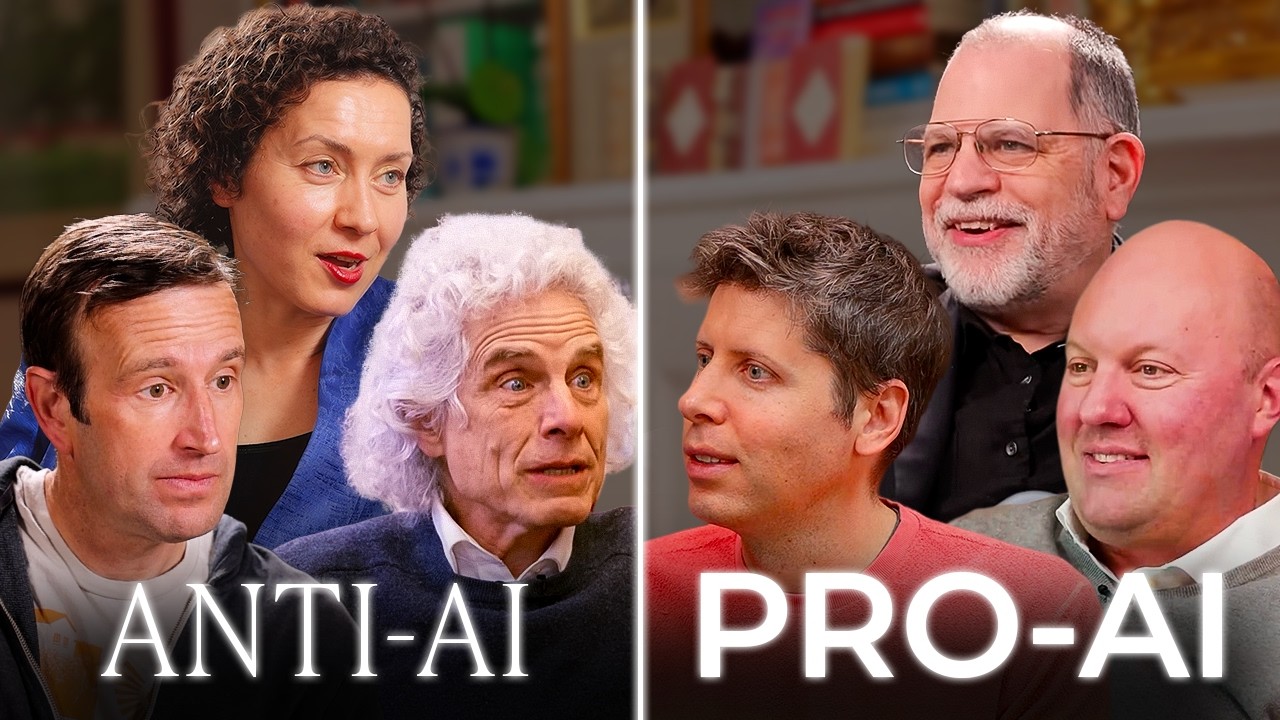
This episode compiles perspectives from twelve prominent writers, thinkers, and publishing figures on how AI is reshaping writing, creativity, and culture — revealing a deep fault line between those who see AI as a powerful tool for the “middle-to-middle” work of research and editing, and those who argue that the irreplaceable value of writing lies in the human struggle, suffering, and embodied knowledge that AI cannot replicate.
The core philosophical divide: tool versus threat
Ezra Klein, Maria Popova, Tom Junod, Yann Martel, and Robert Macfarlane cluster around the view that writing is an act of bearing witness, grappling, and human connection that AI fundamentally cannot perform.
Klein argues that AI is “better at the things I need to do than the things I don’t need to do” — it can replace Google searches but not the hours of reading that change how a writer thinks.
Popova insists AI “will never have feeling” and “can only ever succeed”; without the capacity to suffer or collide with impossibility, it cannot produce true art.
Junod frames writing as humanity’s way of bearing witness to its own history — “the only thing maybe that humanity has ever really done right” — and asks why we would give that up.
Martel compares using AI for creative writing to “hiring someone to have sex for you”; he values the imperfection and human connection in art, and felt betrayed when a wedding note turned out to be AI-generated.
Macfarlane treats Grammarly’s disapproval of his unconventional syntax as “a badge of success,” arguing that AI tools flatten distinctiveness into average correctness.
The “embodied knowledge” argument: why the struggle matters
Klein draws on his essay “Against the Matrix Theory of the Mind” to reject the download metaphor of knowledge: reading a book for seven hours changes you because “you spend seven hours with your mind on this topic” making connections.
He contrasts the RAND report he marked up for an hour — which integrated into his thinking — with an AI summary that would yield only “useful factoids.”
Popova echoes this: had she not spent days in scientific journals on the scallop’s eye, she “wouldn’t have written about it with feeling”; AI offers “instantaneous unfeeling delivery of pure information.”
Klein warns it’s “more dangerous to think you’ve read something that you haven’t than to not read it at all” — the shortcut operates on a misguided model of how minds work.
How writers actually use AI (or refuse to)
Tyler Cowen uses AI as “the new secondary literature” for reading prep: interrogating LLMs about Shakespeare, Wuthering Heights, and podcast guests to acquire context faster and more enjoyably, but never lets it write for him — “it’s like my little baby.”
Sam Altman treats AI as a “sparring partner” and “collaborator” for subtasks: word suggestions, phrasing alternatives, not full drafts.
Jimmy Soni, a self-described power user, calls AI “the most unbelievable tool I’ve ever seen” — using it for research (verifying Talmudic sources for a grief memoir), as an always-on editor, and to stress-test arguments by having Claude write takedowns of his op-eds.
Soni cites Bji Shinvas: “AI is not end to end, it’s middle to middle” — humans set vision and verify; AI accelerates the middle.
Soni also describes AI as an “anxiety antidote”: voice dictation via Whisper Flow gets him to a bad first draft fast, bypassing perfectionism.
Marc Andreessen predicts a “pair programming” model for all writing: continuous human-AI dialogue where the human directs the overall product.
Jon Yaged (Macmillan publisher) sees legitimate tool uses: research assistant (with permission to ingest books), thought partner for character development — but emphasizes contracts require authors to represent work as their sole creation and identify non-original parts.
The role of suffering, feeling, and soul in art
Popova: “Without suffering, what kind of true art can there be?” — not the tortured-genius myth, but the restlessness from lived suffering that drives meaning-making.
Junod: the soul is “the part of us that is willing to and in fact needs to bear witness to the truth, to ourselves, to God, all of it” — visible across literary history responding to war, technology, tyranny.
Martel: “What you want in art is connection” with another human being; a chatbot partner is short-term, long-term you want human imperfection.
Altman: after finishing a great book, “the first thing I go do is like I want to know about the writer… you feel like you have this important shared human experience” — a significant percentage of the enjoyment.
Steven Pinker’s linguistic analysis of LLM prose
LLM output is “well written” in a narrow sense: grammatical, plain, orderly, with introductory/concluding sentences — but “so generic and prosaic… so banal.”
Two hypotheses for why: (1) reinforcement learning from human feedback hammers it into a five-paragraph-essay shape; (2) like morphing faces into an attractive composite, averaging billions of sentences yields clarity but not beauty.
“It’s not the way it’s designed. It’s designed as a mashup, as a pastiche.”
Copyright, legal, and business implications
Yaged: copyright law does not protect AI-created works — “no one can own it,” creating zero barrier to entry for publishers.
The test is “substantially created by a human” — not a bright line; page-level distinctions (e.g., one AI-edited word on page 297) are unresolved.
Contracts already require authors to represent work as their sole creation and flag third-party material (lyrics, quotes); AI is treated the same way.
Macfarlane adds the “absolute piracy” of books ingested into LLMs without recompense, licensing, or permission.
Riva Tez’s critique of AI hubris and the STEM-humanities divide
AI researchers use loaded terms — consciousness, agency, intelligence — without introspecting on definitions philosophy has debated for centuries.
“We don’t even know what those definitions mean… no single answer of what intelligence means” — spider webs, bee colonies, bird murmurations all demonstrate intelligence.
The arrogance: “if we can make it resemble our intelligence… that is a primary form of intelligence” — while synthetic biology (building biological intelligence from non-organic matter) may pose greater existential risk.
Calls for a “massive humility pill” and dialogue: machine learning originated from behaviorism (Pavlov, reward functions) but divorced from study of intelligent animals.
Tyler Cowen on how AI changes what writers should write
Two effects: (1) predictive books (near-future topics) are obsolete — four-year publication cycles can’t keep up; writers must shift to ultra-high-frequency output (Substack, blogging, Twitter). (2) The “question box” model: AI may not write books but will answer any question a book would address — so human writing must be “more interesting than the question box.”
Cowen’s next book, Mentors, is deliberately human: about mentoring/mentee relationships grounded in lived experience — “I don’t think people want to read that book from an AI.”
He predicts fewer books from himself, more high-frequency writing; many who thought they’d be writers won’t be, akin to declining programming jobs — starting with generic corporate writing.
Sam Altman on teaching writing in the AI era
Recounts a creative writing teacher’s exercise: cut one metaphor per page, one unnecessary word per sentence — students produced beautiful prose but “no story at all.”
The challenge: mass-market hits (e.g., Twilight) have interesting stories but horrible writing — can AI help achieve both?
Dismisses “AI will kill writing” claims: no evidence serious writers (e.g., Paul Graham) are being replaced; full superintelligence would be required, at which point “we have much bigger issues.”
Even if AI writes better, the 2027 bestseller will likely have a human name — readers want connection to a life story.