Harlan Coben, author of 38 bestselling thrillers, shares his philosophy on writing as a craft requiring obsession, discipline, and emotional honesty rather than talent or inspiration alone; he treats the thriller as a form (like a sonnet) that forces story momentum while demanding heart, character, and theme to matter.
Ideas begin with “what if” and stick like hooks
Coben constantly asks “what if” while observing the world — overhearing teens talk about drinking and driving sparked Promise Me when he imagined one calling him for a ride and then vanishing.
He collects hundreds of “what if” fragments in a file; the ones that become novels are those that snag on a mental hook and won’t let go, feeling like a relationship you can’t walk away from.
The “what if” operates at the start to find the idea and during drafting to navigate choices, but he warns against choice paralysis — pick the best two or three routes, commit to one, and stay with it.
Know the ending before you start — it grants freedom to wander
Coben always knows his ending before writing; he compares it to driving from New Jersey to LA with a GPS set to the destination — knowing where you’re going lets you take detours (Mount Rushmore, In-N-Out) without panic.
The thriller form acts as a constraint that prevents naval-gazing; even detours must serve the final destination, and every scene must stir the pulse, mind, and especially the heart.
He cuts ruthlessly — each book has a “spare” file of ~50 pages of excised material, and in 38 novels he has never once put a cut passage back in.
Talent is irrelevant without practice; fear fuels the work
Coben’s first published novel was his fourth written; he compares writing to basketball — even with LeBron’s natural skill, you’d suck if you’d never played. You must practice the craft.
He embraces impostor syndrome: “Only bad writers think they’re good.” The moment you feel confident, you start phoning it in. A little fear keeps the edge sharp.
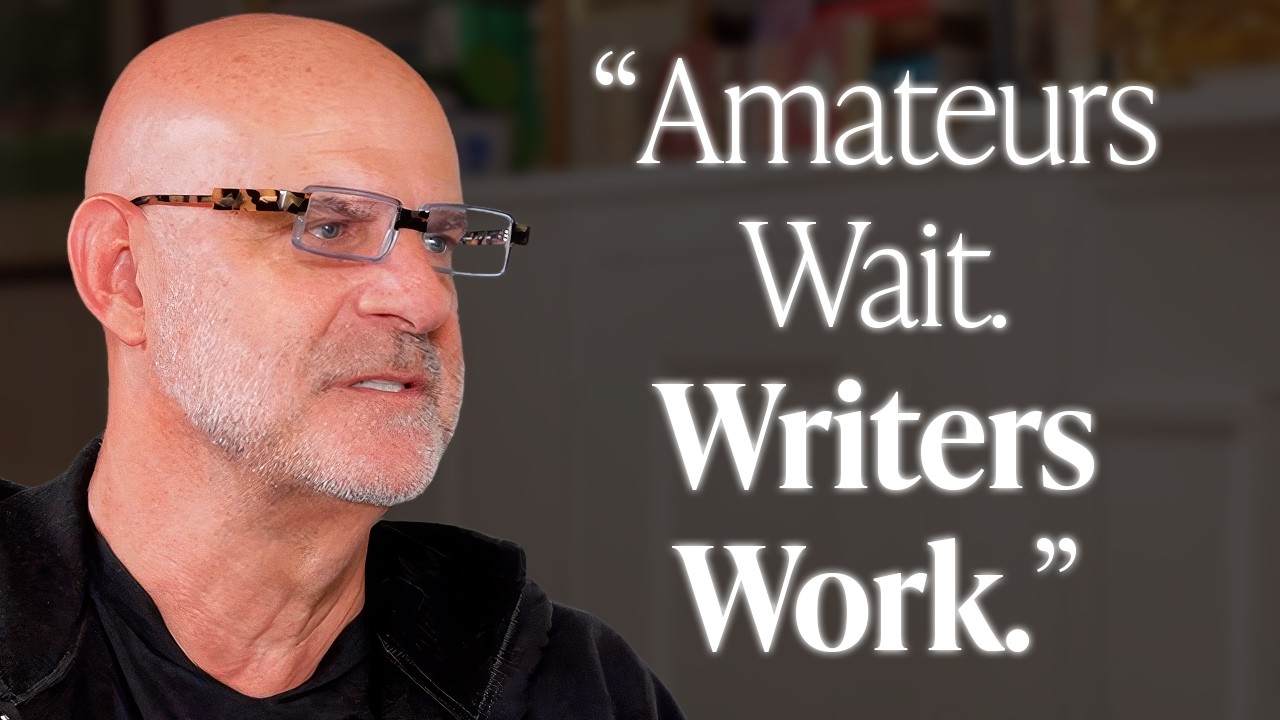
The muse isn’t angelic — it’s a pestering, guilt-inducing voice (like his mother) that says “you should be writing.” He treats writing as a job: “Amateurs wait for the muse; the rest of us just get to work.”
He writes fast, terrible first drafts (Lamott’s “shitty first draft”) with zero audience — no one sees it until it’s fixed. The only unbreakable rule: never show anyone the first draft.
The reward is the creation, not the process
Coben doesn’t always love writing — he loves having written. He compares it to painting: if you paint all day but the canvas stays blank, did you really enjoy it? The finished work is what pulls him back.
Writing is communication — a writer without a reader is “a man clapping with one hand.” He writes to make someone laugh, cry, feel suspense; if no one reads it, the story doesn’t exist.
He wants maximum readership — every writer wants better reviews and more sales — but not at the cost of compromising the story.
Adaptations are different mediums, not betrayals
Reading is interior (each reader casts their own David and Rachel); TV is visual (Sam Worthington and Britt Lower are the characters). Coben embraces changes in adaptation because the experiences are fundamentally different.
The Stranger changed the titular character from a male computer nerd to Hannah John-Kamen’s cool, visual female stranger — it worked on screen but wouldn’t in the book. He cites James M. Cain: “They’ve done nothing to my books. They’re right there on the shelf.”
Character, plot, setting, and dialogue are one thing — don’t separate them
Coben rejects the standard writing-guide chapters on character, plot, setting as dangerous fragmentation. Batman’s origin (parents killed → becomes Batman) is both character and plot; Spider-Man’s guilt over Uncle Ben is plot becoming character.
The Boy from the Woods emerged from setting (hiking in Ramapo Mountains) → character (feral boy) → plot (DNA test 30 years later). The entry point varies; the mistake is thinking you must start with character.
He would teach writing holistically: use whatever sparks the idea — character, plot, setting, “what if” — and let them braid together organically.
Dialogue must feel real without being realistic
Dialogue is Coben’s favorite part — it creates character faster than description (Elmore Leonard: “I bet you don’t skip dialogue”). Real speech is boring (ums, pauses); fictional dialogue must be authentic feeling but compressed and purposeful.
He keeps exchanges short, fast, often humorous — wise-ass banter as defense mechanism. Each character’s voice reflects their core: Wilde (feral, stoic, barely speaks) vs. Myron Bolitar (gregarious, cracking jokes).
To hone dialogue: eavesdrop with purpose — give characters an urgent situation (a fight, a death, a confession) and make them speak in as few words as possible. Quiet moments earn the loud ones; you can’t have a storm without a placid lake first.
Themes find you through your life scars
Coben doesn’t consciously choose themes. He writes about missing people and hope because he lost his father, mother, and delivered seven eulogies by age 32. I Will Find You opens with a father in prison for murdering his child — then a photo suggests the boy is alive. That’s hope, not justice or retribution.
Agatha Christie had dead bodies; Roth had the Jewish experience; Coben has missing people. Your themes are your battle scars — everyone has them. A novel without that personal core is just “something to pass the time.”
Ordinary people in extraordinary circumstances
He avoids CIA agents, snipers, superheroes. Hitchcock’s “ordinary man, extraordinary circumstance” resonates — readers relate to happy families where one small thing goes wrong. Even his series character Myron Bolitar is human first, skilled second.
Suspense tools: Hitchcock’s bomb, but vary the rhythm
Hitchcock’s bomb-under-the-table (audience knows, characters don’t) creates suspense, but Coben disagrees with using it always — sometimes the bomb should explode without warning. Variety (fast/slow, known/unknown) keeps it interesting.
Cheap suspense = cliffhangers for their own sake. Good suspense = emotional resonance. Each twist must change how you see the characters and story, not just be sleight of hand.
Best suspense answers questions but opens deeper ones (Alice down the rabbit hole). In The Boy from the Woods, Wilde confronts his father in chapter one — the answer rewrites everything.
Secondary characters can hijack the book — let them
Coben often discovers a two-page character becoming central (Myron’s love interest appeared for one scene, stayed for six books). In Missing You and Just One Look, secondary characters took over climactic moments.
TV producers hate this (“the hero must do the heroic thing”), but breaking genre rules within the form makes the book stronger. He’d rather the sidekick save the day than stage a boring showdown.
Never talk about your book — it lets the air out of the balloon
Coben has never been in a writers’ group; he and his writer friends don’t discuss works-in-progress. Talking about a book at a party gives false satisfaction — the balloon deflates. The only way to get that satisfaction is to finish the book.
Even sharing early pages for feedback is dangerous — you’re chasing the hit of being read, not the work. Keep it inside until the draft is done.
Routines are temporary — be a “serial routinist”
Coben doesn’t have a permanent writing space. He rode horses until they died: Ubers for three weeks writing The Stranger (expensive but productive), a Stop & Shop deli counter for four months (smelled like olive loaf), coffee shops until Wi-Fi killed focus.
He needs white noise and no internet. Parenting made home impossible — he’d find any excuse not to write (fake handyman projects). Leaving the house after school drop-off was the only way.
No excuses — if you don’t have time, it’s not a priority
Mary Higgins Clark: widowed at 37 with five kids, no life insurance, mother-in-law died the next day. She wrote 5–7 a.m. at the kitchen table before waking the kids. If she could do it, almost no one has a valid excuse.
Writing must be a priority, not a hobby. Every successful writer Coben knows was obsessed. If it’s a hobby, that’s fine — but don’t expect professional results from casual effort.
Genre is a trap; form is freedom
“Genre” implies formulaic rules; “form” (like a sonnet or haiku) is a container where anything can happen. Coben focuses on heart, not genre checkboxes — stirring the pulse and mind isn’t enough without the heart.
He builds character by asking of every person: what were their hopes and dreams? What happened to them? That empathy — on the page and in life — is the real engine beneath the thriller form.