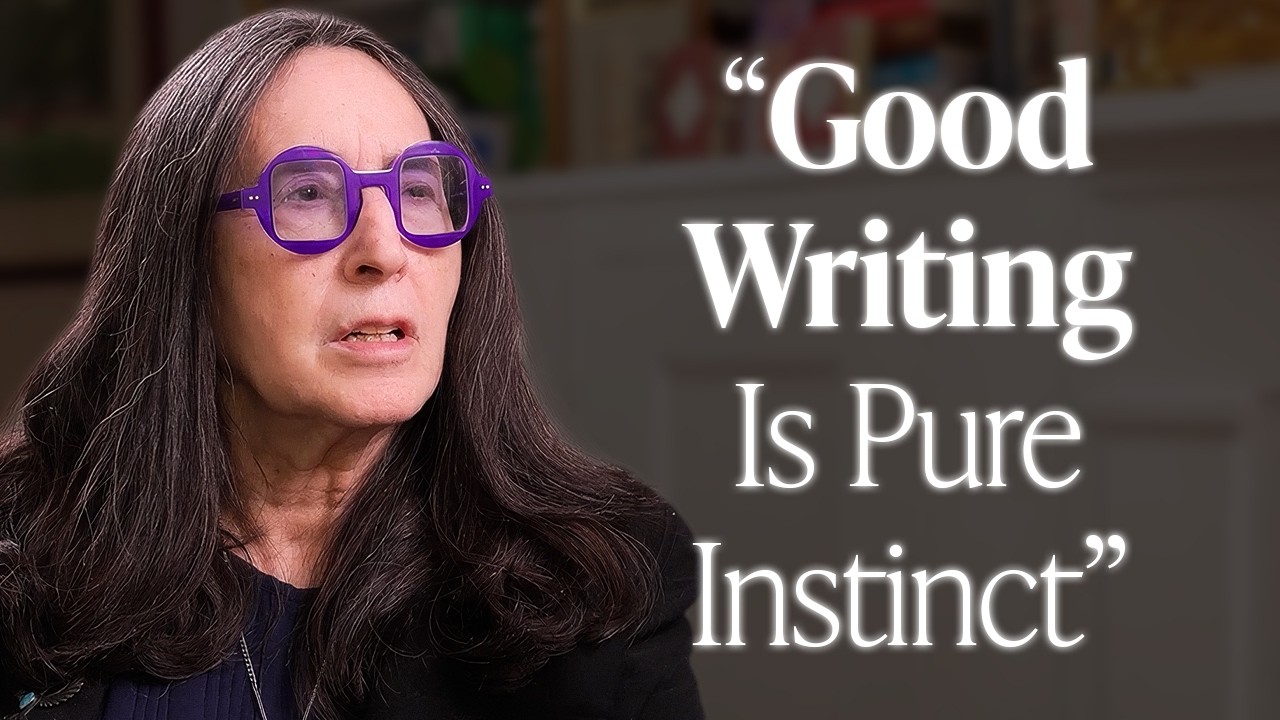
Francine Prose — author of over 30 books and longtime teacher at Harvard and Bard College — explains how to read like a writer, why clarity matters more than rules, and what she has learned from decades of writing and revising novels, stories, and nonfiction.
Reading like a writer means close reading, not rule-following
Prose describes “reading like a writer” as slowing down to ask why a specific word, punctuation mark, or sentence structure was chosen instead of another.
She contrasts this with how-to-write manuals, which she calls negative models: they tell you what not to do rather than showing you what works.
Positive models are great books you dissect to solve your own craft problems — for example, studying party scenes in Joyce’s “The Dead” or Tolstoy’s Anna Karenina to learn how to handle many voices and intersecting storylines.
In Anna Karenina, Tolstoy filters the ballroom scene through Kitty’s eyes because she is the only one obsessed with Anna and Vronsky dancing; in “The Dead,” Joyce builds a cacophony of voices that gradually resolves into character, theme, and the story’s title.
Prose suggests a practical exercise: write a story as if one person is telling it to another, letting the listener interrupt for clarification — this solves point-of-view and audience questions naturally.
Students already selected for ability still need to learn how to read closely
Prose’s students apply for admission, so they arrive with talent; what they lack is the habit of reading as apprentices rather than consumers.
She is teaching a ghost-story seminar next fall — 60 applications for 15 spots — and plans to start by asking whether any student has seen a ghost or has a direct connection to one.
She believes ghosts exist: too many credible people across cultures have experienced them for it to be pure imagination; they point to something real about the dead and the afterlife.
Latin American cultures, she notes, live more closely with the dead (Día de los Muertos), which produces richer ghost stories; her own family maintains an altar, and her granddaughter once placed one of Prose’s books on it “in case she comes back and needs something to read.”
Clarity is the non-negotiable standard; jargon is death
Prose insists on clarity not because everything must be simple, but because obscurity is annoying and disrespectful to the reader.
She has no patience for Finnegans Wake-level difficulty: “if someone put a gun to my head and said, ‘You have to read Finnegans Wake now,’ I’d say, ‘Shoot me.’”
Writers often switch to “capital-W Writing” — fancy words and convoluted syntax they would never use in speech. Her test: read it aloud; if you can’t say it naturally, it doesn’t belong on the page.
Jargon collapses when translated into plain English: she used to assign students to bring in a passage of academic or art-historical jargon and rewrite it; the inflated language would vanish, revealing nothing underneath.
The same principle applies to museum labels, exhibit texts, and documentary scripts: “just say the thing plainly.”
Books endure because they remain alive, surprising, and emotionally true
Teaching Jane Eyre and Great Expectations in the same year showed her that Brontë’s portrayal of female rage still feels immediate; students recognized it instantly.
The long, coded conversations between Jane and Rochester — really about sex but never naming it — became hilarious and vivid when two students performed Rochester in perfect Alan Rickman impressions.
Enduring books are still engrossing, powerful, beautifully written, and surprising no matter how many times you reread them.
First drafts are exhausting; revision is where the book is made
Prose writes first drafts on a computer (she can’t read her handwriting) for two to three hours a day before mental fatigue sets in.
The difficulty: you are constantly resisting clichés — the stupidest way to say something arrives first, and you must fight it off.
Revision is a different energy: she numbers drafts and her current novel has gone through roughly 40; cutting words feels like “losing weight without having to not eat.”
Early in her career, a magazine bought a 20,000-word story but only had space for 3,000–5,000; she cut it for the money, and when it appeared she couldn’t detect a single missing word — proof that compression often improves the work.
Nonfiction and fiction revision are the same process: both serve clarity.
Endings are the hardest part; indeterminate endings frustrate readers but can be deepened
Prose loves indeterminate endings — Chekhov’s “The Lady with the Dog” ends with the characters realizing “the hardest part was still before them” — and wishes that were the law for every novel.
Readers, especially younger ones, often hate open endings: a YA novel she wrote with an ambiguous conclusion drew sacks of letters from eighth-grade classes demanding a sequel.
Her new novel Five Weeks in the Country (about Hans Christian Andersen’s disastrous stay with Charles Dickens) originally ended with a fairy tale Andersen writes transforming his humiliation into glory.
Her editor, Noah Eaker, insisted on “one more turn” and suggested a letter from Catherine Dickens, the abandoned wife; Prose wrote it, and the final line — Catherine noting that the youngest child, “Baby,” now insists on being called Edward — landed an emotional truth about growing up that Prose hadn’t planned.
The ending came through dialogue with her editor, not solitary inspiration.
Good dialogue is not exposition in disguise; it moves by indirection and subtext
Bad dialogue is information masquerading as conversation: “Is it true you live in the West Village? Is it true I’ll have trouble getting there?”
Real dialogue is ping-pong only on the surface; often character B ignores character A’s remark and responds five lines later, revealing they heard it all along but couldn’t answer yet — just like life.
The key is listening for what people are not saying; subtext carries the weight.
Prose eavesdrops constantly — on subways, streets, in cafés — and finds the fragments more interesting than the speakers’ intended meanings.
She once overheard a man seemingly discussing ayahuasca, then realized it was something else entirely; she preferred her misheard version.
Fights are especially rich: a woman yelling “It’s just your personality and literally everything about you” hands a writer a whole world.
A single photograph can unlock a novel’s worth of story
A Brassaï photograph of a lesbian couple at Le Monocle in 1930s Paris named the butch woman as a professional race-car driver.
Research revealed she was barred from competing in France by a Napoleonic-code cross-dressing ban; Hitler invited her to the 1936 Olympics as a guest; she returned to spy for the Gestapo.
“What a great story — why hasn’t a million people written this?” The image opened a world Prose could step into, and one thread pulled another until a novel formed.
Painters make great readers and writers because they pay attention differently
Prose’s husband is a painter and her first reader; many of her closest friends are visual artists (David Salle, a photographer).
They literally see more: walking the same street, they notice details — light on a cornice, a gesture in a window — that Prose misses.
That observational intensity transfers to writing: the ability to pay attention to the world is the same muscle.
She saw this at a Monet/Venice exhibit: Canaletto painted Venice with photographic realism for people who’d never been there; once photography existed, painters no longer had to do that. Monet captured the spirit of Venice through light and color — a different way of seeing the same subject, which writers can also do.
Peggy Guggenheim was underestimated; her “ditsy” persona masked a sharp eye and historic impact
Guggenheim was a wealthy, unhappy woman with terrible taste in men but excellent advisers and a genuine eye for art.
Men of her generation repeatedly told Prose she was stupid; Prose disagreed — her memoirs are hilariously self-deprecating, but she saved Brancusi’s Bird in Space, Picassos, Giacomettis, and more by smuggling them out of Europe in her household crates to avoid taxes (and the Nazis).
She was the first to champion Jackson Pollock; the survival of much 20th-century art owes to her.
Characters emerge from intuitive accumulation, often revealing autobiographical sources only in retrospect
Prose doesn’t build characters from templates; they “pop up because they’re needed” — a family, a neighbor, a memory — and details collect around them.
In Five Weeks in the Country, Andersen bonds with the youngest Dickens child, “Baby,” a stutterer whose speech improves when correcting Andersen’s English. Only weeks later did Prose recall her own son Leon babysitting a stuttering boy who suddenly could say “Leon, Leon, Leon” after idolizing him.
Another scene: Andersen cuts all the red geraniums Dickens loves. Prose later remembered doing the same with a friend’s chrysanthemums, devastating the gardener.
She attributes this to “deep bodily memory reemerging,” not chance — a mystical dimension of writing where invented characters and events later manifest in reality.
Muriel Spark’s Loitering with Intent captures this phenomenon: you invent a character, then meet them; you imagine an event, then it happens. Prose and her close friend Deborah Eisenberg developed a running phrase: “It could be a coincidence” — but they didn’t believe it was.
Anne Frank deliberately revised her diary for publication; natural voice is crafted, not spontaneous
Frank, aged 12–15, heard a radio announcement that postwar readers would want firsthand accounts; she rewrote her diary multiple times with publication in mind.
The myth of the naive girl scribbling on her stomach erases her literary intention; addressing the diary to “Kitty” gave it an intimate, conversational tone — the same technique Prose recommends for finding voice.
Naturalness on the page is the product of revision, not the first draft.
Prose orbits narrative, not theme; structure serves the story
She doesn’t start with themes or driving questions: “I’m just trying to tell a story.”
Characters appear when the narrative needs them; their connections and memories generate further detail.
Some books have schematic structures: a YA novel about a high school turned into a prison camp used real “preventing school violence” protocols (metal detectors, strip searches) as its plot skeleton.
Every word is a choice; the sentence is the unit of craft
Language is the raw material — the brushstroke. Finding one word that replaces ten is “insanely satisfying,” a genuine buzz.
Reading like a writer means seeing a page as a thousand deliberate decisions: semicolon vs. period, this adjective vs. that.
Prose cites Woolf’s 141-word, single-sentence opening of “On Being Ill” — clear, beautiful, and structurally audacious.
Average sentence length has dropped from ~23 words (1931) to ~15 (2026); Prose is surprised the shift isn’t larger.
Hemingway’s “write one true sentence” resonates: some days a single true or funny sentence feels like mission accomplished.
Paragraph breaks are instinctive, not rule-governed
Prose believes in paragraphs but admits she can’t define a “topic sentence.”
García Márquez’s The Autumn of the Patriarch is one unbroken paragraph; a Polish artist friend hated it because there was nowhere to set down his beer.
The break signals a slight shift in thought; it’s learned by reading until the instinct internalizes.
“Good writing is instinctive. The answer is to read and write.”
Narration establishes distance; the right choice depends on what the story needs
Every narrator sets a distance between reader and events: omniscient third is far; close third is inside a head but not first person; first person is closest.
Second person works only when the addressee is clear (epistolary novels, Mavis Gallant’s “Madame Dostoyevsky”).
Five Weeks in the Country uses five modes: collective narration of the nine Dickens children (like Eugenides in The Virgin Suicides or Ferris in Then We Came to the End), third-person Dickens, first-person Andersen (too interior for anyone else to access), and letters.
Writing across gender is not harder: Prose grew up with a brother, has a long marriage, raised two sons — men aren’t space aliens.
Chekhov breaks every “rule” and proves rules are useless
Teaching at Sarah Lawrence, Prose would state a rule (“don’t give two characters the same name”), read Chekhov on the bus, and find him breaking it immediately (“The Two Villages”).
She told students a close-third narrator can’t die; Chekhov’s “Gusev” follows the dead sailor’s body into the sea and up into radiant sky.
The only rule she keeps: don’t write what the reader can’t understand — pretend the reader is the stupidest person in the room.
Writing from the interior chatter reveals the strange architecture of the mind
A therapist asked Prose to transcribe her internal monologue; the recurring fragments — phrases from childhood, self-beratement, self-encouragement — were startling when externalized.
A writer friend realized she yelled at herself for ten minutes after dropping something in the kitchen; she’d done it her whole life unnoticed.
This inner dialogue is the wellspring of character voice.
Dialogue in fiction is compressed reality; gesture and space breaks do the work of exposition
Real speech is full of empty language that reveals character; fiction dialogue must be compressed, move the story, or reveal character — ideally both.
In Five Weeks, Andersen speaks no English; Dickens speaks no Danish; much of the novel is stalled communication, gesture, and the children teaching Andersen English.
Gesture must mean something: if cutting a gesture leaves no trace, it was a placeholder — cut it.
Space breaks are underrated: instead of two pages moving characters from house to street, a space break puts them on the street.
Hollywood advice (“enter late, leave early”) doesn’t always apply; novels can linger (e.g., Downton Abbey’s long driveway) because they assume a different attention span.
Dialogue pleasure comes from transmuting life’s annoyances into art
Prose admires Shirley Jackson’s Hangsaman: the father, a fatuous blowhard writer, speaks in ways that must have been fun to write — putting on the page the nonsense you’ve had to endure in life.
If a writer overhears a couple fighting, that fight will appear in fiction within moments.
The core lesson for students: a human being made this up with words
Prose teaches literature, not craft workshops, but assigns a 300-word paper weekly.
The one thing she repeats: “A human being wrote this. A human being wrote this.”
Madame Bovary, Heathcliff, Ahab — they feel like holograms we can turn on a desk, but they were assembled from words by an actual person.
That fact — that language alone creates beings we know better than real people — is the magic she wants students to carry forward.