Elizabeth Gilbert reflects on four decades of writing discipline, tracing her path from a teenage vow to writing as a spiritual practice, and shares practical craft wisdom on creativity, research, discipline, and the writer’s life.
The Foundational Vow and Early Apprenticeship
At 15 or 16, Gilbert made a ceremonial vow to dedicate her life to writing, which felt holy and like her first encounter with divinity.
She took the vow seriously even when she neglected her own health and well-being.
The sense of magic came both as a reader and a writer; as a teenager she hand-copied long passages from novels into notebooks to “eat” the language, a practice Cheryl Strayed also did.
She read voraciously from her father’s library — Roth, Updike, O’Brien, Irving, Hemingway, Faulkner — and later read the entire NYU undergraduate English syllabus on her own without majoring in English.
Copying by hand trained her ear for voice and rhythm the way a painter copies masters in museums.
On MFA Programs and the Debt Trap
Gilbert does not categorically oppose MFAs but pleads with writers not to go into debt for an arts degree.
Starting an artistic life in debt is a nightmare; she repeats the warning three times for emphasis.
Anne Patchett’s rule: if a program doesn’t give a full ride, they just want your money; a full ride means they actually want you.
She avoided MFAs partly because workshop culture felt dangerous — casual cruelty, cliques, and politics could wreck a young writer’s voice.
She wanted to find her voice in the world, not in a room full of other young people trying to find theirs.
Creativity as Divine Partnership: Labor and Mystery
Creativity is the partnership between human labor and the mystery of inspiration; both are true simultaneously.
Sometimes she works hard and knows she made the thing; other times she enters an altered state where hours vanish and the work feels “better than I can write” — The Signature of All Things is her example.
In that channeling state she is not present; it feels like a vacation from being herself, similar to what meditation promises but rarely delivers.
This rapture is rare — a minuscule percentage of her writing life — and cannot be chased.
Discipline prepares the ground for the miracle; she compares it to farming: hard, repetitive work, seasonal cycles, and showing up daily.
Practical Discipline: Seasons, Sessions, and Systems
Gilbert writes in seasons, not daily year-round: research season, preparation season (90% of the work), then a generative season of three to four months where she clears her calendar completely.
During the generative season she keeps farmer’s hours: up at 4:30 AM, writing by the clock, not word count.
The 45-minute rule: set a timer, sit down, cannot stand up, cannot get on the internet; if only three sentences result, that is a good day.
Crucial trick: stop when the timer goes off even if you want to continue; pushing through breaks the discipline and leads to months of not writing.
She alternates writing with lying on the floor doing nothing — no scrolling — because deep focus is physically exhausting, like creating new synapses.
“Barn fever” hits near the end of a book: a frantic burst of energy to finish, sometimes feeling like she has damaged her brain.
She advises against quitting a day job to write; an hour a day consistently beats eight hours of unfocused time.
First Readers, Criticism, and the Vulnerable Draft
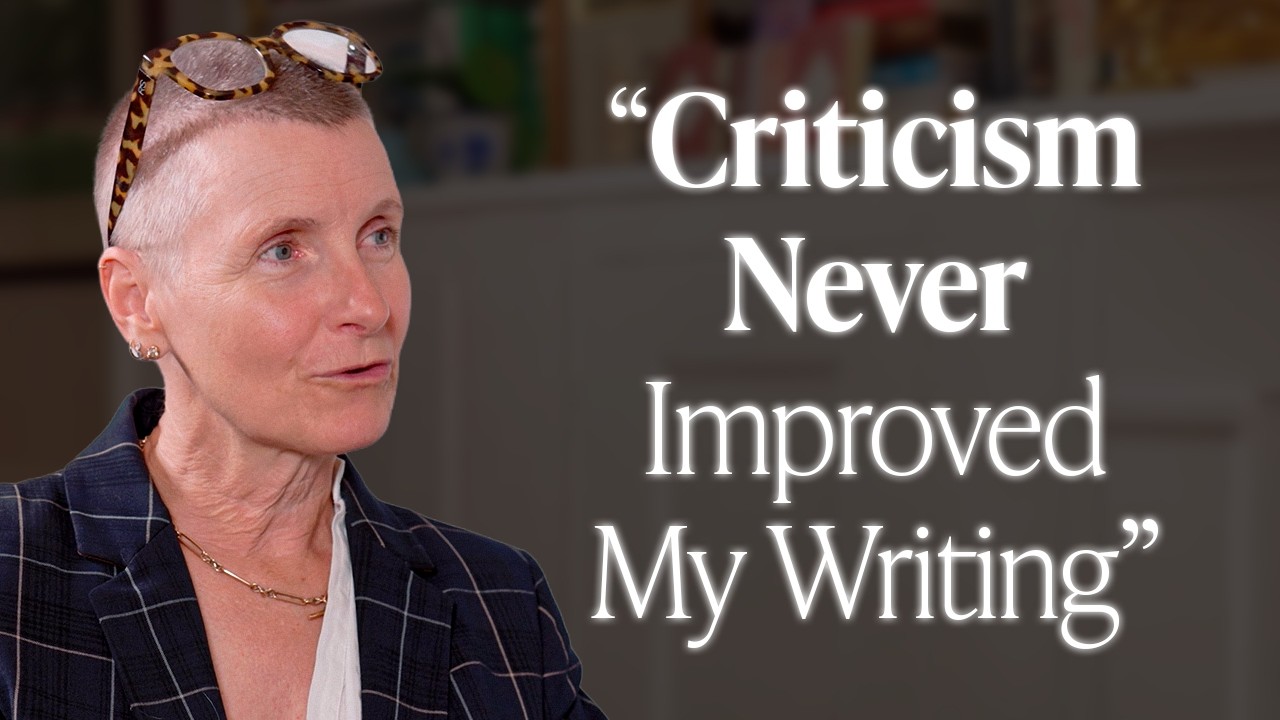
Criticism has never helped her write better; she is extremely careful about who sees early work.
“Brutally honest” readers often just want to brutalize; first readers must want you to succeed, have taste you trust, and deliver hard news tenderly.
She slightly disagrees with the “tender but honest” model: her first reader gives pure validation (“it’s perfect, you’re perfect”), and she reads the reader’s energy to detect where the work sags.
She has seen writers wrecked by premature criticism; the first draft needs velvet gloves.
The 20s as Graduate School: Jobs, Travel, and Voice
Her 20s were a series of jobs — diner waitress, bartender at Coyote Ugly, ranch work, lobster boats in Maine — that served as her real graduate school.
Bartending put her behind a “reverse stage”: hundreds of drunk, open, fighting, crying characters every night, teaching voice, drama, and human range.
Journalism beat: eccentric subcultures that didn’t know they were subcultures — isolated Maine islands, Russian geologists, Tahitian caves.
Voice comes from going out and rolling around in the world; you cannot fathom the range of human character from a classroom.
Dickens taught her character distinction: each figure so precise you never forget them, even across 300 pages; she aims for that populist clarity.
Research System: Index Cards, Shoe Boxes, and Analog Rigor
Her research method comes from a 1983 high school history class (Mr. Kisco): shoe boxes, index cards, categorized by subject, each card keyed to source and page.
She adapts it for fiction: cards labeled by character (Vivian’s lines, clothing, phrases), by setting (cars, theaters, architecture), by plot threads.
Cards are movable, shuffleable, tangible; she photocopies boxes every few weeks after once losing a box on a Metro North train (recovered, but traumatic).
For a short-story research week in 1880s Mississippi: go to the place, smell it, find the smallest historical society, talk to old people, gather uncataloged ephemera, then get a local to read for “omelet errors” — details that betray ignorance.
Identity, Grief, and Stubborn Gladness
Writing has been her anchor: after her partner Rayya died, she wrote City of Girls (upbeat, champagne-happy) to get off the grief; seven years later she could write directly about the loss.
The vow gives ground when life has none, but she now sees clinging to “writer” as identity as slightly dangerous — everything can be lost.
Rob Bell’s “seven Robs ago” and Springsteen’s “everyone I’ve ever been is in the van” capture the evolving self that still contains all past versions.
Jack Gilbert’s poem “A Brief for the Defense” — “We must risk delight… We must have the stubbornness to accept our gladness in the ruthless furnace of this world” — is tattooed on her wrist in white ink: “stubborn gladness.”
Delight is not denial of suffering; it is the discipline of noticing miracles unfolding even in the inferno.
The Business of Writing Today
The industry feels harder, less fun, less profitable than ever; attention is hijacked, distraction industry massive.
Readers who love her work often don’t know she has published three books in ten years despite a four-month publicity tour.
Publicity and marketing teams spend lives putting out fires; one line taken out of context can bring death threats.
AI will write “better” novels, but humans already write better novels than she does (George Saunders); she writes to write the best novel she can write.
Werner Herzog’s letter to a complaining filmmaker: “Quit your complaining… steal a camera if you have to, but stop whining and get back to work.” Every decade artists say “it’s hard now” — it’s never easy, yet people still do it.
When the Well Runs Dry: The Sabbatical
After burnout, she took a six-month sabbatical with one rule: no writing.
She rested, didn’t travel, healed a physical injury, organized her house, spent long hours with friends — “let’s go out again tomorrow.”
Agricultural metaphor: fields must lie fallow or the soil is destroyed; stopping is essential.
Literary Lineage: George Eliot, George Saunders, Hilary Mantel, Jack Gilbert
George Eliot: fearless, cunning, self-confident in an era that discouraged women; published as a man because she knew she had the goods.
George Saunders: genius who is also kind, decent, Buddhist, proving assholery is not a side effect of genius.
Hilary Mantel: Wolf Hall is a historical novel that feels utterly modern without anachronism; she co-wrote with Thomas Cromwell, literally pulling up a chair for him.
Mantel avoids the “too many twe historical details” trap; her characters feel vividly present, not researched-at.
Jack Gilbert: “stubborn gladness” — the defense of joy amid suffering; the world is worth slowing down to see, smell, taste, touch.
Advice to Aspiring Writers: Do More, Think Less
Don’t go into debt.
Get jobs — washing dishes on a nuclear submarine, working with human beings all day — you learn more from a job than a grant.
Go out and roll around in the world; don’t sit under fluorescent lights in an MFA classroom.