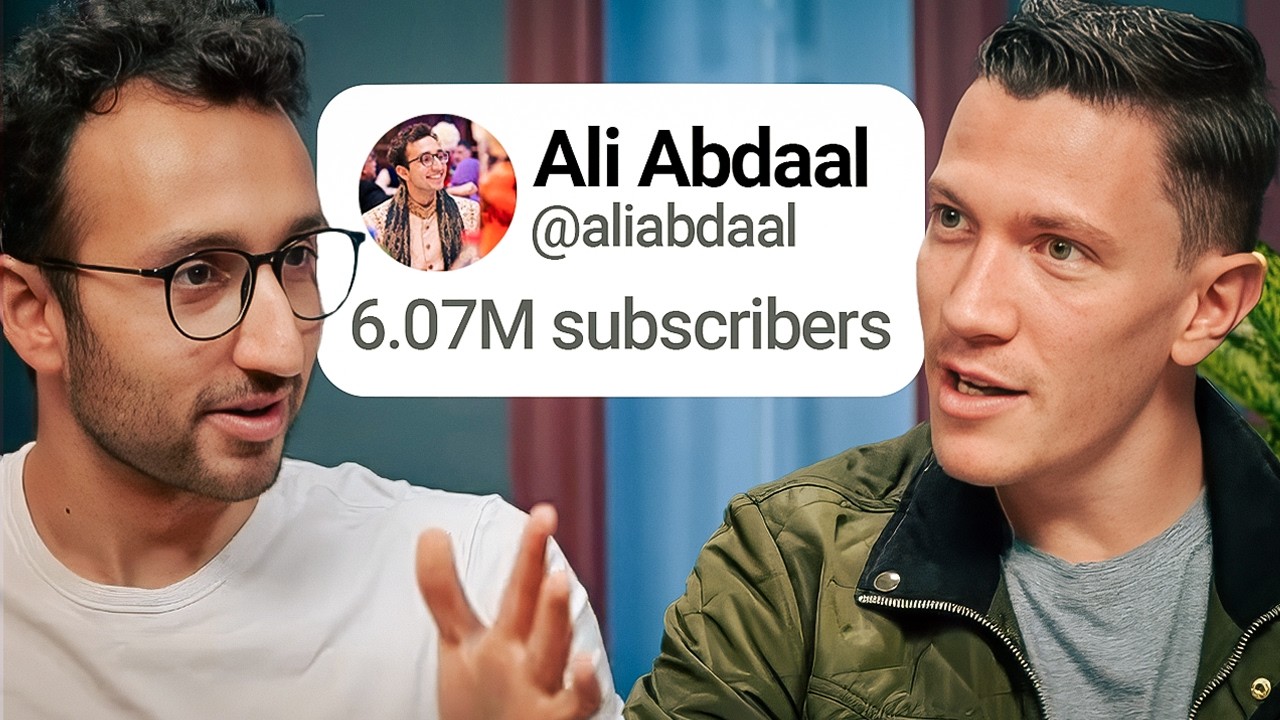
Ali Abdaal is a former doctor turned full-time YouTuber and author who has built a massive audience around productivity advice. In this conversation, he walks through the philosophy and practical methods behind his writing and content creation, centered on the idea that authenticity, joy, and showing your work matter more than performing expertise.
The Guide vs. Guru Mindset
Ali frames all his content around being a guide, not a guru — a fellow traveler sharing what has worked for him rather than an authority figure dispensing answers from a mountaintop.
This shift resolved his imposter syndrome around writing a book: instead of asking “who am I to write this?” he reframes it as “here’s what I’ve learned, maybe it helps you too.”
His best-performing YouTube videos follow this pattern: titles like “How I Rank First at Cambridge” or “How I Type Really Fast” outperform more generic “how to” titles because they feel personal and relatable.
He starts every video and newsletter with “Hey friends” to reinforce that he’s talking to real people, not performing for an audience.
Writing to One Person
The single most effective writing technique Ali uses is writing as if to a specific friend, not to a faceless public audience.
He noticed that when a med school friend texted him asking about investing, he typed out a detailed explanation on a hospital computer — and that explanation became a YouTube video that has since generated 8 million views, over $100,000 in revenue, and tens of thousands of subscribers.
When writing for public consumption, he tends to stiffen up, generalize, and lose personality. When texting a friend, his language is faster, wittier, and more emotionally charged — and that energy translates into better content.
He uses voice transcription (an app called Scribe) to capture that spoken, natural energy, then edits the transcript into writing, because his brain outpaces his fingers when typing.
Perfectionism and the “Get Going, Get Good, Get Smart” Framework
Ali is open about struggling with perfectionism, especially around the book. His writing coach Azul functioned more than anything as a therapist, helping him work through fear and insecurity.
He uses a three-level framework (from Jack Butcher): Level 1 is Get Going, Level 2 is Get Good, Level 3 is Get Smart.
Most people fail because they worry about strategy (Level 3) before they’ve even started creating (Level 1).
“Get good” means producing content until you no longer cringe at your own work — either because your skills have improved or your standards have calibrated.
Strategy is pointless when you suck at execution, but powerful once you’re competent.
He emphasizes prolific over perfect: quantity leads to quality because you need reps to improve. He references the parable of the pottery class from James Clear’s Atomic Habits — students who produced the most pots made the best ones.
He pushes back on the “discipline equals freedom” mentality. While discipline helps in small doses (e.g., committing to write for just five minutes to get started), relying on it long-term is a recipe for burnout and unhappiness.
The Book: From Productivity Equation to Feel Good Productivity
Ali spent about three years developing the book’s concept, initially pitching a “productivity equation” involving a pilot, plane, and engineer metaphor.
A book proposal consultant (David Muldaur, who worked with James Clear) told him the equation was too complicated and “productivity” itself was a boring, dying concept.
The breakthrough came when he was asked: if you had to nail it down to one secret, what would it be? His answer: having fun.
He then dug into the science and found that fun is a subset of positive emotions (positive affect), which generate energy and make productivity sustainable. This connects to Shawn Achor’s The Happiness Advantage, which argues happiness drives performance, not the other way around.
After testing dozens of titles, he landed on Feel Good Productivity — the idea that experiencing positive emotions in your work is the key to doing more of what matters without burning out.
Editing and Relatability
The first draft of the book was around 110,000 words; the target is 65,000–70,000. Much of the editing involves cutting personal examples that are too specific to Ali’s life as a doctor or YouTuber for a mainstream audience.
The solution: personality through voice, not just examples. Dry humor, first-person phrasing, and a conversational tone can make writing feel personal even without specific anecdotes.
He references Morgan Housel’s The Psychology of Money as a model: 20 short chapters, each built around a story with a clear takeaway at the end, and a line that segues into the next chapter. This “listicle” structure works well for topics without a single unifying framework.
He also notes a tension in editing between density and personality: cutting too much for information density can strip out the voice that makes writing engaging. His editors constantly juggle whether to cut a segment that reduces density but adds personality.
Specificity and the Buildup
Ali has found that going deep and specific often performs better than staying general, even when he worries the content won’t be broadly applicable.
A 20-minute video showing exactly how he manages his time with a Google Sheet template became his highest-performing video in six months, even though he feared it was too niche.
He connects this to a broader principle: the universal is in the specific. Writing to one person paradoxically reaches more people because it feels genuine, whereas content made for everyone often feels bland and watered down.
He uses the metaphor of an EDM set: bass drops (the punchy takeaways) only work because of the buildup (the personal story or context). A book that’s just punchlines with no buildup loses its impact — which is why “this could have been a blog post” misses the point.
YouTube Process
Most of Ali’s videos are not heavily scripted. He prepares with a mind map on an A3 pad (3–5 main points, each with 3 bullet points) and then riffs from those notes.
The first 10–20 seconds (the hook) are scripted for tightness. The rest is improvised, which is why his delivery sounds natural.
For topics outside his expertise (e.g., an evidence-based skincare video), his researchers script the video almost word-for-word using interview transcripts and studies, and he reads from a teleprompter — though he finds this harder to make sound natural.
He experimented with writing the book’s first draft by speaking it out loud during a team retreat in Wales, producing 10,000 words a day for seven days using the “Fast, Bad, Wrong” (FBR) principle from Safi Bahcall’s Loonshots.
Content Marketing and Lead Magnets
The business’s key metric is weekly or monthly views. Everything funnels toward growing that number.
Every video now includes a lead magnet — a free resource that encourages viewers to join his email list. This is how he grew from 200,000 to 300,000 email subscribers in a month.
Sales happen exclusively through the email list, never on YouTube. The list allows segmentation (e.g., people interested in starting a YouTube channel get a targeted 7-day email course) and relationship-building without spamming the channel.
About 90% of content aims for discoverability (new audience), while 10% is more personal/chatty for existing fans.
Leaving Medicine and Family Expectations
Ali’s decision to leave medicine was driven by fear — fear of instability, fear of being seen as a sellout, fear that his YouTube success was temporary and his audience only cared that he was a doctor.
A conversation on Lewis Howes’s podcast helped him realize these were scarcity mindset stories. When challenged — “If you could make $100K doing your own thing, would you go back to medicine?” — his answer was no.
Underlying the fear was a desire for his mother’s pride. As the child of immigrants (his mother is also a doctor), stability was deeply valued, and YouTube seemed risky and frivolous by comparison.
He still carries some guilt about leaving an altruistic career for a lucrative one while his medical friends struggle financially — a tension he hasn’t fully resolved.
Creative Fulfillment
Ali’s core creative loop is: get interested in an idea → figure it out for himself → share it with others. This is what makes him feel creatively fulfilled.
He genuinely looks forward to Mondays now — something he never experienced in medicine. He describes a “palpable sense of urgency” to get into the studio and start working with his team.
He doesn’t have a single big moonshot goal. His dream is to keep doing what he’s doing, stay creatively fulfilled, and eventually get married and have kids — a “score takes care of itself” approach to life.