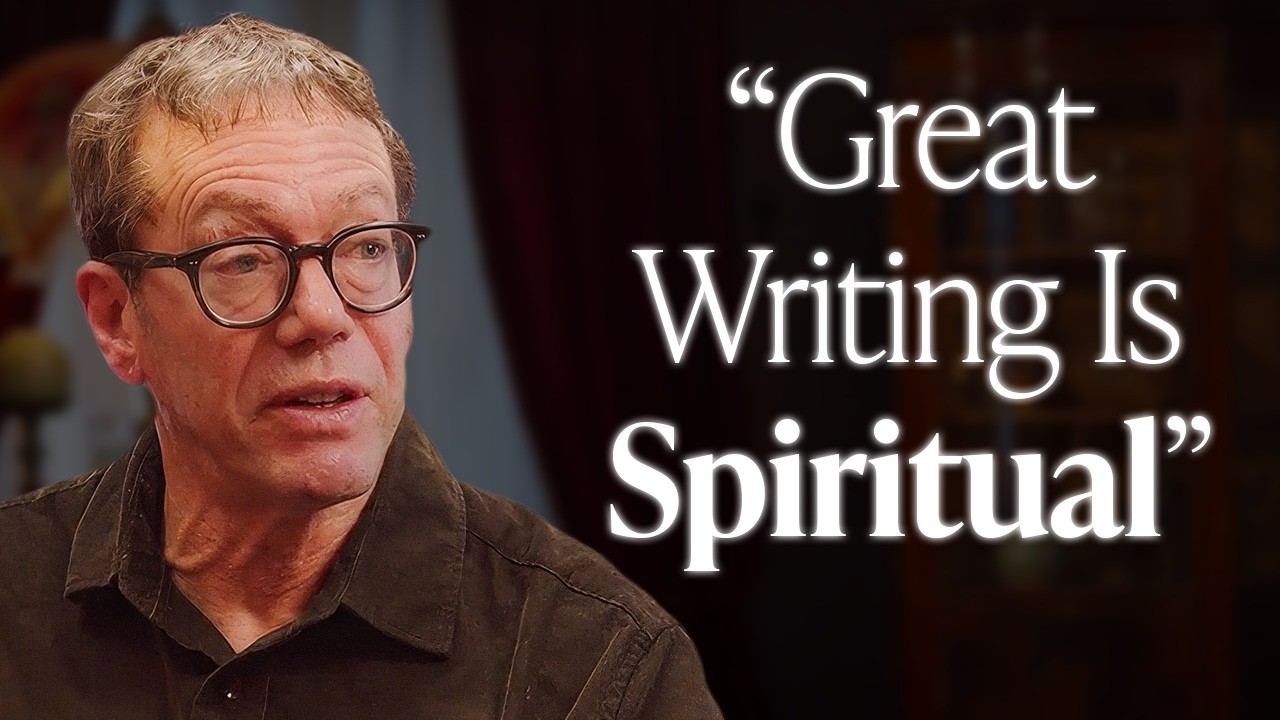
Robert Greene discusses his new book Sublime, written after a stroke left him partially paralyzed, forcing him to handwrite the entire manuscript across roughly one hundred notebooks, then transcribe via Whisper dictation and edit on paper and computer with one hand — a process he calls excruciating yet exciting, and the most personal work of his career.
The Book Sublime and Its Origins
The book was conceived twenty years ago but delayed by other projects; the stroke and near-death experience made its themes — death, transcendence, the limits of language — immediate and visceral.
Greene could not travel or seek adventures as originally planned, so he trained himself to find the sublime in his immediate surroundings, using music (different composers for each chapter) to inhabit the emotional tone of each subject.
He argues that if the writing is not alive in the author, it will be dead on the page; academic books on the sublime often fail because the writer does not feel the experience they describe.
Defining the Sublime
Greene visualizes the sublime as a circle: human consciousness is confined by cultural codes, conventions, and social norms that define what is real, moral, and thinkable.
The sublime is the electric shock of stepping outside that circle — a deep, ancient need driven by our consciousness of death and our restless brains.
The book’s twelve chapters are twelve “points outside the circle,” each a different portal: the interspecies sublime (entering animal consciousness), the cosmic sublime, the childhood sublime, the historical sublime, the death sublime, etc.
Example: J.A. Baker’s The Peregrine — a dying man becomes the hawk he observes, tasting its prey, experiencing a transcendent shift in perception.
Cultivating the Sublime: Defamiliarization and Sensitivity
Defamiliarization is the core practice: shifting perspective to see the familiar as strange — e.g., viewing a bird as seeing you, or asking “what is a dollar bill?” until its abstract nature dissolves.
Poetry and painting are engines of defamiliarization: Shelley, Keats, Cézanne (who saw apricots and sunlight making love), Van Gogh (whose altered brain chemistry revealed the vibrating, impermanent energy of reality).
Psychedelics and certain neurological conditions (temporal lobe epilepsy) reduce the brain’s filtering mechanism, flooding perception with raw data — what Huxley called the “mind at large.”
Sensitivity is the gateway: modern life (airports, social media, coarse environments) desensitizes; the sublime requires porousness, receptivity, a “photographic plate” that lets the world develop inside you.
Returning to childhood perception — not as nostalgia but as a way of seeing — is essential; Einstein kept his three-year-old wonder at a compass; Jobs retained awe before beautiful objects.
The Daemon: The Second Self in Creative Work
The daimon (daemon) is the true self beneath social conditioning — the unique physiology, spirit, and soul stripped of others’ judgments.
Nietzsche and Van Gogh exemplify the explosive power of contacting the daemon: work poured out in intense bursts, but both risked self-destruction.
Flaubert embodies the balance: methodical, obsessive over words, yet fully inhabiting his characters (becoming Emma Bovary) — discipline and possession together.
Rilke represents analytical depth fused with supreme sensitivity; his Notebooks of Malte Laurids Brigge explores death with a precision that defamiliarizes.
The daemon must be domesticated: too little and work is dead; too much and the artist burns out (Rimbaud). The middle way is bringing one’s uniqueness into the work while maintaining structure.
Craft and Discipline: Balancing Technique and Spirit
Automatic writing (Surrealists) accesses the unconscious where opposites dissolve; Greene uses it as an exercise to contact the daemon.
Technical mastery (conventions, structure, patterns) is necessary to connect with readers — stories and music have deep structural codes — but mastery without spirit produces soulless competence.
Coltrane mastered every musical pattern (like a chess grandmaster) before breaking into the unprecedented A Love Supreme; Scriabin disciplined his wild spirit through conservatory training, then shattered convention with the “mystic chord” (dissonance and consonance fused in one sound).
Scriabin’s breakthrough came at maximum frustration — the cloud bursts after prolonged pressure — a pattern Greene also describes in Mastery.
Cultural Context: Rebellion, Standardization, and Architecture
The late 19th/early 20th century saw a wave of rebellion against hardening conventions (Scriabin, Gaudí, Nietzsche, Van Gogh); artists felt the standardization of experience and created new languages.
Today’s postmodern culture lacks that rebellious anger; conventions are all people know, enforced by corporate conglomerates in publishing, film, architecture.
Architecture illustrates the loss: Calatrava and Renzo Piano still sketch by hand; most architects use CAD, producing formulaic, inhuman spaces (faucets in wrong places) because the human hand — with its artistic, mathematical, tactile discipline — is removed.
Greene sees hope in the younger generation (Gen Z) who feel anger at a programmed, monopolized world and may spark a rebirth like the 1960s did against 1950s conformity.
The Publishing Industry and Writer’s Livelihood
Publishers homogenize work: they shave off coarse edges, demand right angles, push self-help lessons over poetic narrative (e.g., Brent Underwood’s Ghost Town Living vs. Desert Solitaire).
Economic pressure forces writers to produce quickly, conventionally, or take soul-sucking academic jobs; Greene acknowledges his privilege — his success buys him seven-year cycles and editorial freedom.
Advice to young writers: be reckless. Live cheaply, write what compels you, bring your anger and unconventionality, ignore publisher expectations. A truly original book will find its audience.
Sneak the message in: wrap the subversive core in entertaining veneer; contrast the ugly present with a beautiful past (e.g., ancient Babylon’s unified, sunlit, erotic city) to provoke awareness without preaching.
AI and the Future of Writing
AI is a tool for research (finding obscure facts), not for writing. It mimics language but has no lived experience — no depression, frustration, disappointment, years of churn — so its output is dead, soulless.
Future belongs to human writers who develop their own style and resist the laziness AI encourages; readers remain emotional animals who need to be moved by something alive.
Do not let AI dominate; keep the resistance of the material, the hardness of the craft.
Literary Influences: Dostoevsky, Black Culture, Poetry
Dostoevsky is Greene’s favorite novelist: he loves the marginalized (prostitutes, criminals, nihilists) with Christlike non-judgment, bringing them to life as an act of grace; even villains are rendered with love.
Black culture shaped Greene from junior high busing onward: the aliveness, humor, edge, spirituality of jazz (Coltrane, Miles Davis), literature (Wright, Baldwin, Ellison, Malcolm X), painting (Motley’s gospel church scenes).
Coltrane exemplifies the discipline–wildness synthesis: heroin nearly destroyed him; quitting unleashed a supremely practiced musician who absorbed all patterns then transcended them.
Victor Hugo and Jung capture the sublime’s true nature: not dainty or sweet, but monstrous, grotesque, terrifying, chilling the blood — a mix of awe and fear that overwhelms our petty egos and reveals the infinite.
The Nature of the Sublime: Terror and Beauty
The sublime is “pregnant with meaning, yet chilling the blood with its strangeness” (Jung) — glamorous, demonic, grotesque, bursting human standards of value.
It arises from timeless depths; it is a revelation beyond words, a vision of beauty we cannot articulate.
Greene’s seven-year struggle to write the unspeakable is the book’s own enactment: pushing language to its limit until it breaks open into silence.