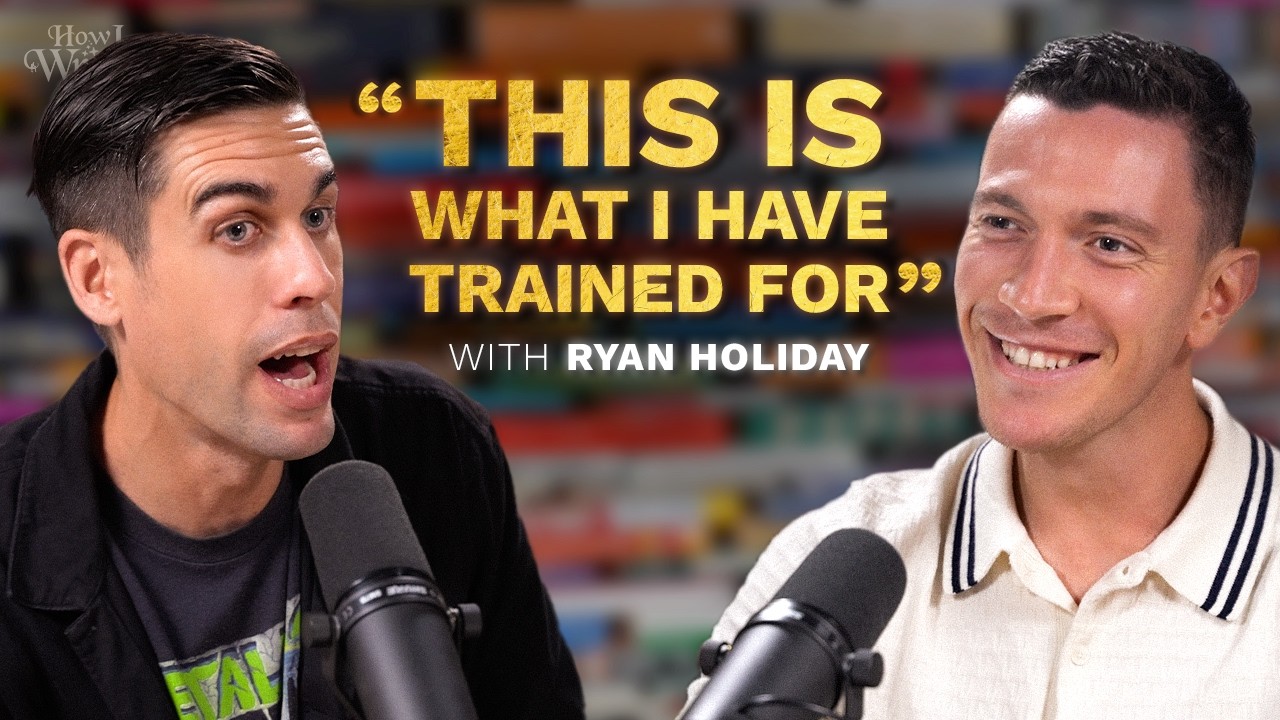
Ryan Holiday is one of the world’s most prolific writers, with 16 published books, a daily newsletter running for eight years, 1.7 million YouTube subscribers, a podcast, ghostwriting work, and a creative agency. This episode explores how he generates and maintains creative momentum, how his writing process has evolved, and the practical systems that allow him to produce at such a high volume without burning out or losing quality.
The power of momentum
Ryan’s core creative philosophy is to always be working on the next project, which insulates him from both the disappointment of underperformance and the ego inflation of success.
When The Obstacle Is the Way didn’t hit the New York Times list due to a categorization error, he was already deep into writing Ego Is the Enemy, so the news didn’t derail him.
When that same book later took off a year and a half after launch, he was equally unbothered because he was focused on the next thing.
He deliberately schedules himself to be working during the window when sales results come in, so he’s never tempted to spend a day refreshing numbers or riding an emotional high.
The lesson: good news can be just as damaging as bad news if it pulls you away from the work.
Book launches and redefining success
Early in his career, Ryan derived most of his satisfaction from external validation (sales, bestseller lists). Over time, he’s flipped that ratio so most of the win comes from internal measures.
He now asks: Is this the best thing I’ve written? Was it creatively fulfilling? Was it less disruptive to my life than previous projects?
The irony is that as he’s shifted focus inward, his commercial success has actually grown.
He acknowledges he may have swung too far in the other direction recently, feeling somewhat detached during a major media push, which he sees as a mild form of ingratience.
Quantity vs. quality
Ryan is firmly in the “quantity leads to quality” camp, more Bob Dylan than Robert Caro.
He argues the economics of publishing no longer support the Robert Caro model of spending years on a single book, and that the cultural infrastructure that once supported that (authors on late-night TV, books as central to public discourse) has largely disappeared.
He writes shorter books about historical figures, which requires less immersive research than contemporary political biography.
He believes staying in a rhythm is critical: pauses between books make it harder to start the next one, and he’s watched successful authors stall because they didn’t move on to the next project.
That said, he did take an extra year on Right Thing, Right Now, his most recent book, and sees both benefits and downsides to that choice.
The process of writing a book
Every project goes through a “trough of despair,” but having been through it many times, Ryan now trusts the process rather than panicking.
The first time you hit the low point, you don’t know what it is. The second time, you wonder if it’s different. The third time, you recognize it and keep going.
He compares it to football: if you don’t get out of shape, you don’t have to get into shape.
He’s now confident that any material he’s gathered can be shaped into a salvageable, publishable book, and he won’t quit or be rushed before that happens.
A telling example: while working on Discipline Is Destiny, he found an old index card he’d written to himself in red Sharpie that said, “When you go through these cards in June, it’s going to feel like there’s not a book here, but there is. Just keep going through the cards and you’ll find it.” He has no memory of writing it, but it arrived exactly when he needed it.
Ryan’s note card system
Ryan’s research process is built on physical index cards collected over years, which he sorts through at the start of each book.
He begins each project on his birthday by laying out all his note cards and looking for patterns.
He throws material into a “doom bucket” over months or years, then sifts through it later, discovering connections he didn’t realize he was making.
When he hits a section where he doesn’t have enough material (like the Queen Elizabeth chapter in Discipline Is Destiny), he puts a pin in it and works on other sections where he does have material, maintaining forward momentum rather than stalling.
For the Queen Elizabeth chapter alone, he read an estimated 5,000–10,000 pages to find what he needed for a 5,000-word chapter.
How Ryan’s writing has evolved
Writing children’s books during the pandemic taught him the power of iterative refinement and cutting.
He told the story to his son every night, writing a new version each time, cutting whenever the child got bored. The final story was only 500–800 words.
Reading his own adult books to his son afterward made him realize how much less tight the prose was, which made him aware of a tendency toward self-indulgence that can come with success and experience.
He noticed each successive book had been longer than the last, and he’s since worked to reverse that trend.
On Right Thing, Right Now, he cut the manuscript from roughly 85,000 words down to 65,000–70,000, combining chapters and eliminating any place where one word could do the work of two.
How Ryan’s writing has improved
The thing that makes him cringe when reading old work is not style but certainty.
Early books reflect his understanding at that point in life; with a decade more experience, he sees the nuance that was missing.
He’s replaced examples that were the best he had at the time but didn’t hold up, and he’s added depth that comes from more reading and learning.
He’s also more disciplined about what stays in, cutting more aggressively during editing.
Editing and the extra year
Inspired by Joyce Carol Oates, who puts a finished novel in a drawer for a year, Ryan took an extra year on Right Thing, Right Now.
The book was essentially done in January 2023 but wasn’t published until June 2024.
During that time, he let it sit, kept researching, then came back and cut aggressively, combined chapters, and mended the incision points.
He also wanted to give his audience a chance to catch up and to make the process more sustainable for himself.
Great introductions
Ryan believes the introduction defines the shape of a book and should be a codification of the central metaphor, main thoughts, and conceit.
He studies great openings: the first seven seconds of Kanye West’s Yeus album, the opening of Nabokov’s Lolita, and the prologue of Andre Agassi’s Open biography—all of which communicate enormous amounts of information almost instantly.
He’s learned not to be too precious about intros; he’d rather get most of what he has down and keep moving, then come back to it later.
He’s skeptical of book proposals because he believes in “writing to think”—you figure out the idea in the process of writing, so defining it in advance is inherently flawed.
Ryan’s relationship with Marcus Aurelius
Ryan considers the Gregory Hays translation of Meditations one of the most formative lucky breaks of his life—he bought it randomly on Amazon in 2006 with no idea what he was doing.
He’s drawn to a passage where Marcus Aurelius finds beauty in nature’s inadvertence: bread splitting open in the oven, ripe figs beginning to burst, olives on the point of decay, wheat bending under its own weight, the furrowed brow of a lion, flecks of foam on a boar’s mouth.
He sees Meditations itself as an example of nature’s inadvertence—a private journal never meant to be published that became an unprecedented work of literature lasting 2,000 years.
Stylistically, he’s taken from Marcus the idea that the most specific art can be the most universal, and that direct, unstructured writing can feel like it’s speaking to you personally even across millennia and cultures.
How music helps Ryan write
Ryan listens to the same song on repeat when writing, entering a trance-like state.
The loop creates a stable emotional mood without the disruption of shuffle mode, where a bad song could break his concentration.
The lyrics get burned into his head the way repeated reading does, creating a kind of recall that feeds the writing.
He doesn’t deliberately memorize passages, but repeated use causes things to seep in naturally.
Reading to lead
The best piece of advice Ryan ever got about reading came from a secretive movie producer and talent manager: “It’s not enough that you read a lot. To do great things, you have to read to lead.”
The idea is that learning by trial and error is expensive, especially in positions of leadership or responsibility.
He references General Mattis, who said that for a military leader not to read is unconscionable because learning by trial and error means “filling body bags.”
Mattis also said, “If you haven’t read hundreds of books about what you do, you are functionally illiterate.”
Ryan applies this by reading deeply and broadly, tracing subjects back to their core sources (e.g., reading Thucydides to understand current US-China tensions), and taking bibliographies seriously to find the foundational texts.
Research for writing
Ryan’s research method involves first getting the narrative arc from a high-level source like Wikipedia, then reading deeply to understand why things happened.
He traces ideas back to their oldest sources, building a web of understanding from foundational texts.
He’s gone deeper on each successive book, going down rabbit holes and seeking multiple angles rather than settling for a convenient example that confirms what he wants to say.
This depth is partly why his books have gotten longer, though he’s now pushing back against that tendency.
Ryan’s schedule and productivity
Ryan’s rule for the day is simple: did he make a positive contribution?
On a typical day during the book tour, he got up early with his kids, made breakfast and school lunches, dropped one off, went for a run, then wrote for about an hour before the interview.
He’s currently integrating a large stack of note cards into his manuscript on wisdom—filing them into chapters he hasn’t written yet, flagging “pickup” notes for chapters already written, and setting aside cards for future projects.
He doesn’t need to produce several hours of focused work to feel good about the day; even 50 minutes of meaningful progress on a chapter counts.
Reading for style vs. content
Ryan doesn’t read for style deliberately; he reads primarily for content.
The exception was when he wrote Conspiracy, his first book in a different genre, where he read more in that genre and took notes on interesting devices he might try.
He’s planning a future biography project and may read more stylistically as he decides what kind of biography to write.
Biographies
Ryan considers Plutarch the greatest biographer of all time, noting that Plutarch understood that character is revealed in off-handed remarks and gestures, not just facts and figures.
He thinks most modern biographers are too scholarly and don’t understand why we read biographies: to understand people, places, moments, and ultimately ourselves.
He’s deciding between a “Gonzo-style” biography (like Rich Cohen’s The Fish That Ate the Whale) and a more traditional thick, important biography (like Doris Kearns Goodwin’s work).
Criticism and feedback
Ryan tries to avoid reading criticism of his work, especially as his books reach massive audiences where feedback is overwhelming.
He’s been edited less as his sales have grown, which creates a tension between creative freedom and the risk of self-indulgence.
He references Curb Your Enthusiasm as a show with higher highs and lower lows due to its looseness, compared to Seinfeld, which is tighter and more disciplined. He sees value in both approaches.
His key insight about feedback: you have to do the hard work of figuring out what you’re trying to do and articulate that to the people you’re asking for notes. Then you can evaluate whether their notes help you achieve your specific vision.
On Conspiracy, he had rounds of conflict with his editor until he learned to say, “This is the kind of book I’m writing. Give me notes that help me do that.”
A great editor figures out what the author wants to do and helps them do it, rather than trying to make the book the editor would publish.
Fear of failure
Ryan believes fear is the primary blocker for most creative people: fear of judgment, fear of failure, fear of the blank page.
The blank page is scary because what ends up on the page is never as good as what’s in your head, so keeping an idea in your head keeps it safe and perfect.
He references Michelangelo’s “Hall of Prisoners” in Florence—unfinished statues that look demented and ugly, caught between raw marble and finished masterpiece. You have to get through that ugliness to reach the finished work.
Seneca said the one thing all fools have in common is that they’re always getting ready to start. People endlessly delay with reasons: the holidays, needing to read one more thing, waiting for the perfect moment.
The biggest lie in the world is “I’mm going to do it in the morning.”
Storytelling
Ryan looks for stories about people the audience has already heard of, but with a surprising angle or something they wouldn’t know.
Obscure stories are less powerful for the kinds of lessons he’s trying to teach.
The story can’t be an aberration; it has to be part of a theme that can be layered with other stories to demonstrate an observable reality.
He writes each chapter as a self-contained Google Doc (roughly 1,000–1,500 words), thinking of it as a small blog post that has to work on its own with its own pacing, without callbacks or connections to other chapters.
Only later, when most chapters are done, does he assemble them and adjust the overall pacing.
He’s gotten better at storytelling primarily through better research—finding richer material—and at rounding out characters by showing both greatness and weakness (as he did with Kennedy in Stillness).
He’s also improved at using contrast between characters (like Lou Gehrig and Babe Ruth) to deepen the reader’s understanding of both.
Top lessons from Ryan
Don’t lose momentum. Many people finish their first book and stop. The pauses between projects are where careers stall.
Trust the process. This confidence comes through reps, not just intellectual understanding. Ryan has done 16 books plus eight years of daily emails, which is still fewer reps than a musician playing live shows.
Get more practice. Ryan accidentally built in massive repetition through the Daily Stoic: 366 stories in the book, plus a daily email to a million people for eight years. That’s the equivalent of at least eight books of practice in storytelling.
He also wrote 44 blog posts in 2007–2008, so his career started with volume.
The challenge in writing is that books take a long time and are expensive to produce, unlike standup comedy or music where reps come faster. Writers need to find other ways to get practice.