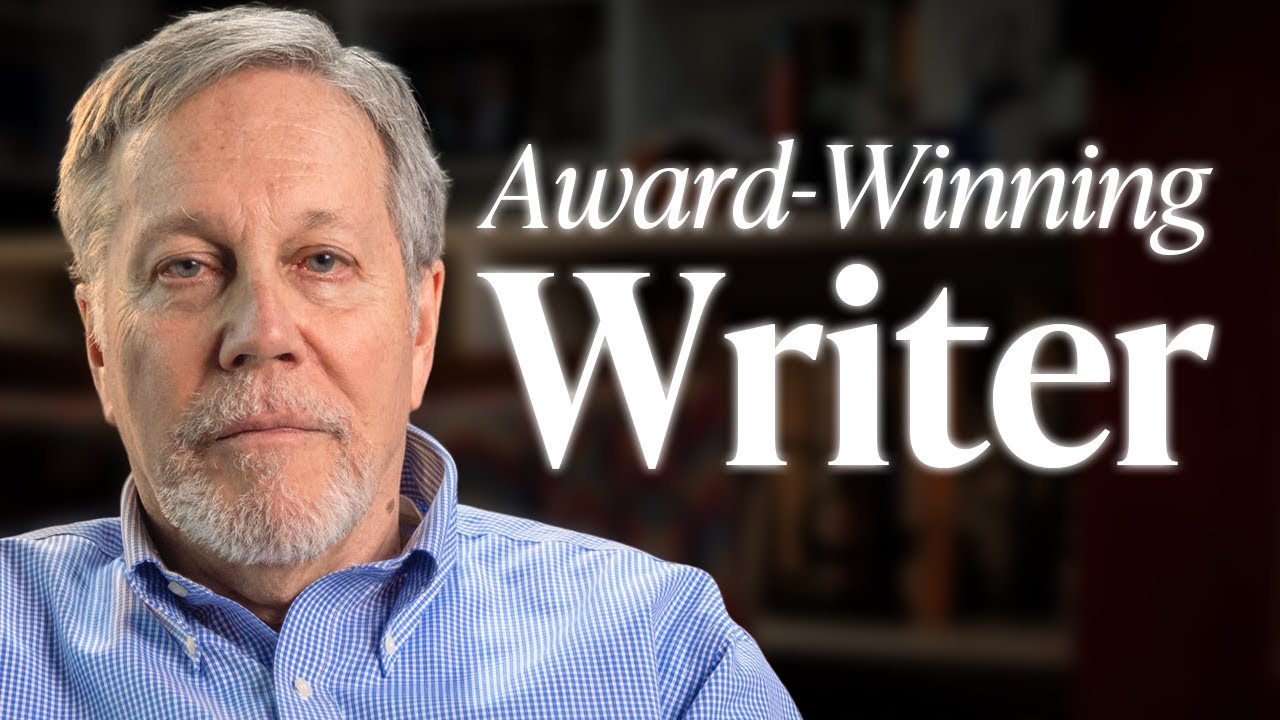
- Dana Gioia is a poet, critic, essayist, and former chairman of the National Endowment for the Arts who has spent a lifetime thinking about what it takes to write well—not just the craft, but the life, discipline, and sacrifices required. This conversation covers his creative process, the role of inspiration and revision, how grief transformed his work, the relationship between poetry and music, the importance of saying no, and his mission to build a serious Catholic literary culture in America.
The Creative Process: Inspiration, First Drafts, and Revision
-
Gioia distinguishes sharply between two kinds of writing: journalistic prose, where he writes from what he already knows and can sit down and produce on demand, and literary or artistic writing, where the act of writing is itself a process of discovery—he doesn’t fully know what he wants to say until the poem reveals it to him.
- He describes the onset of a poem as a quasi-mystical, involuntary experience: he feels it physically in his temples and throat, beyond words, and then a single line or image becomes the bridge to the page.
- He writes first drafts in a frenzy—30 to 45 minutes of intense, almost manic composition—and then the inspiration vanishes, leaving him with a messy page from which he must excavate the real poem.
- He has lost countless good ideas because he was driving, in a meeting, or otherwise unable to write in the moment. Sometimes he jots down a fragment and the next day can’t remember what he was reaching for.
- Robert Frost’s principle guides him: “No surprise for the writer, no surprise for the reader.” The writing that grabs you is writing that astonished the writer.
-
Revision is where the real work happens. Gioia has taken poems through 100 drafts. He describes a process of writing something, seeing it as brilliant, then reading it the next morning and seeing only what’s wrong—then tearing it apart and rewriting, over and over, until the piece radiates more energy than he could consciously put into it.
- He uses the metaphor of atomic energy: you push and push on a potentially radiant element until it begins to radiate on its own.
- He alternates between what he calls “the madness of invention” and critical objectivity—writing with abandon, then coldly assessing what’s wrong, then diving back in. He describes this as a kind of productive schizophrenia.
- He often recopies his previous day’s work by hand as a way of re-entering the inspiration and continuity of thought before writing something new.
-
The turn is a central concept in his writing. He is drawn to moments where one emotional direction is pushed to an extreme and then suddenly reversed or qualified—creating energy from internal argument. He credits W.B. Yeats: “Out of arguments with others we make politics; out of arguments with ourselves we make poetry.”
- He applies this not just to poetry but to prose, building toward a climax, pulling back, building another climax, and cutting dead patches.
The Life Behind the Work
-
Gioia made a deliberate, counterintuitive life choice: rather than becoming the expected academic poet, he went to Stanford Business School and spent 15 years working a demanding corporate job in New York—not because he wanted a business career, but because it gave him economic security and forced him to write with extreme discipline in the margins of his life.
- His days in New York were budgeted hour by hour: 10-hour workdays, then 90 minutes of writing at night. He had exactly three priorities—marriage and family, his job, and his writing—and could not have added a fourth.
- He saw this as a bargain with fate: he gave up the conventional literary path to protect the writing. His Harvard professors thought he was making a terrible mistake. He nearly went bankrupt when he first left the corporate world to write full-time.
- He now lives in California, where his days combine physical labor (pruning trees, maintaining land) with writing. He discovered that physical work unlocks his unconscious—he’ll hit an impasse in a poem, go prune a tree for an hour, and return to find the problem solved.
-
He is the “least marketable writer you could possibly imagine.” He routinely says no to prestigious opportunities—he turned down the poetry editorship of the The New Yorker, returned advances for essays he didn’t want to write the way editors wanted, and published a landmark essay in a small journal with 2,500 readers rather than Harper’s with a quarter-million.
- He spent seven years not publishing at all while he figured out who he was as a poet. When he finally sent work out, he went from zero to publishing in the best magazines in America.
- He believes his stubbornness and willingness to say no have been the key to his success—his work lasts because he refused to compromise it for short-term attention.
Reading, Study, and the Craft of Language
-
Gioia is a voracious and systematic reader who studies great writing at the sentence and paragraph level. He keeps annotated books where he marks syllable counts, rhyme schemes, metrical stresses, and speech stresses to understand how master poets create sound.
- He maintains commonplace books—volumes of quotations copied from his reading over decades—as a pool of wisdom and a way of remembering “what it would impoverish us to forget.”
- He urges writers to read widely, make judgments about what’s good, and then analyze great passages closely: find a paragraph you love, figure out why it works, and you’ll be surprised at how compact and simple it actually is.
- He learned prose craft by studying dead masters he never met—George Orwell, Randall Jarrell, Clive James, T.S. Eliot, D.H. Lawrence—analyzing their paragraphs to understand voice, tone, and the knockout sentence.
-
On description: Most people describe others by assembling abstract details from different times and places, which produces flat writing. Instead, create a single scene—a little story with a beginning, middle, and end—in which the person is revealed through action and detail in one moment of time.
- He demonstrates this with a two-paragraph portrait of a poet named Samuel Menashe, standing in the corner of a New York poetry reading, speaking one octave lower than anyone else, identifying himself as a pariah—a scene that is both funny and touching.
Poetry, Music, and the Body
-
Gioia insists that poetry is a technology older than writing—it is sound moving through time, closer to music than to print. He argues that the print age taught people to read silently and visually, but poetry should be heard and felt physically.
- He writes while walking in circles, muttering lines aloud, feeling the rhythms in his body. He knows a line is right not intellectually but physically—through intuition and bodily intelligence.
- He taught his USC students (215 at a time) to memorize and recite poems, taking them to speak before the Board of Trustees and at public events. Most had a “conversion experience”—they discovered that poetry awakened their full human capacity.
- He criticizes the way poetry has been taught since the New Critics of the 1930s: brilliant visual analysis of the dead silent page that killed the audience. For thousands of years before that, poetry was taught through memorization, recitation, and performance—and everyone loved it.
-
He sees the cultural shift from print to digital/audio as actually favorable to poetry, because it returns us to the oral, performative origins of the art form. He now has a significant YouTube presence, reciting poems and giving lectures with integrated visuals—a format his filmmaker son helped him develop.
Grief, Loss, and Emotional Directness
- Gioia and his wife lost their first son to SIDS at four months old, just before Christmas. He made the decision to follow the grief wherever it led rather than repress it, as he had seen other men do—men who shut off a portion of their humanity to cope.
- He spent nights cleaning his son’s gravesite in a working-class cemetery, and there he encountered other bereaved people—often older immigrant women—with whom he shared an equality of grief that transcended every social boundary.
- After his son’s death, his writing became simpler, more emotionally direct, and more musical. He stopped over-explaining and allowed mystery into his work, trusting the reader to participate in meaning-making.
- He doesn’t recommend the experience, but it taught him humility, sympathy, and brought him back to the center of his humanity. It also made him a better parent to his next two sons.
Finding Your Voice and Writing from Your Life
- Gioia’s advice for writers struggling to find their voice: everyone’s life is trite and boring from some angle. The problem is usually that people don’t want to admit anything embarrassing or shameful, so they write from a position of looking good—which produces boring work.
- People identify with you when you share the weaknesses they perceive in themselves, which then allows them to believe in your strengths.
- He found his own voice after 20 years of trying to write about the kind of elevated subjects he thought poetry required (birch woods, oceans) before realizing he needed to write about his own urban, working-class, unmemorable landscape—just as rappers transformed their neighborhoods into poetry.
- He compares finding your voice to finding the right instrument: before you find it, it feels mysterious and maybe impossible; once you find it, it feels like it was there all the time.
On Prose: Layering, Subtext, and the Long Game
- Gioia divides his prose into two categories: pieces to be read on Monday (journalistic, commissioned, deadline-driven) and pieces he wants read in 50 years (literary essays meant to last).
- He brings poetic technique to prose through what he calls layering—creating a text and a subtext, evoking things without stating them directly, leaving enough out that readers bring their own experience into the work.
- He thinks about three imaginary readers when writing: a bright teenager who doesn’t know much, a fellow writer who knows too much, and someone in between. He tries to say something that will interest all three, or surprise at least one.
- He spends a full day on a paragraph getting the right combination of examples—testing each angle until it strikes him like the right chord in music.
On Books, Publishing, and Patience
- Gioia counsels young writers to be deliberate about their first book—it gets a special kind of attention, and you shouldn’t squander it. But he also warns against rushing: most non-fiction books have a wonderful first chapter and then become padding.
- He turned down major publishers for his first book, choosing a tiny two-person press (Greywolf) out of intuition and respect for the publisher’s integrity. Forty-two years later, he’s still with Greywolf, and every one of his poetry books remains in print—whereas a major publisher would likely have let it go out of print within two years.
- He warns against three traps that derail writers: taking a university job that consumes your creative energy, freelancing where you must constantly produce, or writing a quick book for an advance with the promise that the next one will be the masterpiece.
- On patience: Wallace Stevens said people talk about writing but never about the meditation that precedes writing. Gioia believes in putting yourself in a space where inspiration can arrive—reading, thinking, waiting—rather than forcing production.
Opera, Lyric Moments, and Genre
- Gioia has written opera librettos and a book about opera called Weep, Shudder, Die. Writing for opera taught him three things: write simply enough for a composer to set to music, write simply enough for an audience to follow even when they miss sung words, and write characters deeply enough that a singer can fully embody them.
- Opera works through intense, compressed lyric moments—peaks of emotion with minimal connecting tissue—rather than through the novel’s method of simultaneously showing outer action and inner thought.
- In a novel, you spend 200 pages inside a character’s mind; in opera, a five-minute aria can achieve the same transference through melody and drama. This is why you can extract an aria from an opera and feel its power in a concert hall, but you cannot extract five pages from Anna Karenina and have them make sense.
- The lesson for all writers: understand what your genre does, why people come to it, and what experience they want from it—then give them the best possible version of that experience.
Catholic Literary Culture and Building a Counterculture
- Gioia has spent the last 15–20 years writing explicitly as a Catholic writer, stepping forward when he saw the literary and academic culture becoming increasingly anti-Christian. This alienated some gatekeepers but gave courage to others.
- He founded a Catholic writers’ conference that grew from a small gathering to 1,300 registered attendees at Notre Dame, creating a community where Catholic writers realize they are not alone.
- He draws on St. Augustine’s City of God: there is the city of man (ruled by wealth and power) and the city of God (eternal, invisible, governed by divine rules). He tries to build the latter—communities where people treat each other as equals, respect each other, and are dedicated to truth.
- His two remaining life goals: finish his career as a poet by writing the best poems he can, and help foster a serious Catholic artistic culture in America—knowing he won’t live to see its full fruits.
Literary Influences and Quick Takes
- Baudelaire: The greatest poet of having screwed up your life; turns universal failure and decline into art.
- Marshall McLuhan: A religious visionary disguised as a technological expert who predicted the digital age; mocked in his time, now vindicated.
- Bob Dylan: A poet who changed pop music, folk, and rock by making lyrics the center; borrowed all his tunes.
- The Beatles: Proof that artistic collaboration can make people greater than they are individually.
- Martin Luther King: Perhaps the last great American political speaker, because he anchored his rhetoric in the Bible and Christian vision.
- John Steinbeck: Showed the dignity of the poor and outcasts; The Grapes of Wrath is one of the greatest American novels.
- John Cheever: Published more stories in The New Yorker than anyone; wrote parables of moral falling and redemption disguised as suburban realism. Gioia has studied his paragraphs word by word to learn the power of the evocative detail.
- Tarantino vs. Tolkien: Tarantino is “morally repulsive, cinematically arresting”—he descends into darkness without the moral vision that redeems. Tolkien took a second-class genre and turned it into literature; The Lord of the Rings is the English War and Peace, about a decent person dragged into a war he doesn’t want, who emerges morally strengthened.
- Tolstoy vs. Dostoevsky: Tolstoy is a social-psychological visionary; Dostoevsky is a religious visionary. Anna Karenina may be the greatest novel ever written; The Brothers Karamazov is one of the three or four greatest. Dostoevsky scares you—and that’s the point.
- The Modern Novel: Gioia is disappointed by most contemporary fiction, which stays trapped in small subcultures and creative writing departments. Great novels—Anna Karenina, Crime and Punishment—take you to the center of life itself.