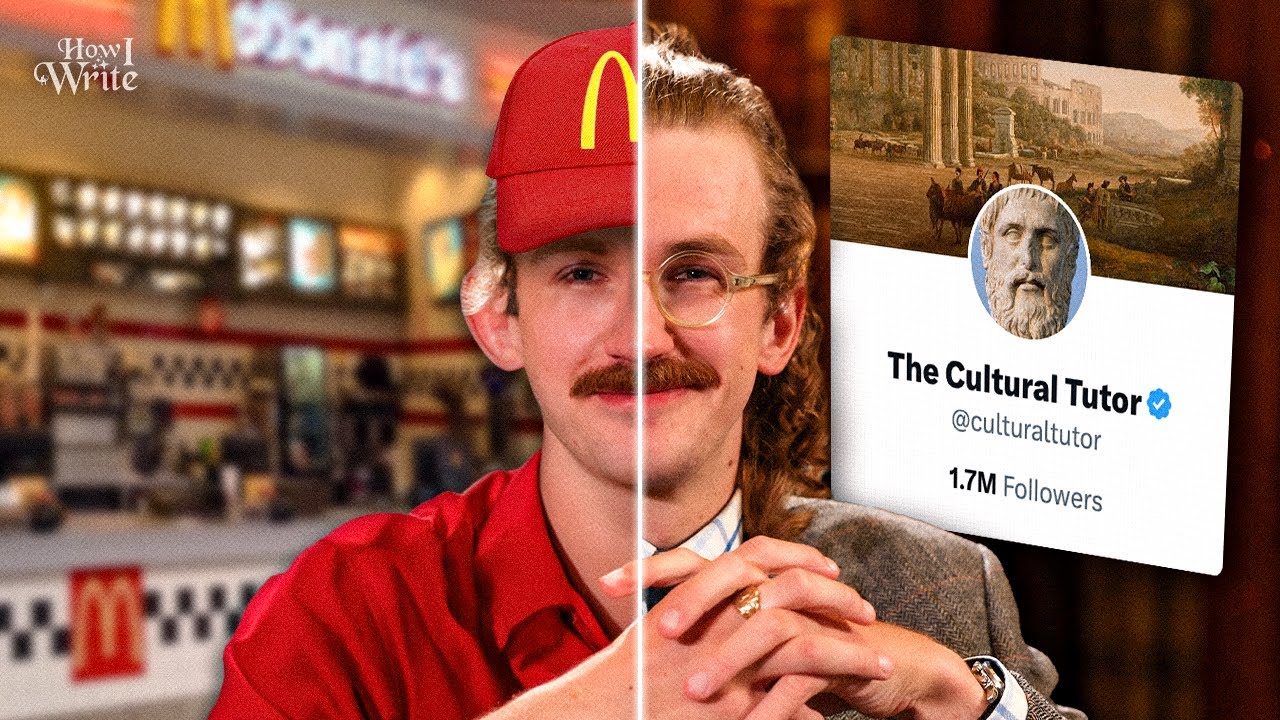
The Cultural Tutor (Shan) went from working at McDonald’s to amassing over 1.5 million Twitter followers in roughly 15 months by writing daily threads about art, history, and culture. This episode explores his unorthodox creative process, his philosophy on writing, and the principles behind his rapid rise.
The daily practice and what drives it
Shan writes a Twitter thread every single day, treating it as a non-negotiable compulsion rather than a disciplined routine.
He has no fixed schedule, no productivity tools, and no planning system. He just opens Twitter and writes.
He describes the feeling as “if I don’t get it done, the game is up” — a sense of urgency that overrides everything else in his life.
He’s been writing every day since he was 10 years old, making it an unbreakable habit.
He distinguishes between wanting to write and needing to write.
He doesn’t frame it as desire — he says “I can’t help it” and “I can’t avoid it.”
He compares himself to Novak Djokovic, who simply loves hitting a tennis ball, versus Andre Agassi, who hated tennis despite reaching number one. The person aligned with their compulsion wins.
The best time to write about an idea is when it first strikes.
He keeps a list of ideas but rarely consults it because the urgency is gone by the time he returns to them.
He wakes up each day looking for something that grips him that day, because then the stakes feel high: “If I don’t write this today, I’m never going to write it.”
Surrendering to his nature
Shan is nocturnal, walks for hours doing nothing, smokes a pack of cigarettes a day, and avoids all productivity optimization — yet produces consistently.
He argues that people waste energy trying to become the person they think they should be rather than surrendering to who they actually are.
He believes in long periods of “zoning out” — walking, staring at the floor, doing literally nothing — because that’s when the brain makes connections on its own.
He sees creativity as being a conduit rather than a source.
His best work has come when he just started typing and something poured out — the result of years of accumulated thinking, not active effort in the moment.
He references a thread on the danger of minimalist design that got half a million likes and took about 5 minutes to write — but was the product of roughly 10 years of observation and reflection.
Writing by hand vs. typing
Shan prefers typing because of speed — he’s a “volume writer rather than precision.”
David (the host) offers a counterpoint: the delete key on a computer homogenizes writing.
When speaking or writing by hand, words can’t be taken back, which preserves personality and voice.
He notices he has more voice when he speaks than when he types, and attributes this to the availability of the delete key.
The origin story: McDonald’s to a million followers
In April 2022, Shan was working at McDonald’s because he needed money and had been rejected everywhere else.
He had a law degree but didn’t want to be a lawyer. He’d written multiple unpublished novels and hundreds of thousands of words of various work.
He’d become complacent, vaguely expecting opportunity to find him.
He quit McDonald’s, applied to film school (rejected) and the British army (accepted), then got a chance to travel to Tenerife for two weeks — a window he treated as “do or die.”
He tried making money through Listverse articles ($100 each), Fiverr, Upwork, and tutoring.
He created “Cultural Tutoring” — teaching art, architecture, and history — and his friend Harry Dry suggested starting a Twitter account to drive traffic to it.
He chose the name The Cultural Tututor literally from the tutoring service he was offering.
Within two weeks in Tenerife, he had 1,000 followers and abandoned the tutoring idea entirely.
Harry suggested starting a newsletter to monetize.
The early grind on Twitter
In the beginning, Shan wrote 2–3 threads a day and did relentless manual outreach.
He messaged everyone who liked or retweeted his threads individually.
He followed people in his niche, asked bigger accounts for advice, and spent hours on what he calls “dog’s body work.”
Early threads got 1–2 likes. He stayed up until 4 a.m. messaging people.
The motivation was financial survival: “If I want to go back to McDonald’s, I can give up. But if I want to make a living, I have to do this.”
The turning point: being funded to write
Six weeks in, Shan hit 100,000 followers and planned to launch a paid newsletter.
David, who had been following Shan’s work, saw this and thought it was a terrible idea — it would constrain growth and distract from the core work.
Through Harry Dry, David got in touch with Shan and offered to pay him roughly £25,000 a year (enough to live on and move out of his parents’ place) with one condition: write every day.
Shan describes this phone call as one of the best days of his life — someone was paying him to do the thing he couldn’t stop doing anyway.
David’s only advice: write Twitter threads every day, focus on email, and don’t get distracted by other opportunities.
Multiple people reached out early with offers — YouTube collaborations, Instagram deals, other ventures.
David consistently told him these opportunities undervalued him and were distractions.
Shan credits this narrow focus as a key reason for his growth.
Reading old books to stand out
Shan deliberately avoids reading anything written in the last 50 years.
Reason 1: Everyone else is reading contemporary bestsellers. If you consume what everyone else consumes, you’ll think and write like everyone else.
Reason 2: A book that has survived for 1,000+ years (like Boethius’s Consolation of Philosophy) has been validated by “father time” — the most reliable recommendation there is.
He frames this as a shift from a space bias (geographically constrained information in the past) to a time bias (everything from right now, everywhere). The frontier for new ideas is now history, not geography.
He argues that for the cost of a third of a coffee, you can buy a book that has shaped world history for a millennium — and most people don’t.
On originality, truth, and writing for yourself
Shan is skeptical of the modern obsession with originality.
He was challenged by a friend who told him he’s not very original — he’s a curator who synthesizes and reshapes existing ideas.
He finds compelling the Christian writers’ goal of revealing what has always been true rather than inventing something new.
He believes writers must write for themselves, not for their readers.
He writes because he wants to figure things out — he wrote a thread about why people wear ties because he wanted to know.
The danger of only writing for yourself is not refining ideas enough; the danger of writing for others is losing authenticity.
On technical craft vs. passion, he references Byron vs. Keats and Shelley:
Byron was technically sloppy but full of vigor and is still the most beloved and influential of the three Romantic poets.
He’d rather have passion with imperfect technique than technical perfection without soul.
Writing hooks and learning from “shill” accounts
Shan studied why self-optimization accounts with what he considers “patent drivel” were getting tens of thousands of likes while brilliant historians got almost none.
The answer wasn’t content — it was hooks. These accounts had mastered the art of making you want to read.
He learned from Harry Dry (whom an anonymous user called “the best copywriter in the world”) and applied copywriting principles to cultural content.
Example: Instead of “Here’s a deep dive on The Great Wave of Kanagawa,” he wrote something like “It’s not actually a painting” — making a specific, falsifiable claim that demands the reader’s attention.
He describes this as “ruthlessly applying simple copywriting” to trick people into reading history and art instead of nonsense.
Editing, refinement, and the social process
Shan is not a heavy editor or redrafter — he writes fast and moves on.
He’s defensive when others try to edit his work and struggles to hand it over.
David’s process is the opposite: refinement is deeply social.
90% of his ideas come from things he says in conversation that he then writes down.
He works through ideas by talking about them repeatedly — he describes entrepreneurs who tell the same stories 20–30 times, constantly refining the narrative verbally.
Both agree that great writers throughout history worked in circles — Byron, Keats, and Shelley; Tolkien and C.S. Lewis; the Bloomsbury Group; Florentine artists all knowing each other.
Tolkien only published The Lord of the Rings because C.S. Lewis read an early draft and insisted it was extraordinary — encouragement that changed literary history.
Writing is not a hobby
Shan rejects the framing of writing as a hobby for those who are serious about it.
If you’re a writer, it’s not a hobby — it’s something you must do.
His core advice for young writers: only think about the writing and don’t think about anything else.
He echoes Mr. Beast’s “make great videos” — the purity of focusing entirely on the quality of the work.
Everything else — monetization, platforms, opportunities — is superfluous if the writing is truly great.