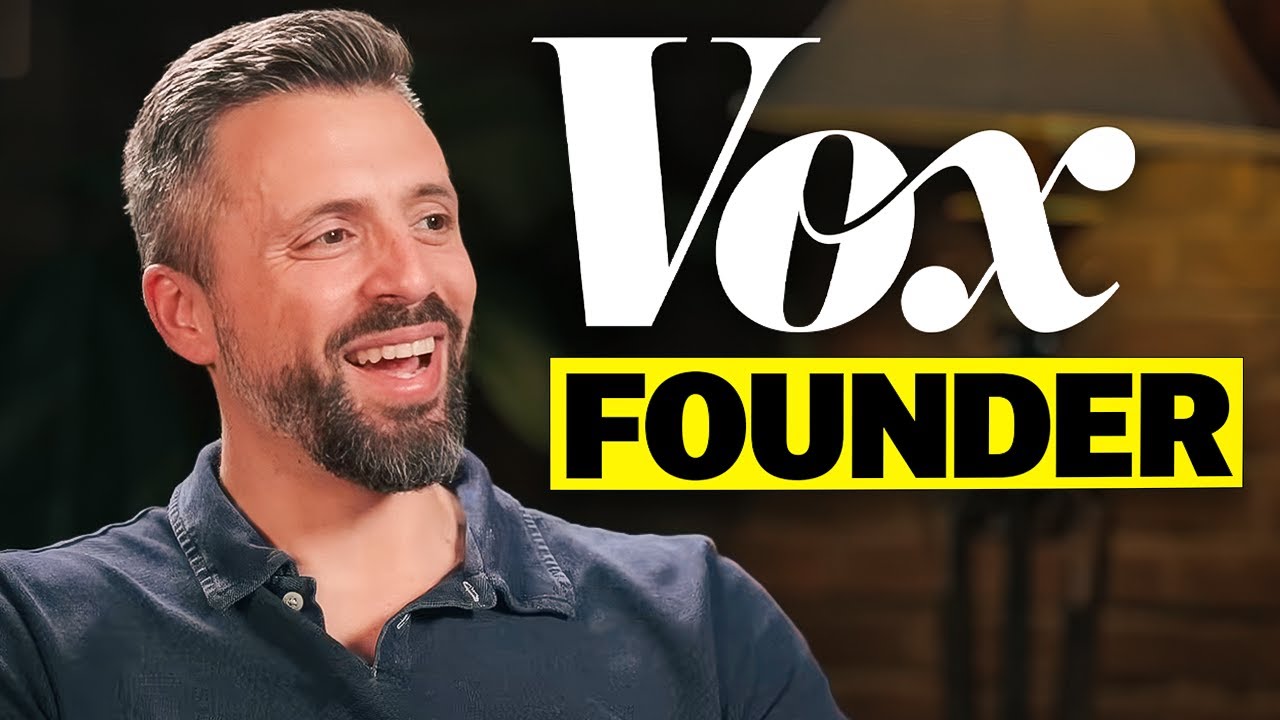
Ezra Klein is one of the most influential figures in online journalism over the past two decades, having co-founded Vox in 2014, worked at the Washington Post, and now writing for the New York Times, where he also hosts the Ezra Klein Show. His book Abundance was number one on the New York Times bestseller list at the time of this conversation. This interview explores how his voice and craft have evolved, why he believes deep reading and reporting are irreplaceable, why he’s skeptical of AI in journalism, and how the media business model has reshaped the profession.
How Ezra Klein’s Voice Evolved
Early in his career, Klein was a blogger who “just let it rip” — spewing opinions freely online. His first editor at the American Prospect, Michael Tomny, told him, “Pick up the damn phone,” meaning that real journalism requires integrating voices other than your own, not just broadcasting your own views.
Around 2010, after moving to the Washington Post, Klein began treating his voice as carrying more weight. He became less interested in takedowns and more in construction. He recognized that as his platform grew, his punches landed harder, and that punching down felt wrong.
He now writes with more institutional responsibility — more people are on the hook for what he writes — and he’s become worse at writing short, partly because he feels a need to justify each piece as worth the attention it will receive.
He doesn’t think consciously about maintaining “an Ezra Klein voice.” The limiting factor in experimenting is time and energy, not a rigid sense of what his voice should be.
The Role of Editors and Taste
Klein doesn’t feel the weight of the New York Times brand on his writing. His show is called the Ezra Klein Show, not the New York Times Opinion Show. What matters most is trust in his editor, Aaron Reica, whose judgment he deeply respects.
He distinguishes between technical editing (grammar, clarity) and taste. Taste — an intuitive sense of what is good — is the hardest thing to find and nearly impossible to teach. It’s textured, subtle, and varies from person to person.
As an editor himself at Vox, he wishes he had trusted his instincts more. Early on, he relied too much on external validation — covering things because others were covering them — rather than confidently saying no to things that didn’t feel right.
Writing vs. Managing
Klein wrote two to three pieces a week at Vox while also running the organization and hosting podcasts. He never felt that managing was “a day of work” the way writing or podcasting was. For him, the creation of editorial product is what feels like real work, not managing the people who create it.
This is why he doesn’t see himself as cut out to be primarily a manager long-term.
Reading as the Wellspring
For Klein, reading is the foundation of everything else he does. He spends two to three hours a day with physical books and papers, in a meditative, associational state of mind where connections form naturally. He describes this as “spending intellectual capital” that he has built up over years.
He acknowledges other valid models — some journalists build their understanding primarily through constant phone calls and sourcing — but for him, if he could only have reading or reporting, he’d keep reading.
He is currently in a phase of spending down intellectual capital through book promotion and travel, and is planning to protect two months to rebuild it through sustained reading.
The Craft of the Book
Klein wrote Abundance in just two months of book leave (he had planned four, but October 7th disrupted the schedule). He believes a book requires six to eight months of dedicated time to do properly.
He considers the book his best craft work — a step forward in marrying extremely granular reporting (like the CHIPS Act notice of funding opportunity or how tax credits stack in LA’s Prop H) with highly generalized arguments. He calls this “marrying the 30,000-foot and the 3-inch view.”
Unlike his first book Why We’re Polarized, which was almost entirely descriptive, Abundance is a manifesto — prescriptive, pointing toward a vision of how government and liberalism should work.
The writing in Abundance is stripped down and declarative, with little rhetorical flash. He kept a sticker above his keyboard that said “say what you’re saying.” He believes the most important thing in non-fiction writing is having something worth communicating, and that embellishment often distracts from a hollow core.
Why AI Is a Bad Fit for His Work
Klein has not found a way to consistently use AI in his creative workflow, despite having access to the best models and knowing the people at the labs. He sometimes uses it as a Google replacement or for quick data tasks, but he refuses to let it do his research or summarize books for him.
His core argument: the time spent reading, grappling with texts, and making connections is where the actual value of his work comes from. AI can’t tell you that you’re doing the wrong thing entirely — it can only help you tweak what you’re already doing. It gives you what everyone else would see, not the unique connections he’s looking for.
He pushes against the “Matrix theory of the mind” — the idea that knowledge is something you download. Instead, knowledge is embodied: it changes you through the process of engagement. A book read for seven hours changes you in ways a summary cannot. He cites his decades-long relationship with Matthew Glaciius’s work as an example — it’s the length of engagement that matters.
He’s wary of shortcuts generally. He thinks it’s more dangerous to believe you’ve read something you haven’t than to simply not read it at all.
Writing as a Technology of Rigor
Klein sees writing as fundamentally different from conversation. In conversation, you can rhetorically glide past gaps in your reasoning without noticing. Writing stops you. It’s much harder to skate by something you haven’t done the work on.
He’s drawn to the Joan Didion idea that “I write to find out what I think,” but cautions that writing can also persuade you of a simpler reality than is true. The process of chiseling down to one best argument often overpersuades the writer themselves.
He wishes he were better at writing uncertainty — holding multiple ideas in tension without falsely resolving them. The opinion column format pushes toward definitive takes, and there’s no good mechanism in writing (unlike speech, where tone conveys confidence levels) for expressing “I’m not sure yet.”
The Media Business Model and Institutional Journalism
Klein is an institutionalist. He co-founded Vox because he wanted to build a great institution, not topple existing ones. He loves the New York Times and considers it irreplaceable.
The digital media business model of the 2010s was broken: the idea that huge audiences on platforms like Facebook would translate into revenue to fund journalism didn’t materialize. The platforms took the money. Vox couldn’t keep upleveling its newsroom because it couldn’t keep paying talent at the rate they were being poached.
He identifies two dimensions of “unbundling” that have damaged journalism:
The functional bundle — classified ads, movie theater schedules, local advertising monopolies that cross-subsidized foreign bureaus and investigative reporting — has been pulled apart.
The internal bundle — where high-audience, lower-investment writers (like opinion columnists) cross-subsidize expensive, high-public-benefit work (like war reporting or six-month investigations) — is what Substack has never been able to replicate.
Substack only works for high-frequency take writing. It was never going to fund investigative journalism. And the subscription model has real limits — most people can only afford so many $5-$10 individual subscriptions.
Journalism is in worse shape than it was 10-15 years ago. Many storied publications have been hollowed out or zombified. The bright spots (like Substack) have not created a journalistic middle class.
The Secret to Great Podcast Conversations
Klein says 80% of a good podcast conversation happens before walking in the room — in guest selection, preparation, and thinking through the arc. He cites the fictional conductor Tár’s line: “Almost none [revelation happens during performance], but a lot happens in practice.”
He often doesn’t remember what happened in a good conversation because his brain is absorbed in the work of conducting it. He has to listen back to episodes he particularly liked.
Doing the Work
The word Klein keeps coming back to is “work.” Writing is not the core of his process — it’s the end point, the selling of a product that has already been researched, created, and manufactured. If you cleaved him off from the research and reporting, you shouldn’t read his writing.
He believes many people in journalism take shortcuts — reading executive summaries instead of full reports, for instance. The opportunity for young journalists is simply to outwork everyone else by reading the things others find too boring.
He once wrote a commencement address called “Just Do the Work,” arguing that you wouldn’t believe how many shortcuts your elders are taking, and that doing the reading others skip is the single biggest competitive advantage available.