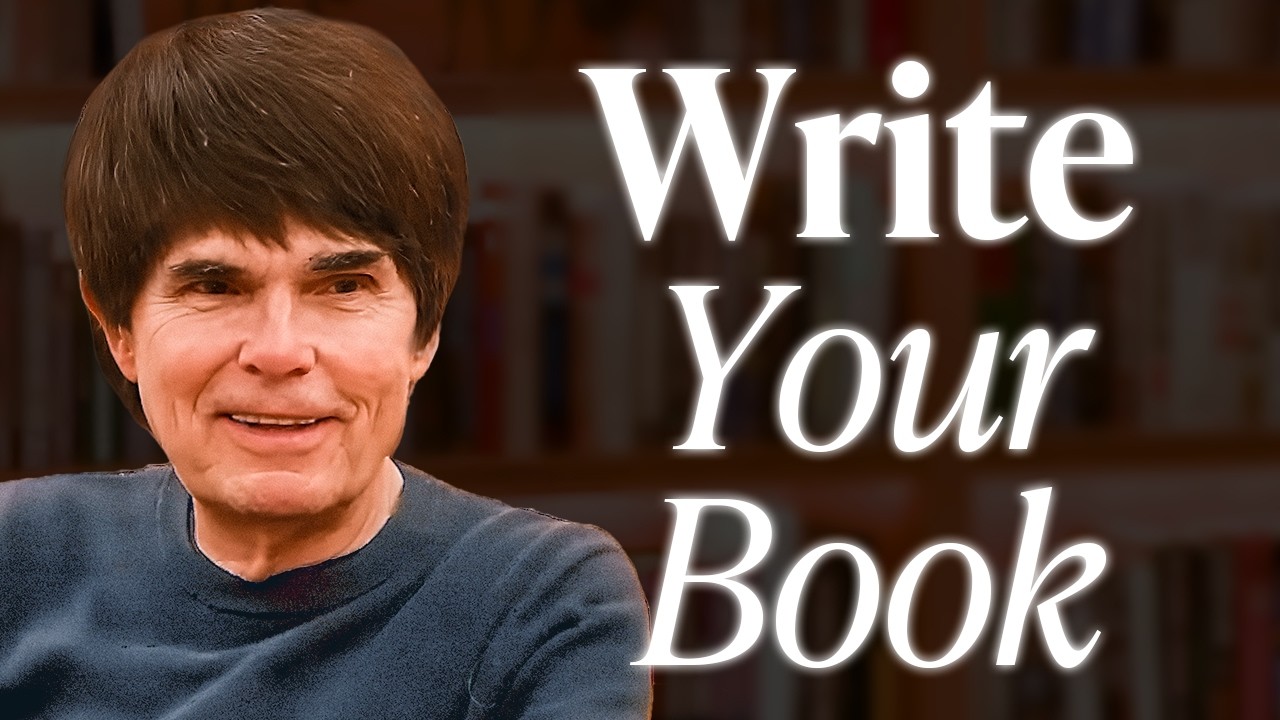
Dean Koontz is one of the best-selling authors in history — over 100 books, more than 500 million copies sold — but what sets him apart from most mass-market writers is his obsessive devotion to craft, language, and the deeper mysteries of existence. This conversation, held in his art deco and Japanese-influenced home library, covers his creative process, the role of self-doubt, how childhood trauma shaped his fiction, where ideas come from, and why he believes metaphysics — the deep mystery of being — is the central issue of any writer’s career.
Why He Stopped Outlining and Let Characters Lead
Koontz used to outline his novels because publishers expected it and would pay half the advance on the outline alone. But he found that creativity inevitably produced ideas better than the outline, and publishers were disappointed when the finished book diverged from what they’d approved. He realized the process was a dead end.
He stopped outlining entirely and began letting characters drive the story. He describes giving characters “free will” — not in a literal sense, but by refusing to predetermine their choices and instead listening to what they seem to want to do. When a character surprises him with a line or action he didn’t plan, he’s learned to trust that instinct rather than force the story back on its original track.
This approach means he often doesn’t know where a book is going. He describes it as a conversation with his subconscious. The characters do things he would have never contemplated, and it always leads to a better novel.
His Writing Process: Page by Page, Never Looking Back
Koontz writes one page at a time, polishing each to what he considers perfection before moving on. He does 10 to 20 drafts per page. He never writes a full draft and then revises — the revision is built into the daily process.
After finishing a chapter, he prints it out and reads it on paper, catching things he can’t see on screen. But once a chapter is done, he rarely goes back. He compares building a novel to a coral reef — each page is layered on top of the last, and the structure grows organically.
He still experiences intense self-doubt with every book. He says he’s never gotten rid of it. The doubt is what drives him to polish each page so relentlessly.
Creating a Character With a 75 IQ
His most recent novel features a narrator with an IQ of about 75 who cannot read or write — the entire book is him speaking his story into a machine. Koontz had to invent a syntax and grammar consistent with the character’s cognitive level while still making the prose fluid and enchanting for the reader.
The voice uses nonstandard grammar and tense, but it’s consistent, and the goal was for readers to fall into it effortlessly. The character, despite his limitations, becomes one of the wisest people in the novel — he enchants people and changes lives without fully understanding how.
Koontz read extensively about people in similar life situations and drew on the idea that even lives that seem inconsequential have profound meaning and effect. The character’s mother teaches him a philosophy rooted in a chicken metaphor — chickens keep laying eggs even when they’re taken, never knowing why, and the lesson is that you must seek the “why” of things, even when it makes you sad, because you can’t know happiness without knowing sadness.
The key rule: you never laugh at the character. You laugh with him, even in the sadness of his condition.
How Childhood Trauma Shaped His Writing
Koontz grew up in poverty with an alcoholic, violent father who held 44 jobs in 34 years and a sickly mother. He initially thought the violence and poverty were what shaped him most, but in his 40s he had an epiphany: the most powerful effect was the constant humiliation of being the town drunk’s son in a small town where everyone knew.
That humiliation drove him inward. He grew up mostly internal, with few friends, watching the world more than participating in it. He believes this inwardness is what allowed him to see the strangeness and mystery in everyday life that others miss.
His father was eventually diagnosed as both borderline schizophrenic and sociopathic. Koontz says this gave him an intimate understanding of sociopathic psychology, which has been invaluable for writing villains. He calls it, in the strangest way, part of the gift.
He didn’t speak about his childhood publicly for decades. When he finally did, he received thousands of letters from people with similar backgrounds asking how he got past it. His answer: “You have to get past it or the bastard won.” He was motivated by refusing to let his father’s destruction of their family be the final word.
He sees his life story — the suffering and the moments of mystery and enchantment — as combining directly in his work. His characters are rarely special agents or people with power. They are bartenders, fry cooks, people with low IQs who carry strange wisdom. He believes that’s where a lot of good in the world actually comes from.
Where Ideas Come From
Some ideas have clear origins. His novel Life Expectancy came from a single line in a Paul Simon song — “My life is made of patterns that can scarcely be controlled” — that struck him like an arrow while driving home from a bad studio meeting. He had the entire concept within 15 minutes.
Other ideas are completely inexplicable. The character Odd Thomas came to him unbidden: “My name is Odd Thomas. I lead an unusual life.” He wrote 30 pages by hand — something he’d never done before or since — and it became the first chapter of a series that grew to eight novels.
Two novels came from dreams. Others arrive at the keyboard without warning. He describes the process as mysterious and one of the most exciting parts of writing.
He believes ideas are given to writers from somewhere beyond conscious control, and the writer’s job is to be a steward of those ideas — to develop them with discipline and craft once they arrive.
Why Character Matters More Than Plot
Koontz believes character is the center of good fiction. A great plot is important, but a mediocre plot with great characters can still be a huge success.
Odd Thomas — a fry cook who sees dead people and lives a quiet life of service — was so unusual that his publisher initially hated the book and refused to discuss it directly with Koontz. But booksellers and readers loved it, and the publisher eventually admitted he was wrong.
He doesn’t write characters with obvious dramatic flaws (like alcoholism) just to make them interesting. His characters’ flaws are more subtle and human — naivete, excessive humility, inexperience. Odd Thomas gets into trouble repeatedly because he’s almost too naive.
He believes great characters are built from recognizable human qualities that make readers care about what happens to them. Without that care, suspense doesn’t work.
What Builds Real Suspense
Koontz doesn’t think much about suspense as a technique — it comes naturally from caring about the character and not knowing where the story is going. He believes suspense is one of the key elements of all good fiction, including literary fiction, because suspense is the key element of life itself: we never know what will happen between now and tomorrow.
He doesn’t like plot twists that come out of nowhere. A good twist is one where the reader looks back and says, “I should have seen that coming.”
He often hides things about a character — sometimes the character is hiding things from themselves — and the gradual revelation of those hidden elements creates suspense.
His novel Intensity is a masterclass in sustained suspense: a woman hides in a motor home with a killer who doesn’t know she’s there, escapes into a convenience store, and then the killer comes in and kills the clerks. She has a moral choice — leave and save herself, or go back and try to rescue a girl the killer has imprisoned in his basement. The suspense comes entirely from the character’s decision, which Koontz didn’t know she’d face until he wrote himself into that corner.
The Four Rules of Writing
Never go inside more than one character’s mind in a scene. Each scene has a single viewpoint. Koontz believes head-hopping destroys the illusion of reality and turns the author into a puppet master. Staying in one character’s head forces intimacy and makes the writer live within the character rather than manipulate them.
Metaphors should seduce, not dazzle. A metaphor should draw the reader into a more intimate relationship with the story, not call attention to itself as a display of cleverness. If a metaphor pops out too far, it breaks the spell.
Every figure of speech must be consistent with the mood of the scene. If a scene is tense, the metaphors should carry tension. If the scene is humorous, the language can be lighter. This becomes especially difficult when trying to sustain both suspense and humor simultaneously.
Metaphors and similes describe a scene more colorfully than adjectives and reinforce mood. Instead of saying “the scene was bathed in moonlight,” a metaphor can create a state of mind — the moon’s face wrapped in clouds that unravel like mummy wrappings. This is what poetry does: using words to say more than the word itself says.
How Faith and Science Intersect in His Work
Koontz reads extensively in science — quantum mechanics, molecular biology — and finds that the deeper science goes, the more mysterious and creative the universe appears. He knows scientists privately acknowledge this but won’t say so publicly because careers are on the line.
He references Stephen Meyer’s work arguing that science, properly understood, points to a world far more complex than numbers and formulas can capture. The human cell, which Darwin thought was a simple blob, contains thousands of interdependent parts that couldn’t have evolved incrementally because the cell doesn’t function without all of them simultaneously — a concept called irreducible complexity.
He sees no conflict between faith and reason. To him, the mystery of existence is self-evident, and anyone who has experienced the strange, unexplainable moments in life — moments where things click into place against all probability — would be foolish to conclude there’s nothing going on.
His faith isn’t didactic in his fiction. He doesn’t preach. But it opens him to the idea that every life is a journey toward something meaningful, and that sense of meaning and mystery permeates his work.
Self-Doubt as a Writer’s Tool
Despite loving the writing process, Koontz still experiences intense self-doubt with every book. He believes self-doubt is actually a useful tool — without it, he might see every word he writes as golden and stop improving.
He thinks all writer’s block is ultimately self-doubt. The doubt he feels is specifically: “I can’t do this as well as I want to, and I’m going to make a fool of myself.” He traces this back to the constant humiliation of his childhood — he never wants to humiliate himself again.
Paradoxically, he consistently chooses projects that carry a high risk of failure — projects his professional life tells him will make him look foolish. He’s drawn to that risk because the challenge is what makes writing exciting.
Authors Who Influenced Him
John D. MacDonald was the first writer who showed Koontz that character can be as interesting as plot. MacDonald would spend five pages on a character’s backstory in the middle of a suspense novel, and what seemed like a detour would become as gripping as the main storyline. His books are among the best fictional records of mid-20th-century American life.
T.S. Eliot taught Koontz about the depth hidden within surface language. He can read Eliot’s poems a hundred times and find something new on the 101st reading. He’s drawn to Eliot’s surrender to the way of the world — the acceptance that life is problematic, we fail, but going on is the purpose. The line “We must be still and still moving” captures Koontz’s own disposition: remarkably peaceful yet incredibly prolific.
Ray Bradbury gave Koontz permission to use colorful, flowery language without fear. Bradbury wrote in a state of joy, and Koontz believes joy is essential to good writing. Bradbury’s sign — “Don’t think” — and his insistence on surprising himself at the page resonate deeply with Koontz’s own process of surrendering to the subconscious.
Charles Dickens wasn’t afraid of genuine sentiment. Koontz distinguishes between sentiment (which connects us to the feelings and hopes of other people) and sentimentality (which goes so far over the top it becomes manipulative). He believes much of modern fiction has stripped out sentiment entirely, resulting in cold, clear prose that doesn’t move people or inspire them to deal with their own lives. The ending of A Tale of Two Cities — Sydney Carton’s sacrifice at the guillotine — is the most emotional ending he can think of.
How His Home and Aesthetic Shape His Creativity
Koontz’s home is filled with art deco design, Japanese and Chinese art, and collections like vintage art deco radios. He grew up surrounded by ugliness and poverty and developed a deep yearning for beauty.
He believes the plainness of contemporary life is destructive to the soul. Surrounding himself with beautiful, peaceful things calms him and gives him a sense of continuity, reason, and meaning. Walking past these objects throughout the day puts him in a better state for writing.
He’s currently taking notes for a potential book about why and how he writes, which would explore the contrast between his father’s deeply dysfunctional family — two brothers who committed suicide, a grandmother whose Christian Science beliefs led to her son’s death from untreated appendicitis — and the beauty and meaning he’s built in his own life.
Why Metaphysics Is the Central Issue of a Writer’s Career
Koontz believes that if a writer’s core conviction is that life has no meaning, they really only have one book to write — and once they’ve said it, there’s nowhere else to go. By contrast, the awareness that life contains deep mystery makes every character’s story a great adventure toward something meaningful.
He’s experienced genuinely unexplainable events in his own life — including standing next to someone who was shot and killed, then having the gun turned on him, only for the shooter to walk away without pulling the trigger. These experiences, and the countless synchronicities he’s noticed, have convinced him that reality is far stranger than we normally perceive.
The more aware he becomes of these mysteries, the more they seem to happen. This awareness inevitably carries into his fiction and sometimes takes readers to places they’re not comfortable going — as with his novel Breathless, which some readers loved and others found too far out there.
He’s concerned about the future — social media’s destructiveness, AI’s threat to people’s self-esteem and livelihoods — but his fundamental orientation remains one of wonder and meaning. For Koontz, the mystery of existence isn’t a problem to be solved. It’s the ink in his pen.