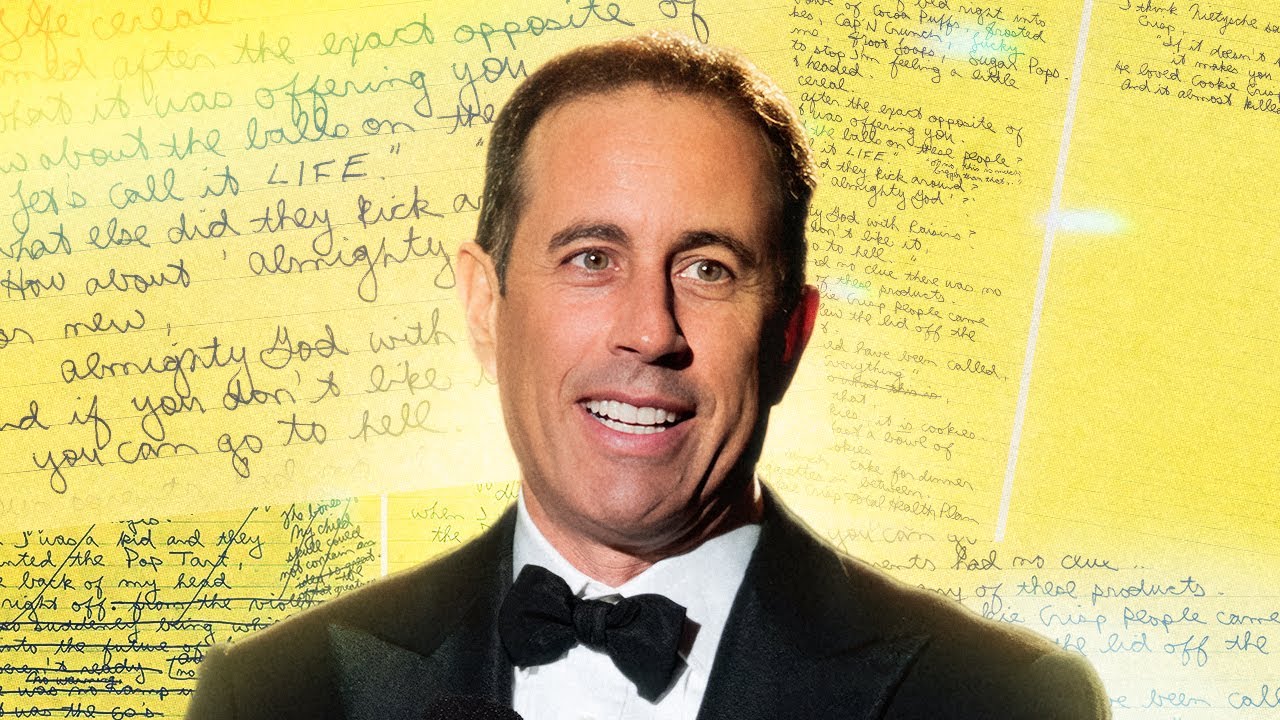
- Jerry Seinfeld is a writer first, comedian second — and his 50-year career offers concrete lessons for anyone who writes. He wrote every joke by hand on yellow legal pads, refined obsessively, and built a body of work that earned 10 Emmys, over $3 billion in revenue, and a spot among the few billionaire comedians. What makes him unusual among top performers is that he openly discusses craft. This episode breaks down what Seinfeld has learned about two things: getting writing done, and making it good.
Getting It Done
-
Embrace the difficulty of writing — Writing is supposed to be hard. Seinfeld’s message to his own daughter when she complained about how hard writing was: “Of course it is. Get over it.” The problem isn’t that writing is difficult; the problem is that people expect it to be easy and quit when it isn’t. His billboard message for the world would be two words: “Just work.” He says people tell you writing should come naturally — “Nobody can do it. It’s impossible. The greatest people in the world can’t do it.” Accepting that upfront is the foundation for everything else.
-
There’s no such thing as writer’s block — time box your writing instead — Even after 50 years, Seinfeld has days where he doesn’t feel like writing. His solution is to commit to a set, limited time — 15 minutes, 30 minutes, an hour. The key is having an end time, a reward for sitting down and doing nothing but working on the problem. When the alarm goes off, you’re done. This mirrors how personal trainers work: knowing the session has a hard stop lets you push through resistance. John Steinbeck kept a journal during East of Eden that repeatedly said “got nothing done today” — but he showed up. That’s the point.
-
Don’t break the chain — Early in his career, Seinfeld told a young comedian named Brad Isaac to get a wall calendar with the full year on one page and a big red marker. Every day you write, put an X over that day. After a few days you have a chain. Your only job is not to break it. James Clear observed that Seinfeld gave no advice about what words to use or how to be funny — the advice was entirely about showing up consistently. The results follow the reps.
-
Distraction is the enemy — There are two kinds. The small kind: checking email, Twitter, texts, Slack, WhatsApp — the dopamine loop of “checking” that fragments your focus while you’re supposed to be writing. The big kind: parties, media events, schmoozing, speaking opportunities, and administrative work that pull you away from the actual work once you become successful. Seinfeld and Larry David spent 99% of their time writing together behind a closed door, ignoring the outside world. When Harvard Business Review asked if a consulting firm could have helped them find a more sustainable model, Seinfeld asked if they were funny, and when told no, said: “Then I don’t need them. If you’re efficient, you’re doing it the wrong way. The right way is the hard way.”
-
Fail doing exactly what you want to do — Dave Letterman told Seinfeld this when Seinfeld was nervous about writing his NBC pilot: “Just make sure you fail doing exactly what you want to do.” The point is that creative people have a vision not just for what they want to achieve but how they want to do it. If you compromise that vision to avoid failure, the regret is worse than the failure itself. A CEO mentor in the episode described it this way: people would rather be on your boat rowing off a cliff following your vision than be in a safe boat going nowhere. Accepting failure from the beginning eliminates regret and frees you to focus on genuine creative expression.
Making It Good
-
The work never stops — Seinfeld is always working on material, even at dinner with his family. “Every second of my existence I’m thinking: could I do something with that?” He describes it as a tortured life, but says the blessing is finding the torture you’re comfortable with. A comedian friend of the host’s pulled out a notebook at the symphony during a moment of belly laughter and started breaking down why the joke worked — switching instantly from intuitive, right-brain mode to analytical, left-brain mode. That’s the skill: recognizing when you’ve stumbled onto something good, then dissecting it.
-
Talk through your ideas and get feedback — Seinfeld’s writing process begins away from the page, in conversations with other comedians. The host calls this “writing from conversation.” You can’t know if your ideas are worthy in isolation — you need to put them in front of people and watch their reactions. Look for what makes their eyes light up (double down), what confuses them (rewrite), and what bores them (cut). Comedians have the advantage of instant feedback on stage — silence tells you immediately what isn’t working. Writers can replicate this by talking about ideas at lunch, on walks, at coffee chats. The host’s key insight: if you’re not writing because you don’t have good ideas, you have it backwards. Write consistently first, and good ideas emerge from the volume of reps.
-
Don’t write and edit at the same time — Seinfeld describes treating yourself like two people: first a nurturing, loving parent (the “baby phase” — free play, no judgment, just get ideas down), then a harsh drill sergeant (the “officer phase” — red-pen everything, demand excellence, cut what doesn’t work). These two modes cannot operate simultaneously. The host’s practice: mornings at his desk are for creating (baby phase); evenings on the couch with less caffeine are for editing (officer phase). For his show Comedians in Cars Getting Coffee, Seinfeld would produce an original edit of an hour and a half, then cut it down to 20 minutes. The creative process always requires both phases, in sequence.
-
Not everybody’s going to like it, and that’s the point — Writer’s block often comes from having “the voice of a thousand critical readers in your head” while trying to write. Seinfeld reads bad reviews because he finds them funny. The host’s goal with the How I Write podcast is to make something most people don’t like, so that the “wackos obsessed with writing” can have something they adore. Trying to make something everyone likes suffocates creative expression. When you accept that not everyone will resonate with your work, and you have inner conviction that what you’re doing is honest and quality, you can enter a creative flow state. The moment you’re trapped by the audience’s judgment, the flow stops.
-
Dosage: leave them wanting more — Seinfeld’s concept of dosage is about restricting supply to only what is excellent. The best comedian in the world can leave an audience happy with 70 minutes — stretch it to 90 and the reaction goes from “wow” to “meh.” A small amount of too much changes the whole feeling. This is why Seinfeld ended his show after nine seasons despite NBC offering $110 million for a tenth: “A small amount of too much changes the whole feeling about it. I wanted to end the show with a feeling of: it was never bad.” Seinfeld is the only long-running TV show whose final season ended in the top 20% of IMDB ratings. This isn’t about being short — it’s about finding the right amount of dosage for whatever you’re making and never letting people get bored.