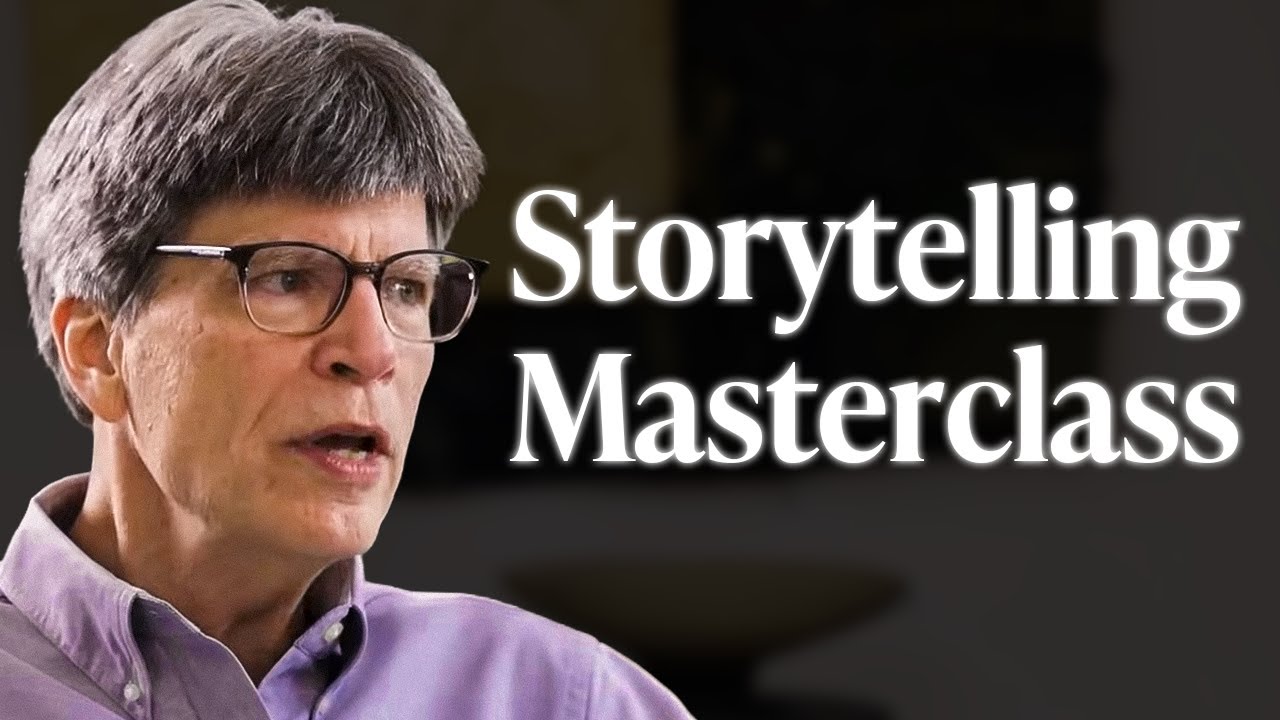
Richard Powers, Pulitzer Prize-winning author of The Overstory, discusses the craft of writing with a focus on how character, drama, voice, and descriptive language work together to create fiction that feels alive. He draws on decades of experience and teaching to break down the mechanics of storytelling, from the inner psychology of characters to the musicality of sentences, and explains how his own process has evolved from disciplined word-count goals to a practice rooted in deep engagement with the natural world.
Character as the Engine of Drama
Powers teaches character using a layered “onion” model derived from Stanislavski’s method of acting:
Outer layer: visible traits—what a character looks like, how they dress, their mannerisms.
Mannerisms: behavioral habits that signal something deeper, like a character who habitually challenges others by asking “What do you mean by that?”
Core inner values: the deepest layer—abstract principles like honesty, fidelity, perseverance, equality, or freedom that drive a character’s choices.
The key to drama is forcing a character to choose between two core values that have come into conflict:
Example: a character who values both honesty and loyalty must decide whether to report a friend’s wrongdoing or stand by them.
This creates interior drama—“man versus himself”—the psychological novel.
When two characters with different core values collide, you get interpersonal drama—“man versus man”—the sociological or political novel:
Powers gives the example of two friends, one who values equality and one who values freedom, facing an election where they must choose opposing candidates. The reader is left to decide who is right.
The third and often-neglected level is environmental or metaphysical drama—“man versus nature”:
Human desires and projects may be at odds with the larger living world, which is either hostile, indifferent, or sympathetic to human aims.
Powers argues that literary fiction from the mid-20th century onward largely abandoned this third type of drama, focusing exclusively on psychology and sociology as if humans existed independently of the natural world.
He traces the disappearance to a cultural belief that technology had “defeated” nature, making that conflict seem quaint—a belief now reversing as climate change and species extinction bring the drama back.
Character Relationships and Personal History
Powers creates characters by drawing on his own unresolved personal history, using them almost psychoanalytically:
In Playground, two central protagonists—Todd Keane, a privileged white Northsider from Chicago, and Rafi, a young Black man from the South Side—serve as alter egos through which Powers worked through unfinished drama from his own youth.
Their friendship is tight and dedicated but also competitive, weary, and laced with the kind of relentless ribbing males direct at each other.
He maintains an ongoing intimate relationship with his characters even after a book is finished, feeling a sense of responsibility toward them: “Did I do right by them? Was there something else they wanted or needed that I didn’t get to?”
Voice and the Mechanics of Language
Voice drives character, and voice is driven by two levels of craft:
Register and diction: the choice of words along a spectrum from casual/slangy to formal. English offers a built-in bilingualism because of its dual Anglo-Saxon and Latinate/French origins:
“House” (Anglo-Saxon) vs. “mansion” (Latinate) carry different socioeconomic signals.
“Freedom” (Anglo-Saxon) vs. “liberty” (Latinate) sound different to the ear.
Understanding this gives a writer power to signal class, tone, and identity through word choice alone.
Syntax and sentence structure: Powers reduces English sentence craft to three basic types based on where the main subject and verb (the “predication”) appear:
Front-loaded: subject and verb come first, delivering immediate impact. Example: “He pointed the gun at his friend.”
Delayed predication: modifiers come first, building suspense. Example: “Way back across the yard, near the fence where a tiny brook ran along an old hedge—she hid.” The reader waits for the subject, mirroring the character’s physical hiding.
Split predication: subject appears early, verb comes late, with material inserted between. This can create suspense or comedy and is the rarest form. Changing sentence type within a paragraph works like a key change in music.
Writing Descriptively Without Overdoing It
Powers’s approach to description involves subtle anthropomorphism and animism—projecting life and agency onto non-human things:
Example from The Overstory: “Each child’s tree has its own excellence: the ash’s diamond-shaped bark, the walnut’s long compound leaves, the maple’s shower of helicopters, the vase-like spread of elm, the ironwood’s fluted muscle.”
The word “excellence” at the end is a registral surprise—not a word one would expect applied to a tree—raising tension and inviting the reader to see the tree as possessing a quality of greatness.
“The ironwood’s fluted muscle” subtly animates the tree trunk, making it resemble a flexing weightlifter.
He encourages writers to “try hard” in first drafts, making their intentions explicit, then editing to hide the footwork and make the prose feel effortless in revision.
The Emotional Power of Fiction
Powers distinguishes between intellectual apprehension of facts and emotional shift in values:
A reader can grasp scientific facts about forests intellectually from a popular science book, but fiction uniquely moves readers through identification and empathy.
He cites experiments showing that people who read a moving fictional story are significantly more likely to help a stranger (someone who drops their belongings) immediately afterward, compared to those who read neutral or purely factual texts.
Fiction’s power lies in inviting the reader to ask: “Who would I be if I were that person?”—and that act alone increases empathy and prosocial behavior.
Rhythm, Rewriting, and the Moving Target of Craft
Powers is deeply attentive to rhythm and pacing at every level—word, sentence, scene, and overall structure.
He rewrites continuously and obsessively, often 12 or 14 times for a passage, and still wants to change published work when reading from it publicly.
He reframes frustration and the sense of “not getting it right” as a feature, not a bug: “You are a moving target. Your reader is a moving target. The world is a moving target.”
His advice: relax, forgive yourself, go for a hike, stand in front of a tree—let the writing breathe rather than forcing it into a final perfect state.
Tension as the Basis of Structure
All three types of drama (interior, interpersonal, environmental) involve tension—the variable that rises and falls throughout a story.
Powers teaches a four-part tension graph:
Hook: artificially elevated tension at the start to draw the reader in.
Exposition: tension relaxes slightly so the reader can learn who the characters are, what’s at stake, and where they come from.
Rising action: the long middle section where stakes escalate. Each solved problem creates larger instabilities, raising tension up a ladder toward the ultimate dramatic conflict.
Climax and dénouement: the peak of tension where characters make irreversible choices revealing their core inner values, followed by the “untying”—showing how those characters and their world are now different.
Humans intuitively expect tension to rise (a story where the prince kills the hardest dragon first, then progressively easier ones, feels wrong), suggesting this structure is rooted in our cognitive adaptation for narrative.
Dialogue: Stylized, Not Empirically Accurate
Real transcribed conversation is chaotic and incoherent on the page. Effective dialogue is highly stylized and manipulates the reader’s learned expectations for how fictional speech works.
Powers tests dialogue by reading it aloud, since most readers subvocalize when reading—the ear is the ultimate judge.
He admires varied practitioners:
Ann Patchett: her dialogue is so vivid and virtuosic that the performance disappears; you feel you’re overhearing real people.
Don DeLillo (White Noise): his dialogue is surreal and highly artificial, yet captures the absurdity of how people talk past each other with uncanny accuracy.
Introductions and Mythological Framing
Powers likes to open his novels with cosmic, mythological framing that establishes the largest possible canvas before zooming into the local story:
The Overstory: “First there was nothing, then there was everything.”
Playground: “Before the Earth, before the moon, before the stars, before the sun, before the sky, even before the sea, there was only time and Taroa.”
He compares this to cinematography—starting with a wide establishing shot, then moving to mid-shots and close-ups.
The Overstory opening line came from a dying poet friend’s last words, which Powers repurposed as a way to memorialize her.
He loves opening lines that contain the entire book in microcosm, citing examples like Romeo and Juliet’s “Two households, both alike in dignity” and Dickens’s “It was the best of times, it was the worst of times.”
The Fusion of Head and Heart
Powers rejects the idea that novels must be either intellectual or emotional, systematic or individual:
His goal is to write books that are “all-in-one”—where thinking and feeling, structure and sensation, science and spirit all pull in the same direction.
He describes the craft as getting all the “dogs in harness”—language, drama, character, form, structure—working in harmony so that higher-level effects emerge from lower-level choices.
Solitude, Engagement, and the Writing Process
Powers’s composition requires solitude to free his imagination from the overwhelming stimulus of the world:
He writes lying in bed, sometimes in the dark, dictating or using a pen, repurposing sensory apparatus that would otherwise be occupied by external input.
But sustained solitude alone is insufficient—he must re-engage with the world to test whether his creations resonate and feel true:
The creative rhythm is moving in and out of solitude: isolation to generate material, engagement to verify and correct it.
He uses different input tools (speech, handwriting, keyboard, typewriter) the way a musician chooses different instruments depending on the song—each tool has different affordances that allow access to different mental states.
Evolution of His Daily Practice
For the first 25–30 years of his career, Powers followed a strict discipline: write a thousand words every morning while his brain was freshest, minimizing interaction with the world until the quota was met.
His practice has fundamentally shifted. He now sees his primary job as being in the living world:
He starts each day by checking the weather and asking: “What’s going out there? At what elevation? Where’s the show? Where can I learn something?”
His accountability is to experience the nonhuman world deeply—walking trails, observing trees, being present.
Writing has become a supporting process: sentences and scenes arise naturally from this engagement, and he often finds himself miles down a trail needing to get home quickly before the ideas escape his memory.
This shift reflects his belief that attention and presence are the most profound sources of meaning, and that the granularity and pleasure of the world depend on slowing down and looking harder.