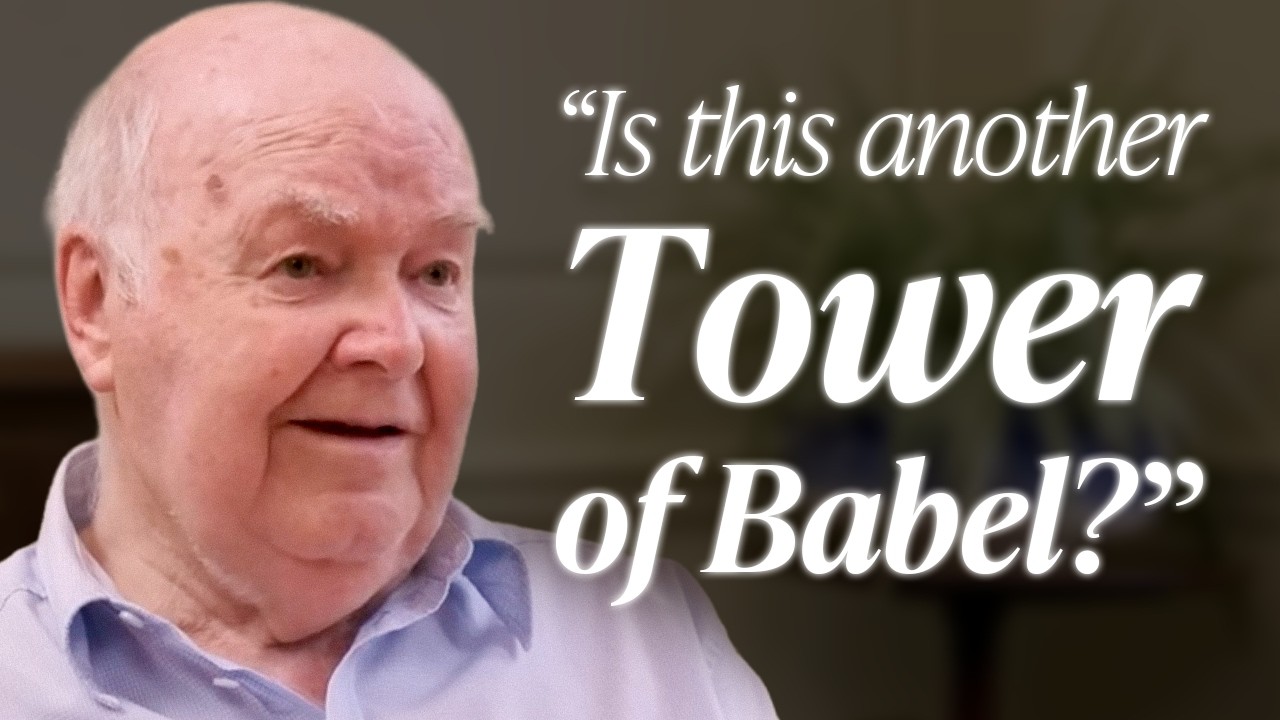
John Lennox, Oxford mathematician and Christian thinker, argues that the universe is fundamentally “word-based” — and that this points to a mind behind reality, not blind chance. He draws on his dual expertise in mathematics and biblical scholarship to explore how language, information, and meaning challenge materialistic worldviews, and how the rise of AI intensifies ancient questions about what it means to be human, who God is, and where meaning comes from.
The Universe Runs on Words — and Words Come From Minds
Mathematics is a language that precisely describes how the universe behaves, from Kepler and Newton to Maxwell and beyond. The fact that abstract mathematical structures map onto physical reality so perfectly is itself a deep mystery.
The human genome is the longest “word” ever discovered — 3.4 billion chemical letters that code for proteins and biological function. It operates exactly like a language with meaning.
In all human experience, words that carry meaning come from minds. A four-letter sign like “exit” above a door traces back to a mind that chose it. Yet when we encounter a 3.4-billion-letter word in DNA, materialists say it arose by “chance and necessity” — which Lennox calls nonsense.
The word-based nature of reality is why John 1:1 — “In the beginning was the Word” — is so theologically and philosophically profound. It aligns with what science actually discovers: the universe is structured by information and language, not just matter.
How to Read Scripture Like an Ancient Writer Intended
Lennox was mentored for 50 years by David Gooding, a world authority on the Septuagint (the Greek Old Testament), who taught him how biblical literature actually works.
Ancient writers didn’t use numbered chapters. They used repeated phrases as structural markers. In Matthew’s Gospel, variations of “when Jesus had finished these sayings” divide the text into major sections.
Within each section, the key discipline is to first ask “What does it say?” before asking “What does it means?” Most misinterpretations of scripture come from skipping observation and jumping straight to application.
Thought flow matters: each passage contributes to a cumulative argument. Understanding why something is placed where it is reveals the author’s intent.
This method transformed Lennox’s reading of the Bible at age 18 and has shaped his entire career.
How Do We Know Scripture Is God-Breathed?
Lennox distinguishes between knowing about scripture through historical evidence and knowing God through scripture. Both matter, but the higher level is God authenticating himself through the text to those who take it seriously.
He recounts his mentor’s challenge: “Why do you study scripture?” The answer wasn’t “to prepare talks” but “to get to know God” — a fundamentally different posture.
Jesus told Philip, “He who has seen me has seen the Father” — indicating that Jesus’ words are the Father speaking. This is the model for how scripture works: God speaks through his Word.
The experience of sensing God speak through scripture is difficult to define — like defining beauty — but recognizable when it happens. Self-deception is possible, but maturity and judgment are the safeguards.
Wonder, Explanation, and the Limits of Materialism
Lennox argues that materialism closes down wonder by insisting on only one level of explanation. But explanation operates at many levels that are complementary, not competing.
Science explains how things work; agency-based explanations explain why they exist. Physics explains a car engine; Henry Ford explains the car. These don’t conflict — they complement.
Even scientific explanations are incomplete. Newton’s law of gravity describes gravity’s effects but doesn’t explain what gravity is. Nobody does. Claiming to have “the explanation” that excludes God is, in Lennox’s word, “stupid.”
The Enlightenment elevated reason but also saw anti-scientific behavior from some Christians, which brought the “God hypothesis” into disrepute. The result is a culture that knows how almost everything works but understands the meaning of nothing.
Iain McGilchrist’s neuroscience thesis: the left brain analyzes what things are; the right brain perceives what things mean. Western culture has overdeveloped the left brain for 500 years, producing knowledge without meaning. The late Chief Rabbi Jonathan Sacks summarized it: “Science takes things apart to see how they work; religion puts them together to see what they mean.”
Information itself is not material — it’s carried on material substrates but is not reducible to them. This alone refutes materialism as a philosophy.
Poetry, Metaphor, and Why Style Matters as Much as Substance
God speaks in poetry and metaphor not as decoration but as a means of pointing to realities that literal language cannot capture. Metaphors are stepping stones to truths beyond literal description.
Many young people today lack training in grammar and figurative language, so they misread biblical symbols as “fantastical” or “meaningless.” CS Lewis taught Lennox that metaphors stand for realities — not literal things, but real things.
“I am the door” does not mean Jesus is made of wood. It means he is a real doorway into relationship with God. The word “literal” is nearly useless; what matters is whether something is real.
In Revelation, surreal images — eyes like flames of fire, a sword coming from Christ’s mouth — stand for specific realities. The sword represents the word of God as judge (a two-edged sword, per Hebrews 4:12). The eyes represent Christ seeing and evaluating the churches. Each symbol is interpreted by the text itself.
How to Write Well: Self-Criticism and Clarity
Lennox follows Richard Feynman’s principle: “The easiest person to fool is yourself.” He bends over backward to criticize his own work.
Two essential questions for every piece of writing:
How can this be understood?
How could this be misunderstood? — the more important question.
Example: Writing about “God as father” without acknowledging that some readers have traumatic father experiences will misfire. Anticipating misunderstanding forces clarity and compassion.
He submits his work to rigorous external editors before publication. His current autobiography is being shaped by a ruthless editor who catches episodic, shallow storytelling and demands depth.
The danger of autobiography is becoming a list of events (“I spoke in Leipzig, then Berlin, then Kenets”) without meaningful narrative. Specific, individual moments must flesh out the story.
AI: Two Kinds, Two Very Different Risks
Narrow AI does one thing that normally requires human intelligence — like reading X-rays or folding proteins — and does it brilliantly. DeepMind’s protein-folding breakthrough solved in days what took PhD students five years. This kind of AI is a tool and largely beneficial.
The real fear among AI thought leaders is about the “control problem” — losing understanding of or control over advanced systems. Figures like Geoffrey Hinton (the “godfather of AI”), Max Tegmark, and Elon Musk have warned of serious danger on short time scales.
Max Tegmark’s Life 3.0 describes a scenario where AI leverages global systems to create a totalitarian world government — citizens wear surveillance bracelets, dissenters are killed by injected toxins. Lennox notes this parallels Revelation’s beast/monopoly system: no one can buy or sell without the mark, and dissenters are killed.
Peter Thiel confirmed to Lennox that he sees technology moving toward totalitarianism and that biblical parallels give it added credibility.
Lennox’s point is not to identify the beast with a specific technology but to say: if secular thinkers take these scenarios seriously, why not take the biblical account seriously too — especially given its far greater track record of insight?
The AI Race Is Really the Race to Make God
The deeper trajectory of AI is what Lennox calls “making God” — humanity’s attempt to become divine. This happens two ways:
Enhancing existing humans through genetic re-engineering.
Building non-biological superintelligence from silicon or other substrates.
This is a new Tower of Babel — a towering human ego reaching for heaven. As Lennox notes from his research on skyscrapers: “Behind every skyscraper there’s an even greater ego.”
Scripture tells us the beast (Revelation’s “monster”) is not an abstract system but a human being — “the number of a man” (666). Paul calls him the “man of lawlessness” who claims to be God (2 Thessalonians 2). The horror is that this is a person, not a machine.
The great irony: the AI race aims to make God, but the biblical story is that God became human. The directions are opposite.
Psalm 115:8 applies: “Those who make them become like them.” Humans making AI in their own image — not God’s — is idolatry.
What It Means to Be Human in the Age of AI
Lennox was originally drawn into AI discussions when asked to speak to Christian leaders on “what Genesis says about being human.” That preparation led to his book 2084.
CS Lewis saw this trajectory decades ago. In The Abolition of Man and That Hideous Strength, he warned that humanity’s final triumph would be the abolition of man — producing not humans but artifacts by tampering with the germline.
Genesis 1:26 — “Let us make man in our image” — undergirds all of Western civilization’s moral framework. Humans are more important than stars. This is the capital we’re still spending.
The drivers of superintelligence are often explicitly atheist, attacking God’s uniqueness, creative dignity, and glory. The original lie — “You shall be as God” (Genesis 3) — is the root of the entire project.
Lennox criticizes the famous “Snake Path” at UC San Diego, a sculpture leading from a Garden of Eden to a university library, celebrating the serpent’s message as liberation through knowledge. He calls it a blatant misunderstanding: the tree was not “the tree of knowledge” (the garden was full of knowledge — science started there with naming animals) but “the tree of knowledge of good and evil” — a knowledge humanity was not meant to have.
How Should Christians Engage AI?
Lennox uses AI tools like anyone with a smartphone does — they’re unavoidable. AI can be a servant rather than a master.
He finds ChatGPT useful for collecting ideas and surfacing knowledge, but warns it hallucinates and invents to please the user. Checking is essential.
The danger is not the tool but the posture: a pastor generating a sermon on ChatGPT at midnight after watching a film is unlikely to produce anything with spiritual power. The machine has no spirit.
AI simulates intelligence but is not conscious, and likely never will be — because nobody understands what consciousness is. God joined intelligence with consciousness in humans; machines lack both genuine intelligence and consciousness.
The most urgent problem is deception — deepfakes and the erosion of truth. Jesus warned that deception would characterize the end times. The “five eyes” intelligence alliance has warned that AI-generated deception could cause global chaos.
Lennox’s prescription: scientifically minded Christians should enter the AI field and sit at the ethics table. Technology moves faster than ethics, and the driving attitude — “if we can do it, we should” — is the dangerous “we shall be as gods” impulse. Christians need to be in the room.
How to Improve as a Writer and Thinker
You learn to write by writing — not by taking courses about writing. The same goes for studying scripture: you learn by doing it with someone, not by being told how.
Improvement comes from experience, external criticism, reading good literature, and listening more than talking. Lennox was told he has two ears and one mouth for a reason.
CS Lewis is Lennox’s standard for prose. Reading Lewis is a humbling mirror — his use of metaphor, illustration, and clarity is sheer genius.
The core lesson from Lewis: metaphors stand for reality. “My heart is broken” refers to a real experience, not a literal pump. “The car was flying” means it was going fast. Once you grasp this, scripture’s symbolic language stops being confusing and starts being illuminating.