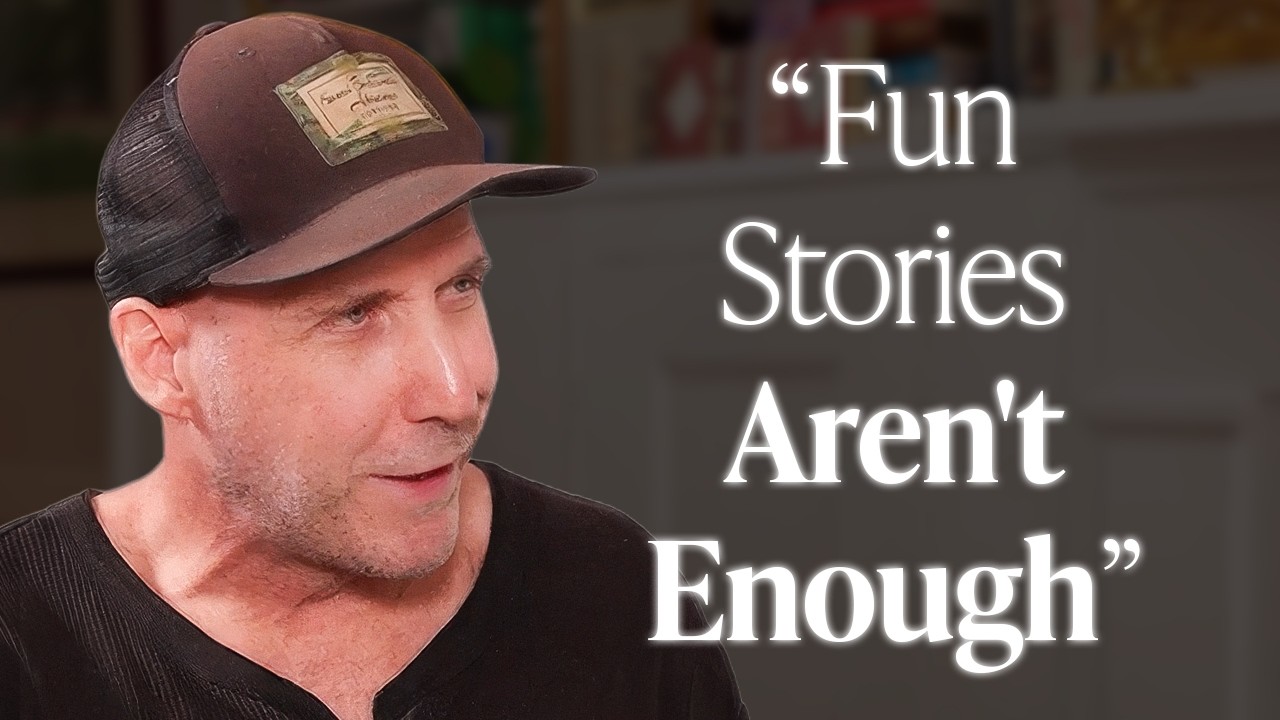
Michael Arndt, Academy Award-winning screenwriter (Little Miss Sunshine, Toy Story 3), breaks down the craft of storytelling through the lens of his time at Pixar, his script-doctoring work, and his study of narrative structure. He argues that great stories are built on an iterative, collaborative process, a clear understanding of three layers of stakes (external, internal, philosophical), and the discipline to make the audience care before the plot kicks in.
Pixar’s iterative, collaborative system
Pixar’s success comes from both the right people and a system that supports them: films go through seven or eight rough “reel” screenings over three years, each shown to expanding circles of fresh eyes, allowing the story to be beta-tested and refined.
The process is non-hierarchical and democratic: the director holds final authority but the “Braintrust” — a room of 25–30 trusted peers — offers ideas without ego; credit for ideas is deliberately blurred (“we came up with this”).
Sequences (25–30 per film) are built and finished non-sequentially; simple scenes lock first (e.g., Toy Story 3’s “Map Quest” sequence in 5–6 drafts), while exposition-heavy scenes take far longer (the staff meeting took ~60 drafts).
“Trust the process” is the cultural mantra: directors are told where they are in the three-year arc is normal, but there is real pressure — directors do get replaced if the story doesn’t come together.
John Lasseter’s genius in meetings: when a screening is a mess, he doesn’t list problems; he asks “Why do you want to make this movie?” and finds a detail he loves, then coaxes the emotional core out of the filmmaker to rebuild from there.
What makes a Pixar-level team creative instead of mediocre
Non-hierarchical, creatively democratic structure: good ideas can come from anywhere; the director curates rather than executes top-down notes from executives or marketing.
Soft taboo on claiming individual credit — ideas belong to the group, which kills ego and enables “half-ideas” to be completed by others (e.g., Spanish Buzz originated as a joke between Arndt and Andrew Stanton, then the room ran with it).
The system balances nurturing (“for where you are in the process, you’re fine”) with hard accountability (directors get fired; you must eventually deliver).
The hardest part of storytelling: distilling the “bumper sticker”
The biggest misconception: writers know what they want to say when they start. In reality, you write to find out; the “bumper sticker” (one-sentence thematic north star) emerges late and then guides every scene.
Little Miss Sunshine: “Fun is more important than winning” — the family loses the pageant but wins by dancing together.
Toy Story 3: “The impermanence of all things; the wisdom of letting go” — the most loving act is releasing someone so they can move on (Andy to college, Woody to Bonnie).
Andrew Stanton on WALL-E: “Irrational love defeats life’s programming.”
Bad writing costs more than good writing
Pixar spent three years on Toy Story 3; one year would’ve yielded a bad movie, two a B-minus, three the actual film. Good writing lasts; bad writing wastes $100M+ productions.
Studios hesitate to pay writers because payoff is uneven, but under-investing in development guarantees mediocrity.
Lessons from reading ~1,000 screenplays as a script reader
Two hallmarks of great scripts: specificity (real places, real characters, not “generic American city”) and authenticity (a real story, not an imitation of movie tropes).
Fake stories feel like “movie world”: shallow jerk learns obvious lesson, becomes decent; the meaning is a banal cliché. Real stories come from the writer’s backstage convictions — what they actually believe and risk expressing.
A great villain is the “centrifugal center”: they embody the quintessence of the story’s negative values and have a convincing worldview (e.g., Lotso in Toy Story 3: “Your kid will leave you; toys are trash” — he’s right at that moment). The villain doesn’t need to be powerful, just philosophically irrefutable.
Hero as antidote to a poisoned world
The hero and the world are two sides of the same coin: the world is flawed (greed, racism, repression), the villain represents the status quo/antidote to that flaw, and the hero becomes the antidote who tries to heal the system.
Katniss Everdeen: normal girl → Hunger Games inciting incident → becomes revolutionary antidote to Panem.
Robin Hood: ordinary nobleman → King John’s injustice radicalizes him → he becomes the antidote to abusive taxation.
Therapy movie (Finding Nemo): internal drama — Marlin’s trauma makes him overprotective; the journey forces him to let go.
War movie (hypothetical Warsaw ghetto girl): no internal flaw; external injustice creates a clear goal (kill Hitler); conflict is entirely outward.
Casablanca sits in the middle: external stakes (Nazis, war) + internal flaw (Rick’s cynicism).
First act problems cascade into acts two and three
Billy Wilder: “If you have a problem in the third act, the real problem is in the first act.” Arndt extends this: second-act confusion (what’s at stake? what am I rooting for?) almost always traces to insufficient setup.
First acts are deceptive: they’re automatically entertaining (new characters, new info), but they must also encode the entire DNA of the story — clear goal, clear plan, clear stakes — so the hero launches like a cannon at the act break.
The “roller coaster” analogy: Act 1 = clicking up the hill (stacking desire, passion, empathy); the crest = act break; the drop = Act 2. The critical job: get the audience in the car with the hero before the drop.
Audiences have a defensive barrier (“I’ve seen a million heroes”); the writer must actively earn empathy in the first 5–10 minutes — not presume it.
Counter to “start fast” advice: Tootsie’s inciting incident arrives at ~25 minutes; the first act builds a specific, sympathetic character (a working actor who just wants a job) so when the world crushes him, we care deeply.
Outdated Hollywood rules Arndt ignores
“Just make entertainment” — meaning is what makes stories last. Two engines of meaning: therapy model (heal internal wound) and competing value systems (dominant vs. underdog values collide at climax).
Insanely great ending: external, internal, and philosophical defeat flip to victory in ≤45 seconds (Little Miss Sunshine: they lose the pageant [external], the family fractures [internal], “winning is everything” seems proven [philosophical] → they dance together, losing spectacularly but joyfully, flipping all three).
Three stakes layers:
External: binary, world-level (blow up bridge / don’t; kill Hitler / don’t).
Internal: emotional (win love, respect, self-respect — Rocky, On the Waterfront).
Philosophical: clash of value systems (greed vs. generosity; winning vs. fun; safety vs. freedom). The villain articulates the dominant view (“This is how the world works; grow up”); the hero embodies the underdog view.
Earning emotion requires restraint: in Little Miss Sunshine, Dwayne’s meltdown is answered not by a speech but by Olive silently holding his hand — the writer paints themselves into a corner and lets the character’s simplicity resolve it.
Winning the Oscar & personal material as fuel
Terrifying: 45-second limit, memorized speech recited daily for a month; “don’t fuck up” loop walking to the stage.
The VW bus push-start came from Arndt’s dad (clutch broken, kids push, start in third gear); the stuck horn, the Maine setting — real humiliations turned into universal comedy.
Little Miss Sunshine was the 6th script; the first 5 were “imitation movies” (plot-first, not character-first). The slightness of the premise (road trip, pageant) forced character dialogue to carry the story — and it worked.
Writing as thinking (from his brother’s Philosophy of Writing)
Writing isn’t transcribing ideas; it’s a daily meditation that generates ideas and reveals who you are. Montaigne, Marcus Aurelius wrote to understand themselves.
Arndt didn’t know Grandpa was the Obi-Wan figure until a year after release; meaning emerges retroactively. Trust the gut, follow the characters.
AI will lower costs, not replace human voice
AI frees low-budget filmmakers from location/VFX constraints (e.g., Killing Satoshi shot on a gray stage in 20 days, 150 locations filled in later).
Flow (Oscar winner, $3.5M budget, made in Latvia) proves animated features can be made for 1% of Pixar’s cost → 100x more directing jobs, more creative freedom.
Audiences crave authenticity; AI handles the expensive “background,” humans supply the voice.
Japanese cinema (Ozu, Takahata) teaches gentleness & competing selflessness
My Neighbors the Yamadas: ordinary family, no high concept, but warmth and humor make every family story engaging — gave Arndt permission to write Little Miss Sunshine.
Late Spring (Ozu): daughter wants to stay (selfless), father insists she marry (selfless) — competing selflessness inverts Western “competing selfishness.” The ending is quiet, not a bang.
Lesson: you can hook an audience on the faintest wisp of story momentum; emotional depth comes from characters trying to out-give each other.
Diagnosing a broken story: stakes, organic logic, fairy-tale vocabulary
Three stakes questions: What’s at stake externally? Internally? Philosophically? Write down the worst possible outcome in all three — that’s your true low point.
Finding Nemo worst case: Nemo dies (external), Marlin never wins his love/respect (internal), Marlin stays overprotective (philosophical).
Organic logic / fairy-tale vocabulary (from David McKee):
Once upon a time (stable world, fixed expectations) → One day (inciting incident disrupts world/self/future) → And therefore (hero forms long-term goal + short-term plan = Act 1 break) → Suddenly (midpoint reversal) → And then there was no going back (Act 2 break = all-or-nothing stakes forced) → Climax (resolution).
Sharpen the “temple moments” (once upon a time, one day, and therefore, suddenly, no going back) — make each distinct, binary, and powerful.
Hero’s Journey: slightly overrated as a universal template; not every hero needs a flaw (Luke Skywalker isn’t flawed — the world is; he fixes it). Underrated for its organic logic about meaning and competing values.
Advice for beginners
Realistic expectations: Arndt wrote 11 scripts before selling one; William Goldman had ~15 unproduced scripts alongside his classics. Expect to write 50, sell 5, have 1 be good.
Humility: Kurosawa at 80 accepting honorary Oscar: “I don’t deserve this yet; I’m only beginning to understand movies.” Billy Wilder: “The audience individually are idiots; collectively, they’re a genius.” Respect the audience’s intelligence.
Craft takes ~10 years (like music or cooking). It’s a lifelong commitment, masochistic humility (“How can this be better?”), but if you love stories, “it beats working for a living.”
Stories are the most enduring human artifact — older than cathedrals, pyramids; Gilgamesh (3,000+ years), Shakespeare will outlast cities. We live in darkness; stories are how we make sense of ourselves.