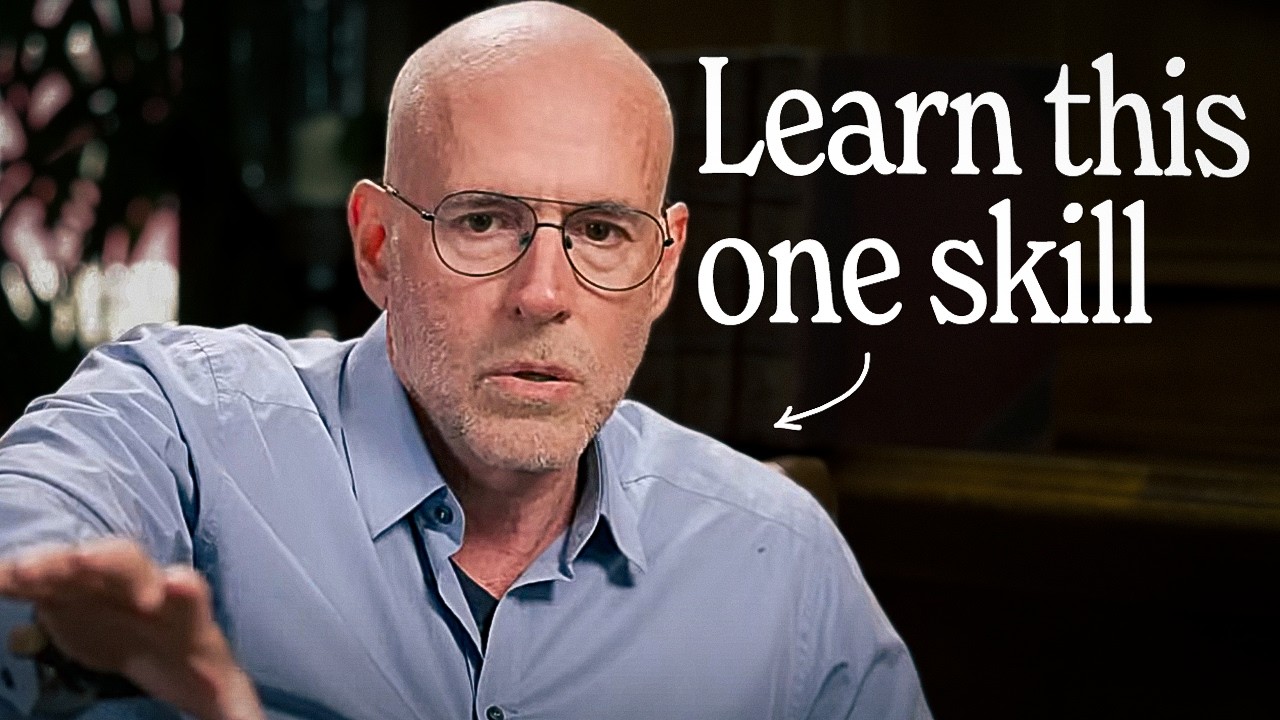
Scott Galloway — NYU professor, author, podcaster, and entrepreneur — is a master communicator whose style blends rapid-fire data, profane humor, vulnerability, and contrarian takes. This episode is a deep dive into how he constructs talks, writes books, builds narratives, and creates genuine connection with audiences. The core lesson: great communication is less about technique and more about fearlessness, preparation, and emotional honesty.
Writing and the creative process
Just start writing — Galloway wrote his first book at 52 and wishes he’d started 20 years earlier. The key is committing to a deadline and beginning, even if the first draft is rough. Most of the magic happens in editing.
Editing is where the work happens — He rarely writes alone anymore. He gives talking points to a team member who drafts 1,500 words, then he rewrites and refines. Very little he publishes isn’t touched and improved by someone else.
The “minor leagues” process for books — Before writing a book, he tests ideas through newsletters and short posts (a “petri dish”), then gives a talk. If the talk performs well on YouTube, he knows he’s onto something. His book The Four started as a talk at a conference called DLD that got 300–400,000 views on YouTube after music industry writer Bob Lefsetz endorsed it, which led to a book agent showing up at his office.
Books as franchises — He’s deliberately building a series (the “Algebra” series: Algebra of Happiness, Algebra of Wealth, Algebra of Masculinity, etc.) modeled on film franchises, committing to a three-book deal at one book every 18 months because he works best under deadline pressure.
How he constructs a talk
The slide deck as architecture — His talks are built around 148+ slides that serve as his outline and teleprompter. He skips slides that don’t fit the tempo. He finds it very difficult to speak without them.
Images over words — He replaces words with visuals wherever possible because humans interpret images 30–50 times faster than text. Every slide is stripped to the minimum number of words.
Choreography takes weeks — For a TED Talk, it’s 8–12 weeks of work: 2 weeks of creative labor, 6–10 weeks of an analyst assembling slides, then 2 weeks of fact-checking and QA. Even after slides are done, there are 2 full weeks dedicated to choreography — the order, pacing, dramatic pauses, and reveals.
Practice through teaching — He’s taught in front of 300 people twice a week for 22 years and does about 50 talks a year. This volume of live practice in front of college students (who visibly show boredom) is what gives him his rapid, confident pacing.
He doesn’t over-rehearse — The night before a talk, he clicks through slides in bed. He fumbles words and pauses slightly on purpose, which makes him come across as less rehearsed and more authentic.
Voice, authenticity, and fearlessness
Two blessings that enable authenticity — Economic security (he has all the money he’ll ever need) and unconditional love (people who adore him regardless). These give him the privilege and obligation to speak his mind without fear of being destroyed.
Writing for his sons — His mental trick: he writes as if the only audience is his boys when they’re 40 and he’s gone. He wants them to think “Dad was smart, Dad was fearless,” even if they think he was wrong about some things.
Atheism as liberation — He’s an atheist, and the belief that everyone will be dead soon is a huge source of courage. It doesn’t matter that much what people think. This lets him “squeeze the juice out of life” and say what he’s thinking.
A code for personal attacks — He speaks aggressively about people, but only those much more powerful than him. Otherwise he stays quiet. He never aims to be unkind, but he doesn’t avoid controversy.
Being a “class traitor” — He openly discusses his own wealth (e.g., making $16 million vs. a young person making $160,000) to argue for policy changes like lifting the Social Security tax cap. This gives him credibility to critique systems he benefits from.
Storytelling as the premier skill
Storytelling is the #1 skill — He’d teach his sons storytelling above anything else. Whether you’re Maya Angelou or Jeff Bezos, success comes down to the ability to convince, persuade, and move people.
Practice initiating with strangers — When his boys were young, he made them speak to strangers before entering any store. The key skill is learning how to open — how to start a conversation.
Anecdotes can be one sentence — A story in a talk or piece of writing doesn’t need to be long. A five-second anecdote creates life and connection. His team literally writes “Scott, personal anecdote needed here” in Google Docs.
Narrative over correctness — His objective isn’t to be right; it’s to catalyze a conversation. He’d rather be wrong and spark a debate about Social Security reform than be silent and “correct.”
Humor and emotional manipulation
Humor as a weapon — He won “most comical” in high school (the Steve Martin award). Humor softens the beach so you can invade with ideas. People are more open to having their ideas challenged when it’s couched in humor.
Interrupting the cadence — He’ll suddenly put up a random photo (e.g., Jeff Bezos and Lauren Sanchez mugshot), pause, let the audience laugh, then say “I just like this slide — it has no context.” This breaks tension and gives the audience permission to let their guard down.
Emotional manipulation is intentional — He’ll put up a picture of himself with his kids knowing it makes the audience like him more. He talks openly about missing his mother 20 years after her death, knowing it connects with men who have no other safe space to express such vulnerability.
Making people feel something beats any business insight — If you can make a dad in the audience pause and think about his relationship with his son, you’ve won. People want to feel sensation and emotion above all else.
Speaking vs. writing
Writing is harder for him — He finds writing the most difficult thing he does. A talk can be pulled together in a couple of days; a book is grueling. He’s now doing one every 18 months.
Writing allows more depth — In writing, you can disarticulate an argument more thoughtfully and go deeper. People give you more license because they’re sitting down, not at a conference competing with Netflix and TikTok.
Speaking requires entertainment — In a talk, you’re competing for attention against endless distractions. You have to keep them engaged like you’re speaking to an ADHD 12-year-old male.
Written word must be near-perfect — Poor syntax or tangents are forgiven in speech but not in writing. He edits aggressively, turning 1,800-word posts into 1,100 words, cutting all the filler (inspired by Steve Jobs telling Nike to “get rid of all the crap”).
Framing and perspective
Rotate the frame — His TED Talk on wealth transfer between young and old was bookended with the question “Do we love our children?” — taking a familiar idea and rotating it 20 degrees so people see it differently. At first the question seems stupid; by the end, it’s profound.
Slay sacred cows — He deliberately targets conventional wisdom (Social Security as a great program, tenure as necessary) to catalyze conversation. The goal isn’t to be right — it’s to start a dialogue.
“Blast radius” thinking — When he finds a striking data point (e.g., Nvidia adding the market cap of the entire global auto industry plus Sweden’s GDP since January), he asks: what’s the blast radius? What are the second- and third-order economic, cultural, and social effects? This one data point can generate a 30–60 minute talk.
Data as proof of work — Showing up with overwhelming data signals “this person did their homework.” It’s receipts, references, and rigor. Even though data can be framed, it’s not just a viewpoint — it’s grounded in facts.
Brand and visual identity
“Brand is Latin for irrational margin” — Brands tap into base, irrational instincts (mating, status, survival). Young people are the target because they’re in their mating years and make irrational purchasing decisions. Old people are terrible for brands because they get smart and stop overspending.
Visual language as a team effort — His iconic charts and sketches are produced by two full-time people, with Katherine Dillon (a professor at NYU Tisch) proofing everything for visual consistency. He can’t draw at all.
Owning a niche — His superpower is attracting and retaining talent. He manages a team of 14 people who handle editing, charts, graphics, and research. This lets him scale what he does in a way most authors can’t.
“Own something” — His advice for writers: find a niche, no matter how small, that you can own completely. Be the foremost, most articulate person on that specific topic, then broaden out.
Physical fitness and success
Working out is the #1 common trait among Fortune 500 CEOs — 480 of them report working out at least four times a week. Physical strength and fitness are paramount. We are hunter-gatherers meant to be outdoors, sweating, and physically active.
Sweating as therapy — If you want to be less depressed and clear your mind, the ultimate antidote is physical exertion. He contrasts people who watch ESPN for hours (future of anger and failed relationships) with those who do Pilates and CrossFit (future of success).
”Life is so rich”
His email sign-off and personal mantra — He struggles with anger and depression and is constantly pulled into the past (dwelling on mistakes) or the future (planning). “Life is so rich” is his reminder to slow down and be in the moment.
His biggest fear — Reaching the end of his life and realizing he was never really present — always in the past or future — despite having unbelievable prosperity and people who love him. The phrase is a call sign to take it all in.
Key takeaways on communication
Fearlessness matters more than technique — The real barrier to authentic communication isn’t grammar or syntax; it’s whether you feel secure enough (economically, emotionally) to speak your mind without fear.
Unconditional love enables voice — People who feel loved unconditionally have a shelter that allows them to be honest and provocative without being destroyed by backlash.
Start specific, then broaden — Own a narrow niche, become the expert, then expand. Act like an owner in everything you do.
Common language, uncommon effect — As the closing example (a Steinbeck-style apple pie paragraph) illustrates, you don’t need fancy words to create vivid, moving writing. Simple language appealing to multiple senses, with careful pacing and structure, is more powerful than ornate prose.