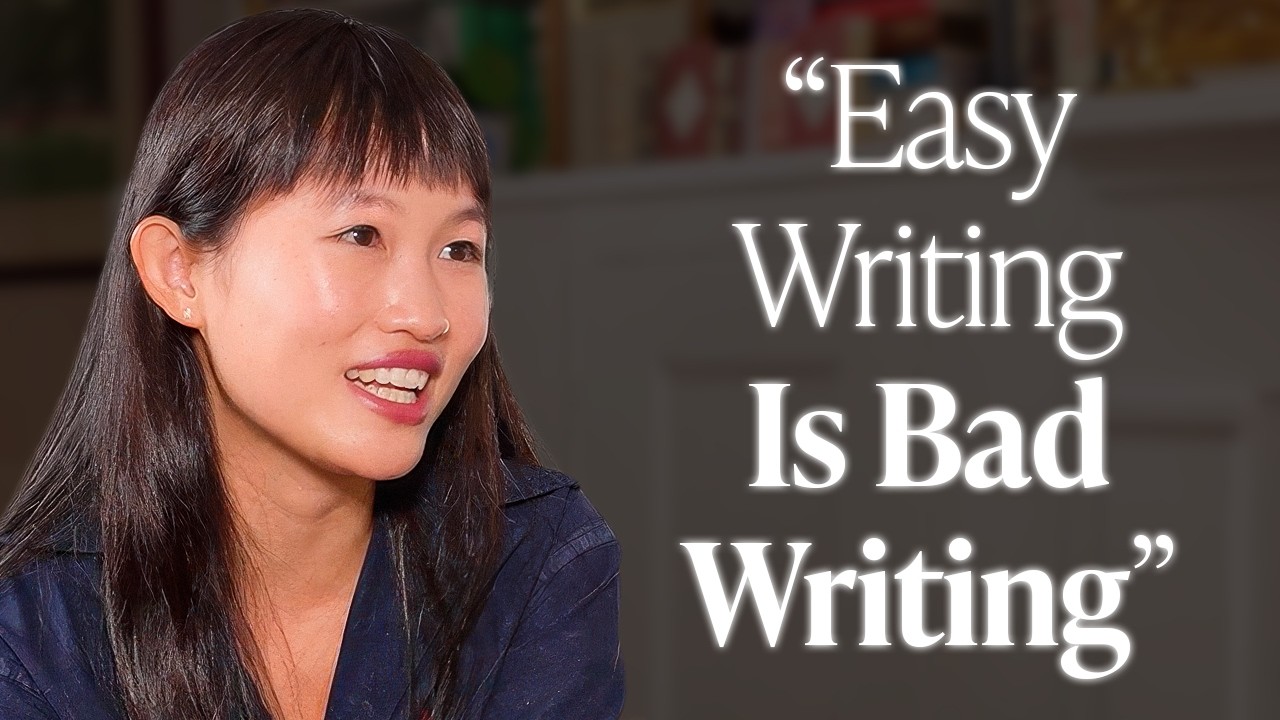
RF Kuang — award-winning novelist (Babel, Yellowface, The Poppy War trilogy), trained at Cambridge, Oxford, and Yale — discusses her writing craft, process, and teaching philosophy, emphasizing that good writing comes from deliberate technical choices, physical observation, and the willingness to push past comfort into emotional honesty.
Writing emotions through the body
Emotions are not abstract labels but physiological responses; Kuang teaches students to describe feelings only through bodily sensation — heart rate, breathing, tingling toes — before naming them.
She uses silhouette diagrams to have writers map where an emotion sits in the body, revealing that “pure” emotions never exist in isolation; triumph carries fear, joy carries dread, love carries terror of loss.
The practice of splitting the psyche — one part living the feeling, one part observing it curiously — lets her document grief, panic, or joy with specificity that makes the experience legible to herself and the reader.
Two barriers keep writers from this depth: lack of observational attentiveness (reaching for theory instead of sensory detail) and refusal to mix emotional “primary colors” (fear with courage, love with revulsion).
Kuang’s wedding “first look” moment illustrates the collision: holding her husband, she felt shining love and simultaneous panic that such love could be taken away; writing that friction creates richer scenes than flat sentiment.
Observing others and erasing the self
Good craft requires the same “vanishing of the ego” that Iris Murdoch argues is the basis of morality: stepping outside one’s subjective experience to see how others hold the world.
Kuang treats every social interaction as data gathering; she deliberately gives main characters flaws, ideologies, and responses she doesn’t share, which she can only do by constantly being in the world — teaching, talking to experts, staying in rooms where she is not the expert.
She refuses to go full-time as a writer because isolation with her own thoughts stagnates her; the classroom keeps her surprised and challenged.
Learning from life drawing for an unpublished novel
Her next fantasy novel (a Faust retelling about art, politics, and mechanical reproduction) required writing from perspectives of painters, singers, and poets — art forms she doesn’t practice.
She took figure drawing classes at a Boston artist collective, learning to “unsee”: squinting to reduce the visual field to values, lines, proportions, and shadow relationships rather than trying to capture everything at once.
A scene emerged where a painter asks his friend (with whom he has romantic tension) to model nude; the intensity of being broken down into angles and shadows by someone who wants to see you fully becomes a metaphor for the novel’s themes of failed perception and communication.
The exercise parallels Drawing on the Right Side of the Brain: flipping an image upside down forces you to draw what’s actually there, not what your brain fills in from memory — a lesson she applies to prose to avoid auto-populating scenes with cliché.
Why easy writing fails
Verlyn Klinkenborg’s Several Short Sentences About Writing debunks the “flow” myth: ease correlates with “volunteer words for volunteer thoughts” — repeating familiar discourse, loading automatically from one’s existing dataset.
Hard writing — where words don’t volunteer themselves, where you pull teeth to find the combination that articulates an unobserved experience — produces the most impactful work.
Kuang’s most productive days feel hardest because she’s rejecting the easy fill-in and building foundations from scratch.
Unlocking stuck scenes through physical honesty
Stuckness usually means she’s unconsciously holding back, scared to push a scene to emotional honesty; comfort (hers and the reader’s) is the enemy.
In Katabasis, Alice’s turn from suicidal passivity to a will to live came alive only when Kuang abandoned “therapy speak” (revelation, finding value) and grounded the shift in visceral physicality: Alice beside a dead cat, smelling hot blood, famished, devouring the liver and gnawing the heart with bare hands — blood on her face, teeth sore, a rush of nutrients and fighting instinct.
Her constant note to students: “What else is going on here? Push further. Get past the shame. Stop looking over your shoulder at how readers might react.”
Literary shapeshifting and voice as construction
Kuang has no default voice; she adopts a new persona for each project — Victorian maximalism for Babel, viral-tweet velocity for Yellowface, meandering stream-of-consciousness for upcoming work.
This fluidity stems from learning English as a second language (accent shifts with environment: Texas, Boston, UK) and from high school/college debate (switch-side debate forces arguing both sides of a proposition).
Voice ≠ author’s personality; the narrator is a carefully constructed “interpretive lens” or “mask” — e.g., Taipei Story’s voice is brash, reductive, and absurd, mocking American study-abroad assumptions, while Kuang’s own understanding is more nuanced.
Conflating author, narrator, and voice leads to bad criticism (“this character killed a dog, so the author supports animal cruelty”).
Primary sources over secondary history
For Babel, she read contemporary monographs for facts but dove into primary sources — student diaries, campus novels, 1830s slang — to capture the narratives Victorians spun about their own worlds, flaws included.
Readers called some slang “too modern”; she had pulled it directly from period sources (e.g., “long vac” for long vacation).
Good historical fiction replicates the subject’s self-narration, not a 2026 historian’s reconstruction.
What AI can never do
AI art bypasses the human creative act: no observation, no feeling, no question of “what spark of human existence am I trying to deliver?” — just a facsimile of existing data.
The camera expanded creative options (framing, light, perspective); AI offers only “volunteer words for volunteer thoughts,” trained on what’s already been done.
True innovation — like Nabokov playing with English as a non-native speaker, stretching alliteration, rhyme, juxtaposition — comes from an outsider’s brute-force reinvention of language; LLMs functionally cannot do this play.
“You’re not going to get your next Pale Fire from an LLM.”
Drafting process: from magpie nest to sculpture
Zero draft: research-driven “word vomit” — reading monographs, collecting shiny historical fragments (Franco-Prussian War, German nationalism, classical music), building disconnected scenes around crunchy details, no outline, no chronology.
Then structural passes: finding the “face poking through the stone,” deciding POV, tense, chronology, narrative distance; beat-by-beat outline; chronological draft with placeholder sentences (faces, descriptions, setting details come last).
Final passes: intentional choices about architecture, furniture, drapes — “layers of animation” from balls-on-sticks to fleshed figures.
Until the end, no pages are readable by anyone else; she cannot share early chapters because it’s a “horrendous Frankenstein mess.”
Trusting the subconscious and dreams
A scene must feel like recounting a daydream or a memory of a life never lived before she writes it; if she has to answer “what are they doing?” analytically in the moment, the subconscious isn’t ready.
She feeds inputs, lets them linger, then trusts “sleep Rebecca” to work on problems; rituals (opening a blank doc, typing a title, closing it) kickstart subconscious gears.
She protects germinating ideas fiercely — no co-writing, no brainstorming with others — because external influence replaces internal drive with writing to suit others’ visions.
Balancing craft and urgency
Craft (analytical, rational choices) is necessary to shape the material, but pure craft without subconscious drive produces lifeless, technically polished work she shelves.
The goal: “a very disciplined form of exploiting and shaping and delivering your own dreams. But you’ve got to have interesting dreams first.”
Imitation as deliberate study
Following Ursula Le Guin (Steering the Craft), Kuang assigns conscious imitation exercises — e.g., writing in Ishiguro’s Never Let Me Go tone (polite, restrained, abject) to dissect the micro-choices creating that effect.
Purpose: not to adopt another’s voice permanently, but to learn to write “not like yourself,” interrogating why a voice serves a story so she can apply that consciousness to her own constructions.
Goofiness, camp, and playfulness as craft
Classics are often campy, silly, irreverent (A Tale of Two Cities as soap opera); mixing registers — soaring philosophy next to potty jokes — treats the full human spectrum with equal care (Eco, Borges, Márquez).
In class: timed exercises with ridiculous prompts (describe paradise from the perspective of someone who hates it, physically, no abstractions) force spontaneity, messiness, and uncanny observations that polished drafting suppresses.
Playfulness unlocks perceptions that “good writing” posture blocks; the goal is to roll sleeves up and try everything that doesn’t work so you recognize what does.
Driving questions: language, failure, and connection
Recurring inquiry: language, translation, moving between worlds, the richness of miscommunication.
Babel: language as resource, mastery, magic; failure framed as loss.
Taipei Story: language misuse and failure as bonding human experience — a character rigid with shame about mistakes learns that humiliation, being laughed at, and saying the wrong things are how you live fully and connect.
The shift mirrors her own life: Chinese American shame about not speaking Chinese well → later realization that group silliness in language classrooms (cracking up at mutual mistakes) is where real learning begins.
What she wants students to leave with
Writing is a technical activity; you are a craftsman tinkering with words.
Read fiction as a series of thousands of deliberate choices on every level, not a fluid delivery of feeling.
Move past “this book made me feel good” / “it poured out of me” — those are mystical, vague, unhelpful myths that suggest writing is unteachable.
Even non-writers benefit: seeing the sausage made makes the audience experience richer; the habit of going to the library weekly and absorbing new work becomes lifelong self-education.
Book and movie recommendations
A Whole Life and The Fields by Robert Seethaler: expansive, dedicated portrayal of humble, unremarkable lives — the Murdochian attitude of stepping out of your subjectivity to find beauty in how others move through the world.
JSA (Park Chan-wook): South and North Korean border troops crossing lines, forming friendships — human connection over extreme separation, beautiful, tragic, hilarious, and slapstick all at once.