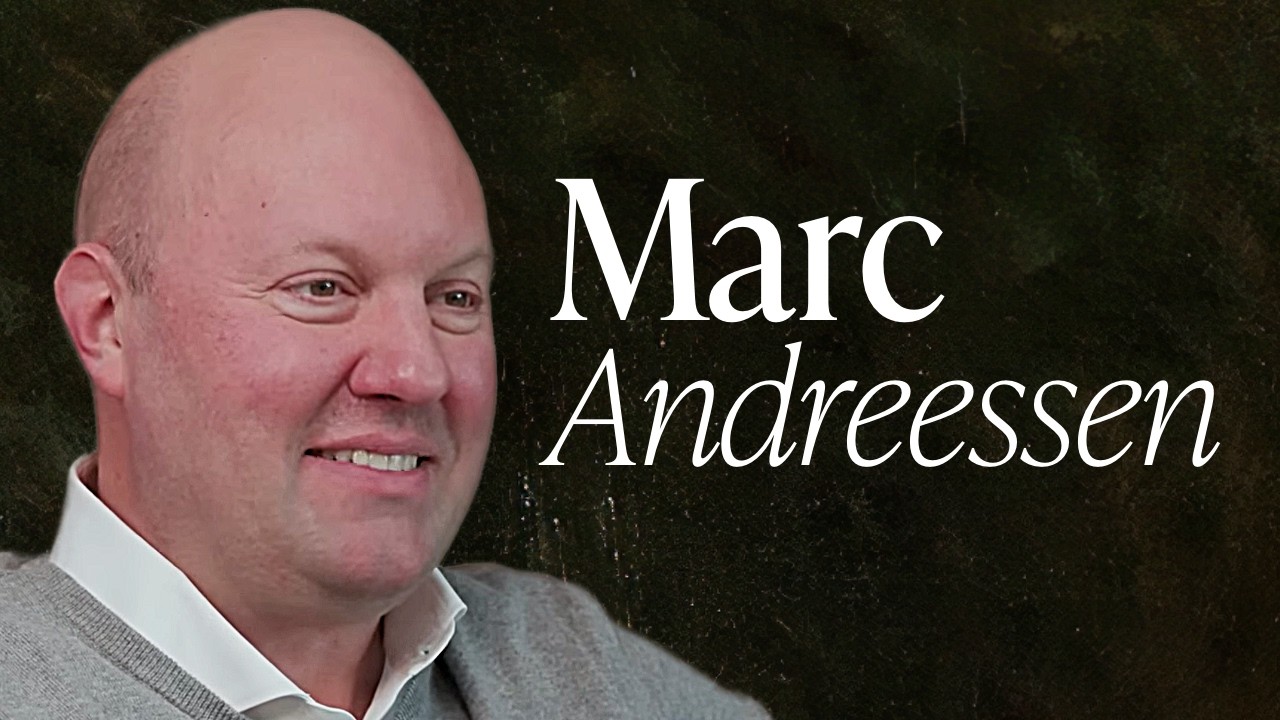
Marc Andreessen is a prolific writer, investor, and technologist whose writing process is driven by accumulated frustration, rage, and a desire to explain what he sees as misunderstood. He writes best late at night, often in a single unedited pass, and his most famous pieces — including the 2011 Wall Street Journal op-ed “Software Is Eating the World” and the 2020 essay “It’s Time to Build” — were written quickly after long periods of mental buildup. He is also a co-founder of Andreessen Horowitz (a16z), where he balances personal expression with professional responsibilities to partners and portfolio companies.
Writing process and philosophy
Writing as speech: Andreessen believes the best writing sounds exactly like talking. He avoids editing heavily because it shifts his voice into something stilted and unnatural. He writes in the same tone he would use in conversation, which is why his essays feel direct and energetic.
Outline-first approach: Before writing prose, he dumps all his points into a rough bullet-point outline — typically 15 to 20 key ideas — and then arranges them into a sensible order. Only then does he do a narrative pass to turn it into flowing text. This is unusual for someone who writes from passion; most people in that mode just start writing.
Speed over polish: Both “Software Is Eating the World” and “It’s Time to Build” were written and published very quickly. He does not use formal systems for tracking ideas (no Evernote, no card catalogs). Instead, ideas accumulate through reading and conversations all day until they hit critical mass.
Rage as fuel: He describes writing as “opening a vein.” “It’s Time to Build” was literally written in a rage after reading that New York City hospitals, during COVID, had run out of surgical gowns and the mayor asked citizens to donate rain ponchos. That moment crystallized years of frustration about America’s lost industrial capacity.
The Kanye of blog posts: His partner Ben Horowitz called him this — meaning he works on his own timeline, misses self-imposed deadlines, but produces something creatively strong when it finally arrives. Andreessen took it as a compliment.
Information diet and learning
Barbell information intake: He deliberately avoids content from “yesterday through 10 years ago.” He consumes either super-current material (Twitter, conversations with experts) or timeless material (books, especially history and biography). He skips the middle entirely.
Conversations as learning: His day job gives him access to tech founders who are world-leading experts in their domains. They come in, often without NDAs, and explain everything — their technology, strategy, and reasoning — because they want a partner who truly understands. This is his primary source of new knowledge.
Audio content: He listens to audiobooks and podcasts two to three hours a day — during commutes, workouts, morning routines, and before sleep. AirPods were the single biggest technological leap in his adult life because they unlocked this habit. He prefers audiobooks for learning entirely new subjects and podcasts when he is deep-diving into a current topic.
Reading for content, not style: He reads almost exclusively for information, but when he encounters truly great prose — like Edmund Morris’s Teddy Roosevelt biographies or Robert Caro’s work — the stylistic quality punches through and reminds him what is possible.
Online reading tools: He uses Substack’s text-to-speech, Natural Reader, and increasingly AI-generated audiobook voices (including Apple’s) to consume written content as audio. He also downloads books from LibGen, though he claims to purchase hardback copies as well.
Group chats and private discourse
Group chats as truth-seeking tools: Andreessen maintains multiple group chats with 4–8 people, which he considers the ideal size. Beyond about 10 people, participants get stage fright and the dynamic becomes performative.
Preference falsification: He references Timur Kuran’s concept — people lie in public and tell the truth in private. Group chats are where private truths emerge. He learned this the hard way on Twitter, where he assumed he could say everything publicly and was corrected multiple times.
Curating for truth, not comfort: He runs many group chats with people who have very different perspectives, then takes a meta-view across all of them. When one chat becomes too extreme or locked into a rabbit hole, he creates a new one to reset the dynamic. Every person matters — one bad actor can destroy the whole thing, like a dinner party.
Group polarization: He is aware that groups reinforce existing tendencies and push members toward more extreme positions. Running multiple chats with different compositions is his way of counteracting this.
Twitter and public communication
Twitter as aphorism engine: He sees Twitter as the return of the aphorism — a literary form that recurs throughout history (Nietzsche, La Rochefoucauld, Poor Richard’s Almanac). If Nietzsche were alive today, he would be the best tweeter of all time.
Tweetstorms: He invented the tweetstorm out of frustration with the 140-character limit. He had more to say than would fit in a single tweet, so he just kept going. It was half-serious innovation, half-comical rebellion against the medium’s constraints.
Curating the feed: He follows people based on a single tweet and blocks based on a single tweet. He blocks liberally. His goal is a direct feed of what the smartest, most insightful people are thinking right now. He uses lists (now private, after reporters wrote hit pieces about his likes and his follows).
Calibrated public expression: He no longer tweets actively because it is too easy to get in trouble. As a representative of a16z and its portfolio companies, he cannot be reckless. Essays and podcast conversations are his preferred formats because they provide context that a single tweet cannot.
Literary forms and media cycles
Recurring atomic units of media: Aphorisms, essays, poetry, and short films are not new inventions — they are ancient forms that go in and out of fashion and then return in new packaging. Blog posts are essays. Rap lyrics are poetry. Tweets are aphorisms. The internet is the meta-medium that can represent all prior forms.
Essay format: He never read essays growing up because by the time he was reading, serious work was in long-form narrative prose (200–300 page books). Essays were seen as academic and literary. Blog posts brought the essay back as a primary communication format.
Manifesto as genre: He is currently working on a 30–40 page manifesto on the philosophy of technology — the biggest thing he has ever written. He has been reading historical manifestos (Communist, Fascist, Futurist) to get into the right spirit. He wants it to be a polemic that rallies true believers, not an objective observer’s take. He plans to include a reading list at the end rather than inline citations.
Short films as the next frontier: He predicts that within a year or two, generative AI tools will be able to take an essay and produce a short film from it. He suggests his manifesto could work as an eight-minute YouTube short. He sees a latent ability that most writers and artists are not yet using but will be within five years.
Lateral thinking and intellectual influences
Three lateral thinkers: He identifies Venkatesh Rao (Breaking Smart), Balaji Srinivasan, and Peter Thiel as the only people he has met who are perpetually lateral thinkers — they never approach a situation the way everyone else does. He spends as much time as possible with them because it trains him to think differently.
Philosopher in residence: Rao was a16z’s first and only philosopher in residence. Andreessen would like to do this again but has been too busy.
Why not hire lateral thinkers: He acknowledges the idea of putting multiple lateral thinkers on payroll just to have them around, but notes the organizational complications — jealousy, status confusion, and the question of why they would not be in the decision-making loop.
LLM in every room: He raises the question of whether there should be an LLM in every meeting, the same way he values having a lateral thinker present. Voice recognition and real-time transcription are now good enough to make this feasible, though he is not aware of anyone actually doing it yet.
Software as a literary genre
Writing code is like writing a novel and building a bridge simultaneously: Software has a structural engineering component (it has to work) but also a creative component that is absent from civil engineering. Every piece of software ever shipped has bugs, not because programmers are lazy, but because the creative element means you are designing all the way through.
Code as structured writing: Programming is literally writing — in a structured format with its own grammar and syntax. Programmers interleave English-language comments with code. Programming languages have evolved to higher levels of abstraction, making programmers more productive.
Pair programming with AI: The old concept of pair programming (two humans at one keyboard) is being replaced by human-plus-machine pairing. Tools like Copilot read your code and give real time feedback, or write code for you while you direct. He predicts this will extend to all forms of writing — prose, fiction, everything.
Outline thinking: His background in software is probably why he thinks in outlines. Code effectively takes the form of an outline, and this structural orientation carries over into his essay writing.
Personal history and influences
Learning to code as a kid: He taught himself to code at age 10 from a book in the library, before he owned a computer. He would write code on the bus ride to and from school. He grew up in rural North Carolina with no computers nearby.
D minus in computer science: He got a D minus in his college CS course because he slept through the final and showed up an hour and 15 minutes late. The professor felt sorry for him and bumped him up from an F.
Hyperlinks are blue because he likes blue: When building the Mosaic browser, he had to pick a color for hyperlinks from a 256-color palette. He chose blue because it was easy to see and he liked it. He also set backgrounds to gray instead of white because of light sensitivity — he wanted dark mode but the displays of the era could not render white text on black well enough.
Science fiction to history: He was heavily influenced by science fiction as a kid but shifted to reading history because real history is more bizarre and instructive than anything a novelist could invent. Real people made decisions — great and terrible — that no speculative fiction could match.
David Milch moment: The television writer David Milch (Deadwood) spent a day with him and told him, “You should be writing fiction.” It never occurred to Andreessen, but the comment stuck. He now wants to write a roman à clef — a novel where all names and dates are fictional but every event actually happened — drawing on 30 years of tech industry experience without writing a tell-all.
Writing at a16z and organizational power
Internal writing: At a16z, he writes a lot of emails and text messages, and occasionally long-form internal memos when there is serious conflict or ambiguity around a new initiative. These internal essays follow the same process as his public ones.
The power of writing things down: He observes that the person who writes down the plan in an organization has enormous power, independent of their formal role. Very few people will actually write something comprehensive and high-quality. Even meeting notes are low-status. He advises young people to be the person who takes notes and writes the summary — it is how up-and-comers get noticed.
Market inefficiency in writing: He notes a paradox: it has never been easier to write, so the world is drowning in bad content. But the tools are also so effective that there should be an explosion of high-quality content — and there is not, or at least it is hard to find. He sees this as a market inefficiency: well-written emails from strangers, for example, have a very high chance of being read by him, yet almost no one writes them.
Drugs, creativity, and culture
Chemical catalysts for civilization: He sees psychoactive substances as underappreciated drivers of cultural change. The shift from alcohol to caffeine (tea and coffee) in England was the catalytic event for the Enlightenment. Financial markets started in coffeehouses (Lloyd’s of London). Scientific discovery, literary salons, and political revolutions all happened in caffeine-fueled environments.
Hunter S. Thompson and amphetamines: Thompson’s daily routine involved whiskey and cocaine starting at 3:15 PM, then writing through the night. Ayn Rand was on Benzedrine (amphetamine) for 30 years, which degraded her judgment over time.
Nicotine withdrawal and obesity: He notes the decline of smoking (a stimulant) and its replacement with cannabis (a depressant) as a possible factor in rising obesity and falling testosterone. Society may be reverting to a state similar to the past when everyone was drunk all the time.
Green tea: He drinks green tea throughout the day because it delivers the right amount of caffeine. Coffee and Diet Coke overcrank him and cause skipped heartbeats. Green tea provides a continuous, manageable feed.
Physical environment and habits
Night owl: He writes late at night, usually at home. During COVID, he worked from his breakfast room chair for 12 hours a day on Zoom, which caused shooting pain down his right side from not working out.
Office: His home office has books stacked in piles rather than on shelves. He buys every book he thinks he will ever want to read and they just accumulate. He has not built shelves.
Music for writing: He listens to music almost always on headphones. For writing, he prefers Synthwave, Future Garage, or Lo-Fi on YouTube — music with a consistent beat that occupies the buzzing part of the brain without being distracting. He does not listen to songs on repeat because they become annoying.
Walking and creativity: Unlike Nietzsche (who walked eight hours a day and wrote aphorisms), Andreessen does not find walking creative. When he is on the treadmill, he watches TV or checks Twitter. It is disconnection time, not ideation time.
Ben Horowitz as a writing model
Literary family: Ben’s father, David Horowitz, was a prolific author and political activist — first on the far left (Berkeley Free Speech Movement, Ramparts magazine, fundraiser for the Black Panthers), then a Reagan conservative, now a Trump supporter. Ben grew up watching his father write books and run a magazine. Ben was a research assistant on his father’s bestselling family biographies (Fords, Rockefellers, Kennedys) as a teenager.
Ben’s conclusion from his father: Stay out of politics. His father enjoyed it but was always leaning into controversy and making people mad. Ben chose business instead.
The Hard Thing About Hard Things: Ben cracked the code on business books — his book sells continuously, has been translated into 27 languages, and has the staying power of Peter Thiel’s Zero to One. Most business books come and go; a few become permanent.
Comment sections and content quality
Why comment sections are low quality: Most platforms lack a consciously calibrated system for evaluating comment quality. Reddit’s karma system works well. YouTube’s algorithm surfaces quality comments effectively. Twitter’s algorithm has improved.
LLMs as comment moderators: LLMs are very good at evaluating text quality, emotional loading, and tone. Commenting systems should use LLMs to score and sort comments, burying angry or low-quality ones.
The missing web feature: In the original Mosaic browser, Andreessen’s team prototyped “annotations” — a commenting layer overlay on top of every web page, stored on a central annotation server. It was too ambitious to build at the time. The idea was that anyone reading a page could leave commentary visible to others, creating a wiki-like or comment-section-like layer across the entire web.
Politics and the internet
Hyperpolitical internet: Until around 2013–2015, political discussions on the internet were isolated to specific forums (Usenet groups). In general-interest spaces, bringing up politics was considered rude. Then a switch was flipped and politics infused everything.
The dog caught the bus: The internet became central to people’s lives, and politics is central to people’s lives, so the internet necessarily became hyperpolitical. He was as shocked by this as anyone, having grown up with the older model.
pmarca screenname
Origin: When he worked at the supercomputing center at the University of Illinois as a college student, his boss’s boss had two email addresses — a regular one and a private one starting with “P.” It was a way of signaling he was important enough to need a private channel. Andreessen adopted “pmarca” as a joke, implying he was important enough for two addresses. It backfired because everyone now knows what it is, eliminating the privacy benefit.