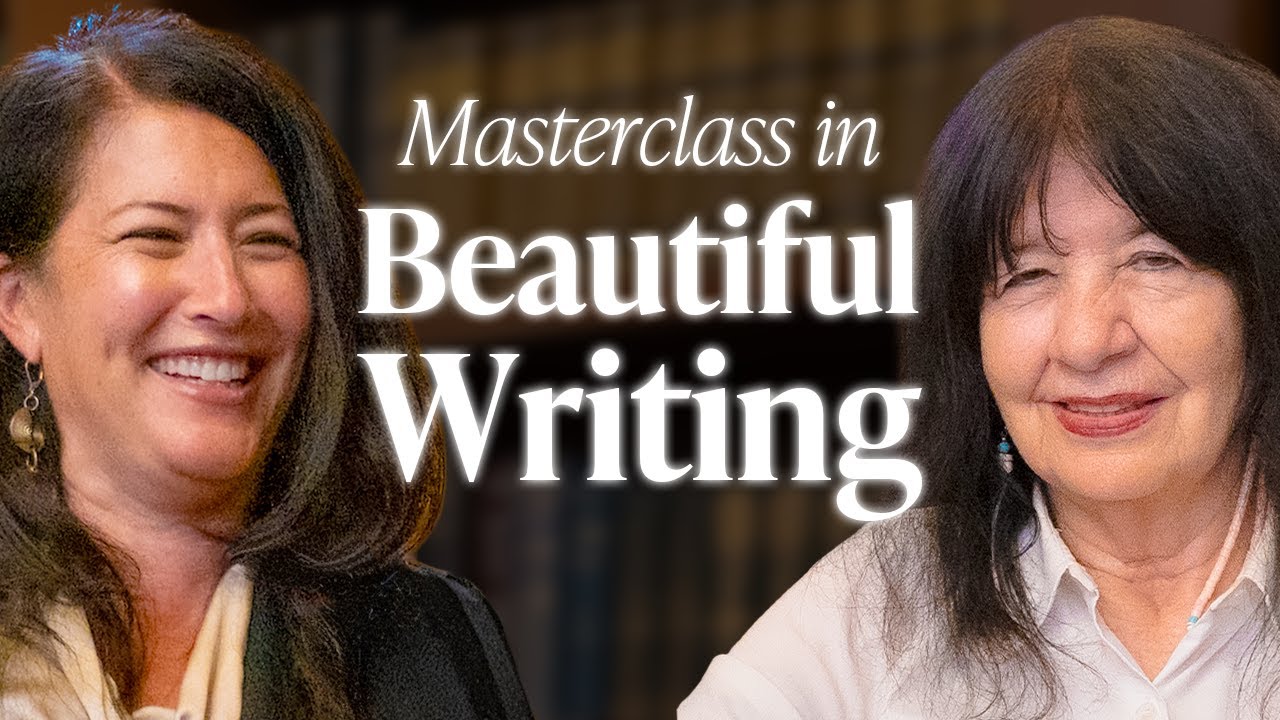
Ada Limón and Joy Harjo, the two most recent U.S. Poet Laureates, discuss how poetry is rooted in deep listening, how rhythm and metaphor shape the art form, and how poetry resists the speed and literalness of modern communication.
Poetry is presented not as a school subject but as an ancient, embodied practice tied to song, dance, memory, and cultural identity.
Both poets emphasize that writing begins with receiving the world rather than imposing on it, and that the best poems emerge from a state of patient, attentive listening.
Listening as the foundation of poetry
Listening is described as the core practice of poetic creation, extending beyond words to include the vibrations and rhythms of the natural world, the body, and the divine.
Joy Harjo describes the Earth as a single being with its own song, made up of the resonances of every living thing.
Ada Limón recounts a moment when she realized the poem she was writing had become so loud in her body that it felt like an external sound, revealing how deep listening blurs the boundary between inner and outer experience.
Both poets note that constant phone and internet use disrupts this resonance, fragmenting the sustained attention that poetry requires.
Silence is not empty but full
Silence is reframed not as the absence of sound but as a state that reveals the constant music already present in the world.
Harjo describes sitting in silence in a canyon in Argentina and discovering that the silence was “super loud” with eagles, waterfalls, and melting glaciers.
Limón recalls using earplugs as a teenager not to block sound entirely but to dampen the overwhelming noise of social life so she could move through the world.
Both agree that cultivating the ability to hear what is already happening is essential to both poetry and sanity.
Rhythm as the fabric of existence
Rhythm is presented as the organizing principle behind all living systems, from the heartbeat to geological processes, and poets are described as especially attuned to it.
Harjo notes that every organ and cell is held together by rhythm, and that losing rhythm is synonymous with death.
Limón compares the experience of hearing a poem’s rhythm to hearing jazz, where phrasing, line breaks, and sound patterns create meaning beyond literal content.
Both poets describe rhythm as something that can be heard before it is written, and that the act of writing is often a translation of a rhythm already sensed.
Voice, identity, and resisting trends
Finding one’s poetic voice is framed not as invention but as uncovering something already present, tied to self-knowledge and resistance to fashionable trends.
Harjo says her voice “cultivated her” rather than the other way around, and that it is the same voice whether she is speaking, singing, or playing saxophone.
She advises young writers to investigate their own belief systems, obsessions, and safe places as a path to discovering what is uniquely theirs.
Both poets resist the contemporary poetry world’s focus on youth, trends, and theoretical frameworks, choosing instead to speak across longer stretches of time.
Harjo encourages Native writers to see colonization as a brief moment in eternal time, and to write from a perspective that predates and will outlast it.
Clock time versus poetic time
The episode explores how industrial clock time constrains attention and creativity, while poetry operates in a different temporal register.
The host observes that people feel bound by minutes on a Tuesday but lose track of time entirely on a Saturday night, illustrating how clock time fragments presence.
Both poets describe losing track of time as a gift that is increasingly rare in a world filled with devices designed to “eat time.”
Harjo points out that clock time is historically recent and that many cultures have long measured time by the sun and seasons rather than by mechanical precision.
How to read and experience poetry
Poetry is presented as an art that requires repetition, patience, and embodied engagement, and that cannot be consumed quickly or passively.
Limón describes reading poems multiple times, each reading revealing more, the same way a song shifts depending on the listener’s mood and body.
She recounts initially resisting John Ashbery’s work, only to return to it years later with greater craft and patience, at which point it opened up to her.
Both poets insist that poetry should be listened to like music, not decoded for a single meaning, and that the experience of sound, rhythm, and image is the point.
The physical book is preferred over the phone screen because the page allows for sustained, repeated engagement.
Line breaks, sound, and the visual architecture of a poem
The line break is described as the primary tool that distinguishes poetry from prose, functioning as a set of instructions for how to read and hear the poem.
Line breaks create pauses, silences, and tensions that interact with the sentence, producing meaning that syntax alone cannot.
Limón explains that in poetry, the elemental unit is the sound, then the syllable, then the word, then the clause, then the line break, and finally the sentence, the reverse of how prose is typically constructed.
The visual layout of a poem on the page is inseparable from its musicality; the way a line ends, whether with an open vowel or a percussive stop, shapes the reader’s experience.
Embodiment, performance, and the power of spoken poetry
Poetry is presented as an art that lives fully only when embodied, whether through voice, dance, or sign language.
Harjo describes hula and other indigenous dance forms as poetry in motion, where music, movement, and language are inseparable.
Limón recounts hearing Linton Kwesi Johnson read dub poetry in Amsterdam in the 1970s, and how the rhythm of his voice alone made the entire audience move as if dancing.
Both poets describe the experience of hearing a poem read aloud as transformative, capable of arresting attention and creating a shared, almost spellbound state.
Limón notes that even deaf poets embody their work through ASL, proving that poetry’s physical expression is not limited to sound.
Metaphor as the essence of poetry
Metaphor is identified as the defining feature of poetry, setting it apart from the literal, utilitarian language of everyday communication.
Harjo defines poetry as essentially metaphor: the real world seen as “not as it seems,” holding contradictions in a single image or phrase.
Limón describes how a William Blake couplet about seeing the world in a grain of sand transformed a stressful walk into a vivid, alive experience, demonstrating how ordinary words in poetic arrangement can awaken perception.
Both poets contrast poetic language with texting and email, which they describe as “clock time writing,” stripped of metaphor and reduced to blunt, transactional communication.
The episode suggests that poetry’s power lies in its ability to use familiar words in unfamiliar ways, creating moments of wonder, mystery, and emotional depth that utilitarian language cannot achieve.