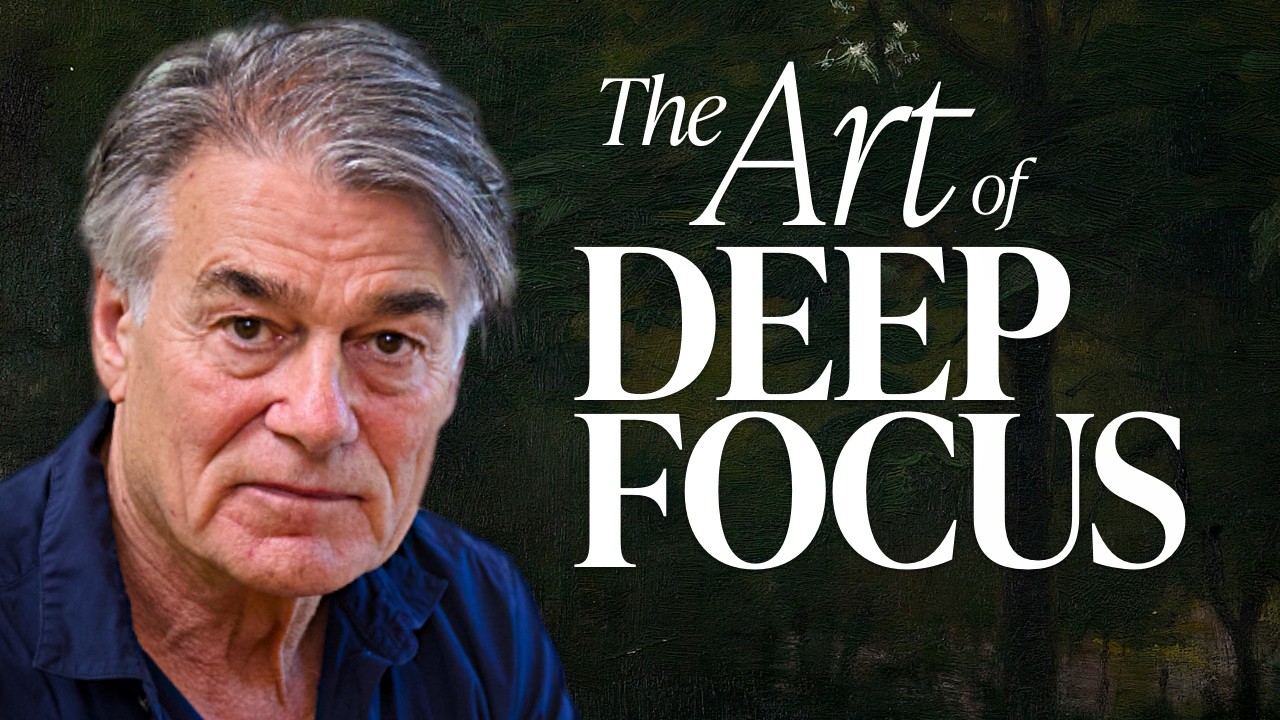
David Whyte is a poet, philosopher, and author who has spent decades exploring what it means to pay deep attention to life, and how that attention transforms the way we write, love, and understand ourselves. This conversation ranges across his experiences as a naturalist in the Galápagos, his practice of memorizing poetry, his understanding of difficult emotions like grief and anger, and his belief that writing emerges from the frontier between what we think is “us” and what we think is “other.” The central thread is that prolonged attention—to the world, to the body, to language—breaks down the small self and reveals something much larger, more generous, and more real.
Prolonged Attention as a Way of Seeing
When you look at something long enough, it magnifies and becomes higher resolution. You see things invisible in the rush of everyday life.
This applies not just to sight but to listening, bodily feeling, and the combined act of hearing and seeing together.
In Zen practice, Whyte was given the koan “Who is listening?”—a form of fierce attention directed inward.
Deep attention eventually dissolves the person who is paying attention. The boundary between observer and observed breaks down.
His poem “Revelation Must Be Terrible” describes this as a kind of death of the personality—“no time left to say goodbye”—followed by the discovery that the world is looking back at you.
The world becomes “much bigger, much larger, more generous, more present, more fiery” than the person who began the process.
Learning to See in the Galápagos
As a naturalist guide in the Galápagos, Whyte experienced animals without fear of humans—looking into the eyes of a hawk at close range and seeing the absolute essence of “hawkness.”
At first, he barely saw anything. Knowing the Latin name of a bird was actually a way of covering over its essence.
Over time, things began to “speak back” in a fierce way. Animals and sea creatures he had come to know as individuals with distinct personalities died regularly on the beach.
Everything was looking back at him more fiercely than he was looking at it.
This led to a fundamental insight: real identity is not “you” alone. Identity is the meeting place between what you think is you and what you think is other than you. That meeting place—that attentive edge—is where you write from.
Writing From the Frontier
Writing comes from the physical frontier between self and not-self. It often feels like darkness—something buried in the body that cannot yet be articulated.
He compares this to the “tactile dome” experience of navigating a dark maze as a child: you move forward without seeing, guided by touch and intuition.
Good poetry is not about something—it is the thing itself. It names the world while keeping it alive, rather than reducing it to a static label.
He sometimes composes while walking, muttering lines aloud, then capturing them on his phone—continuing a tradition Wordsworth practiced with a dog running ahead to warn of approaching strangers.
The rewriting process is secondary. The real work is the ability to have a physical experience and translate it into language that preserves the original movement and aliveness.
Writing in the Dark
Whyte wrote a poem called “Sweet Darkness” after noticing that his relationship to the world changed completely depending on whether he was writing during daylight or at night.
“When your eyes are tired, the world is also tired. When your vision is gone, no part of the world can find you.”
The darkness holds everything. A fire makes a circle of light so that no one comes to find you anymore, but the darkness is invitational—it contains what lies beyond.
At night, the world is evolutionarily unfamiliar and therefore demands heightened attention. We are not meant to be abroad at night; we are prey.
In the African bush, nighttime belongs to lions, hippos, and stalking creatures. The world is half-asleep during the day and fully ambulant at night.
Rilke wrote a poem asking what it would mean to contextualize your life from the darkness rather than from a point of light: “You darkness from which I come, I love you more than all the fires that fence out the world.”
Horizons and the Unknown
A horizon is beautiful precisely because of what lies beyond it. By definition, it has a world beyond that you cannot see, and that is what makes it nourishing and invitational.
Good writing works the same way—it is constantly invitational to what lies beyond the line of beauty it has arranged.
Virginia Woolf never let readers settle into one mind. She moved constantly between characters so the true spirit of the novel emerged from the conversation itself.
Each person has an inner horizon below which lies the next possibility for maturity—the next territory of understanding they are about to enter.
Part of us has already matured beyond where our personality currently exists. We often have revelations and realize we actually knew the truth for a long time but refused to face it.
The task is to drop below the line of discomfort and find equal nourishment there—to dwell in the part of that already knows.
The Primary Imagination
Keats and Coleridge distinguished between the secondary imagination (the fancy, the ability to think up new things) and the primary imagination—a powerful elemental faculty that aligns thousands of unknown elements into one coherent image or line of poetry.
This is a coalescing force, a faculty of belonging. It integrates information the conscious mind cannot process.
Whyte experienced this practically on a walking safari in Africa when his guide stopped suddenly, sensing a lion 20 yards away before seeing it. The guide couldn’t explain how he knew—it was a combination of scent, grass patterns, and tracks integrated at a deeper level of consciousness.
This is not unconscious. It is a deeper form of conscious attention to the world.
Difficult Emotions as Doorways
Every quality a human being can feel is meant to be felt. It belongs in the constellation of how we inhabit the world.
We often use words against ourselves, naming things in ways that keep them at a distance.
Weeping may be the closest experience human beings have to enlightenment. In weeping, you have given up control. Whatever perimeters you built around grief, loss, or heartbreak have been broken down.
You are breaking open a controlled edge. You are becoming larger through the weeping.
Camus said, “Live to the point of tears”—not as sentimentality, but as an invitation to feel everything as much as you can, in beauty and in sorrow.
We are afraid of the consequences of feeling. But feeling everything is what opens you to the world.
Anger as the Purest Form of Care
Whyte’s line “anger is the purest form of care” surprises people because we are taught to run from anger.
We get angry about the things most true to our hearts and purpose. The care overflows the small vehicle we have for it.
Good writing is the act of overhearing yourself say things you didn’t know you knew—dropping below the surface to find what lies beneath an emotion.
Real creativity and real writing involve an undoing process. You break down the field around an emotion so it can be replanted and reimagined.
Routine as Disguised Ritual
Routine can be an empty death spiral, or it can be disguised ritual—something that elevates rather than diminishes.
Whyte’s writing routine changes with the circumstances of his life. During lockdown, he wrote Still Possible from a single study with a natural rhythm.
Writing time starts short—maybe half an hour a day—and gradually expands as the theme concentrates, until he may be writing 8 to 12 hours a day.
Constellations 2 was written everywhere—in gyms, on airplanes, on the London Underground. The culmination was seven days in a castle in central Italy, writing 8 to 10 hours a day and producing seven essays in seven days.
He wrote 68 essays in 7 months total. It came as a kind of fire, a season that may never return in the same way.
Time Is Not the Enemy
While writing the essay on time in the Italian castle, Whyte had out-of-body experiences. The ancient walls seemed to look back at him.
We treat time as an adversary: “time is against us,” “we don’t have time,” “we need to make time.” But time would be surprised to find this out—nothing could happen without the rhythms of time and growth.
The breakthrough line: “Time is not slipping through our fingers. It is we who are slipping through the fingers of time.”
The opportunity is to live in time in a spacious, generous, timeless way.
Forgiveness Through Essence
Writing is the ability to have the world speak back in its own voice and to bring the reader to hear that voice.
You can practice this with people you resent or haven’t forgiven. Spend 45 minutes to an hour with the image and essence of that person. Eventually their essence speaks back, and you understand the real story behind their behavior.
When you hear the real story, forgiveness follows naturally—because given the same circumstances and misunderstandings, you would have done the same.
Memorizing Poetry as Pilgrimage
Whyte grew up with his mother reciting poems and stories at the foot of her bed. In Ireland, poetry is so embedded in the culture that “you’ve only got to shake someone and two or three poems will come out.”
He memorizes one line at a time, building a repertoire by reciting while walking alone in fields and woods.
Memorization is “knowing by heart”—the poem makes an 18-inch pilgrimage from the head to the heart and becomes part of you.
As a child, he felt that becoming an adult was a form of amnesia—forgetting the primary vision and perspective of childhood. Discovering adult poetry by Ted Hughes and Tom Gunn showed him it was possible to keep that vision alive into adulthood.
William Blake’s “Songs of Innocence” and “Songs of Experience” are not sequential. Real innocence is the ability to be found by the world in repeatedly larger ways.
Memorized poems become powerful allies. Mary Oliver’s “The Journey”—about knowing what you must do despite every voice shouting bad advice—can physically carry you through fire.
Reciting poetry in everyday settings crosses a threshold between clichéd language and elevated language, giving freshness to a familiar world.
Poetry in the Corporate World
Whyte has worked extensively with executives and organizations, introducing people who have never confronted poetry in a real way.
He describes the initial reaction as a “bow wave” phenomenon—an enormous wave of something real hitting the personality, followed by people slowly floating out on new waters.
It is a shock to personalities accustomed to language that distances, guards, obfuscates, and neutralizes—language designed so you don’t have to feel, hear, or see.
Beautiful Questions
Every good piece of writing is organized around a beautiful question—an axis of invitation that simultaneously goes out to the writer and, if successful, to the reader.
A good novel draws you in because something is being asked that you don’t know the answer to yet. A book is disappointing when it fails to live up to the questions it raised at the beginning.
The Zen tradition is full of beautiful questions in the form of koans. One example: “A bird calls announcing the difference between heaven and hell.”
The answer, arrived at only after turning your life upside down trying to solve it: heaven is if you heard the bird, and hell is if you didn’t.
Whyte keeps a running collection of beautiful questions. His long poem “Coleman’s Bed” contains 26 invitations—26 questions about why we return to places where something essential happened.
The final lines answer the question: we return because we have had threshold moments in our own lives—moments where we picked up the phone, went out the door, or asked for something—and were granted it. We go back to thank the person we were in that moment.
The even more beautiful question: “What could I do today that my future self would come back and thank me for?” This becomes a practice for shaping your existence.
Cliche and Fresh Language
Cliche is the too-solid naming of the world. Cliches often become cliches because they are stubbornly true, but the truth has been worn smooth and can no longer be heard.
Telling a heartbroken 16-year-old “there are plenty more fish in the sea” does no good. What helps is witnessing the broken heart—language that speaks from the inside out rather than the outside in.
The word “conversation” comes from the Latin conversare—to turn, to dwell—and conversus—turned around, inverted. A real conversation is inside-out: your inner life is nourished as much as your outer senses.
John O’Donohue’s definition of a great conversation: one where “you overhear yourself saying things you didn’t know you knew”—a line he borrowed from Whyte.
Continuing Conversations With the Dead
As you age, more of your conversations are with people who have left the lighted hours of your life. But these can be live, evolving conversations—not repetitions.
Whyte experiences ongoing conversation with John O’Donohue, who died at the height of his powers. He sometimes begins sentences in his own voice and finishes them in John’s, or vice versa.
After John’s death, Whyte felt permission to enter John’s territory of Meister Eckhart—something they had avoided during their lifetimes to prevent competition.
This permeability with the dead may be imagination, or it may be relating to the mature part of the other person that was always there but couldn’t be fully seen during their life.
Love and Heartbreak
All songs, poetry, and dramas are about love. It is disappointing to serious young poets to discover this—but the Beatles had it right.
The word “love” can also cover over what it invites us into. “I love you, love you, love you, click”—the word becomes a placeholder for something no longer felt.
Real love is about granting life to things and people other than yourself. It begins with absolute protection—the parent’s promise over the cradle—but must mature into giving the other person away.
Your child will be disappointed by the world in ways you cannot remedy. They must live within those disappointments. This breaks your heart.
Real love becomes “beautiful proximate witness”—being present, listening, sometimes helping, but mostly just being at the side of a person.
Romantic love must often mature into another form—friendship, siblinghood, parenthood. It is not sustainable in its original form.
It is easier to turn the person you’re separating from into an enemy than to go through the heartbreak of finding the new form of love.
Finding Your Impossible Path
Making a living as a poet is an insane proposition. Whyte’s essential advice: ask for visible and invisible help.
Visible help is transactional—asking for publication, funding, opportunities. You cannot do it alone.
Invisible help is the help you do not yet know you need. If you are not paying scintillating attention, you will walk right past it even when it is offered.
The corollary beautiful question: “What invisible help am I walking right past today?”
Early in his career, Whyte made a vow to do one thing every day for a year toward becoming a full-time poet—pre-internet, this meant writing letters, memorizing Shakespeare soliloquies, arranging speaking engagements. That is 365 contributions building attentiveness.
His first major talk as a poet was to 600 people at a conference in California. He experienced a complete physical breakdown beforehand—unable to get out of bed for days, feeling as if the plug had been pulled.
On stage, all symptoms dropped away. His memory was flawless. Midway through, he heard what he describes as trumpets blaring: “This is what you’re supposed to do for the rest of your life.”
He received a standing ovation and resigned from his position the next day. The experience echoed Wordsworth’s line: “I made no vows, but vows were then made for me.”
Following your passion requires heartbreak. Your present identity is not big enough to carry what you want it to carry. Your future self—a fiercer, more attentive version—must break through your current inadequacies.
When you open the channel, the world finds that emerging part of you.
The Authentic Watermark and the Path
Antonio Machado: “No hay camino, se hace camino al andar”—there is no path, you make the path by walking.
When going through a fiery, difficult time, all you can do is put one foot in front of the other. The best foot is the loving foot—one loving step at a time.
You don’t know what form the love will take at each threshold. It always involves being more present, more generous, more invitational, more robustly vulnerable.
Vulnerability and the Body
The kind of writing Whyte points to is extremely vulnerable because it transcends your sense of control. You are trying to surprise yourself and hear things inside you that you didn’t know were there.
Fear lives in the body—Whyte feels it toward his stomach on the right side. That unexplored place is also where you write from.
As children, we absent ourselves from parts of our body when we are shocked or hurt. We take our voices up above our shoulders so we won’t feel the pain again.
Writing brings the voice back down into the body, which means feeling more and walking back through the portal of old hurt.
Seamus Heaney called this the “coal face”—digging the seam of coal out from underneath. You can put your hand on different parts of your body and listen for what the body is trying to say—stethoscoping your body for words.
Being Influenced Without Losing Your Voice
Young poets should not fear writing in the style of others. You soon develop your own version.
Whyte was freed by the Beat poets and the confluence of West Coast vernacular with haiku and tanka traditions. Coming from Ireland’s dense literary inheritance—a jungle you break through with a machete—he found spaciousness in the Pacific Northwest’s literal and inner horizons.
A single line by Robert Sund—“When I get home I’ll open the barn doors and see the hides of white horses shedding rain”—was a doorway into a new kind of spaciousness in his own writing.
”The True Love” and the Essence of Whyte’s Work
Whyte’s poem “The True Love” was read at a friend’s wedding after a long search for the right words. It captured the couple’s relationship in a way that felt written for them.
The poem draws on biblical imagery absorbed in childhood—stories told by gifted Sunday school teachers, and stamps placed opposite texts showing Moses before the burning bush or Peter stepping out of the boat.
It also draws on a memory from the Scottish Hebrides: an old man who, before touching any item of his fishing gear, would press his hat to his chest and say a prayer to the boat and the turbulent waters—reverence for the thing that can carry you and kill you at the same time.
The poem’s core image comes from the story of Peter walking on water toward Jesus. Peter stays afloat only as long as he keeps his eyes on the figure calling him. The moment he looks back at the boat, he begins to drown.
“What sustains him at the surface of the stormy waters is the attention and intentionality on the star that calls him.”
The final lines: “If you wanted to drown, you could. But you don’t. Because finally, after all these years and all this struggle, you simply don’t want to anymore. You’ve simply had enough of drowning. And you want to live and you want to love. And you will walk across any territory, however fluid and however dangerous, to take the one hand you know belongs in yours.”
The essence of Whyte’s work is the cultivation of beauty: the invitation to the next territory inside yourself that equals the astonishing beauty of the world, and the relationship between inner and outer forms when they move as one—disappearing in the meeting itself.