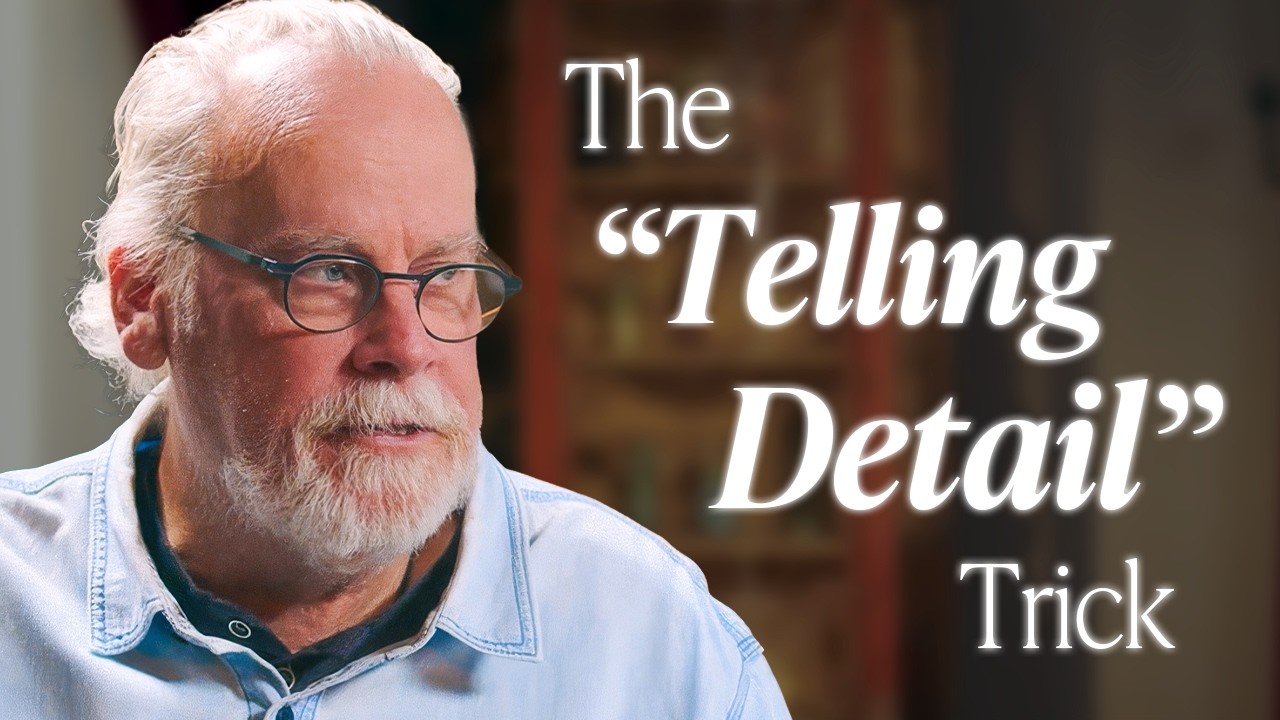
Michael Connelly is a bestselling crime novelist whose series characters Harry Bosch and Mickey Haller have sold over 100 million books and been adapted into major TV shows on Netflix, MGM, and Amazon Prime, where he serves as executive producer. He discusses the craft of writing vividly, focusing on how small “telling details” bring characters and cities to life, how he structures his writing process around momentum and rewriting, and how his background in journalism shaped his lean, information-dense style.
The power of telling details
Connelly spends extensive time with the people he writes about, detectives and lawyers, but never takes notes in front of them, instead watching for what he calls “telling details” that open a window of imagination for both writer and reader.
A telling detail can be verbal, physical, or environmental, and the best ones reveal character with a single precise observation rather than a flood of description.
He gives the example of watching a detective at crime scenes who would take his glasses off and hook the earpiece in his mouth while observing victims; later, noticing a groove worn into the plastic from clenched teeth became the one detail that conveyed everything about that character.
The goal is the fewest details that create the most vivid picture while maintaining narrative momentum, since too many details create speed bumps.
Rewriting as the core of the craft
Connelly’s writing process is built around rewriting, which he considers the real key to his work.
Every morning he rewrites what he wrote the day before, printing it out and marking it up with pencil before entering changes digitally.
When he finishes a full manuscript, he prints the entire thing and reads through it on paper before making revisions, using a personal shorthand of margin notes like “RW” for rewrite and “NSG” for not so good, a code he borrowed from his mother.
Details sometimes emerge during rewriting when the full story has taken shape and he can see where a setup planted 100 pages earlier needs a specific detail to pay off.
Maintaining momentum and validating facts
Connelly’s organizing principle is “always be writing.” He structures his entire life around protecting writing time, meeting sources for breakfast since he won’t write while eating, and delegating research to an assistant who knows to give him concise answers rather than pages of material.
His 14 years as a crime and courts journalist gave him enough foundational knowledge to write without constant research, and he maintains a cadre of detectives, lawyers, and judges he can text or call with specific questions.
He validates details through this network but prioritizes staying in the flow of writing over stopping to verify everything himself.
Character as the foundation
Connelly’s philosophy is “character, character, character,” echoing how realtors say “location, location, location.” Plot, setting, and other elements all serve character.
He writes about characters who don’t exist, so his strategy is to plant their feet in as realistic a world as possible, getting the details of jobs, geography, weather, and history right so readers will believe in the person.
He constantly pulls real-world events into his fiction to see how his characters react to them, grounding invented people in authentic contemporary reality.
Los Angeles as an inexhaustible subject
Connelly loves writing about LA because it never stops giving; it is vast, rapidly evolving, and endlessly varied, with mountains, deserts, ocean, and a freeway system that segregates the city into distinct worlds.
He starts each book aiming to set it in a neighborhood he has not previously written about, and after 42 books he knows he will never cover the whole city.
LA’s identity as the entertainment capital makes it a city of second chances where the gap between haves and have-nots creates palpable friction, which is exactly what a crime writer needs.
He is inspired by Raymond Chandler’s Chapter 13 of The Little Sister, in which Marlowe drives around LA describing it in sardonic terms; Connelly rereads this short chapter before starting every book because Chandler’s 1939 descriptions still feel accurate, which Connelly considers the definition of art.
He also admires how Chandler’s descriptions of Malibu reveal as much about Marlowe’s character, an outsider looking in at wealth he cannot touch, as they do about the place itself.
Writing through different character lenses
Connelly experiences LA differently through each character’s perspective, as if putting on different lenses: a female detective navigating a male-dominated bureaucracy, the aging Harry Bosch in his 70s, and Mickey Haller as a true outsider because he is a defense attorney without a badge or gun who must find cracks in the power of the state.
He does not keep journals or bibles of character traits because he never assumed he would have such longevity; instead he relies on two long-term copy editors who maintain continuity across his books, and he trusts that keeping his eyes on the screen and moving the story forward matters more than looking away at notes.
Writing in distinct voices
Dialogue is the most important part of character for Connelly, and he builds distinct voices through diction, how much a character speaks, and what they do not say.
Harry Bosch was designed as an outsider who nods instead of speaking, an economy of words that became so pronounced an editor once kept a running count of his nods, reaching 540 by page 200.
These are not planned tricks but character-driven choices that give each person a distinct feel for the reader.
Conflict as the engine of every page
Connelly cites Kurt Vonnegut’s advice as the best he ever encountered: on every page, every character must want something, even if it is only a glass of water. This is the distilled essence of writing and of conflict.
In his early books, he made Bosch a smoker in a society that disapproves of smoking, so Bosch always wanted a cigarette he could not have, guaranteeing conflict on every page while also signaling that Bosch exists outside standard society.
He layers big conflicts that readers cannot relate to, like solving a murder, with small ones they know well, like unhelpful bureaucrats or traffic, to keep readers connected.
Harry Bosch lives in the hills with a view of the 101 freeway, and Connelly has used the image of Bosch stepping onto his back deck to read the “ribbon of lights” of traffic as a recurring detail across many books.
Place as a vehicle for character and memory
Geography serves as a trigger for character backstory; when Bosch enters a neighborhood or restaurant, it can kick off a memory of being there with his mother or wife, using physical space to deliver who a character is and how they came to be.
Connelly agrees with Richard Price’s idea that every murder mystery is the tale of a city, because the investigation gives the detective license to go anywhere in society and pierce all its veils, an idea that traces back to Chandler’s essays about detective fiction.
This framework allows him to tell stories about a city’s neighborhoods, power structures, and social fractures through the mechanism of a single case.
How stories get started and gain momentum
Connelly needs an idea he wants to explore as his ignition point; his most recent legal thriller puts AI on trial, using the courtroom as a framework to hear all sides of a technology that could either save or destroy, without being didactic.
He does not outline his books and writes by instinct, and over the years he has grown more willing to delay the hook; where once he felt he had to pull back the slingshot within 10 pages, he now feels free to write 30 pages of conversation that does not advance the plot.
His current book opens with two chapters that are essentially an anecdote a detective told him about solving a case, which has nothing to do with the main plot but serves as a teaser in the TV sense before the real story begins with Bosch’s half-brother Mickey Haller arriving with news about a death from 60 years ago.
He is gambling that his earned trust with readers will carry them through a case where the perpetrator is probably already dead, challenging himself to sustain tension without the possibility of a confrontation.
The origin and meaning of the name Harry Bosch
Connelly originally named his detective “Pierce” as a metaphor for someone who pierces all levels of society, but changed it after being reminded of Hieronymus Bosch, the 15th-century painter he studied in a college humanities class.
He chose the name because it was intriguing and obscure enough in 1992 that readers would either recognize the connection to the painter’s most famous work, The Garden of Earthly Delights, and grasp the metaphor of LA as a modern-day garden of earthly delights, or be curious enough to look it up.
He considers this a win-win for a character name, and has visited the painting alone at the Prado, where it was smaller than expected but astonishing in its detail.
Dialogue that carries meaning
Connelly’s newspaper training taught him to write dialogue that carries information with no fluff, since he was constrained to six-inch stories where every quote had to earn its space.
He brings this discipline into his novels by cutting dialogue roughly in half as soon as he writes it, trusting readers to pick up subtle nuances rather than making everything explicit.
He loves building conflict between characters in dialogue where they appear to be talking about one thing but are really arguing about another, trusting readers to infer the real stakes from small word choices and what goes unsaid.
He cites the example of a scene where people tell Bosch to cool his jets after knee surgery while acting excited, dropping in subtle words of concern that reveal the deeper conflict without stating it directly.
Heroes, villains, and the cost of confronting darkness
Connelly is far more interested in heroes than villains and does not spend much time on the psychological motives of killers, leaving that to other writers.
He is drawn to what it costs a good person to go into moral darkness to bring order from disorder, and how they prevent that darkness from metastasizing into what he calls a moral cancer.
His friend Stephen Cannell kept a sign over his desk reading “What’s the bad guy thinking?” which Connelly considers essential advice, but his own focus remains on the hero’s battle against the darkness that gets inside them.
This is a conscious throughline across his entire career, not something he recognized only in retrospect; he needs a higher human question to sustain him through the 10 to 11 months it takes to write each book.
Books versus television
Books allow depth through internal thought, which can never be directly stated in a script; Connelly considers himself too steeped in writing what characters think to be a strong screenwriter.
He initially hesitated to adapt his work to TV because he had spent over 20 years telling readers to build Harry Bosch in their own imaginations with minimal physical description, and casting an actor felt like a betrayal of that trust; many fans have told him they do not watch the shows for this reason.
He was drawn to serialized streaming television because 98 episodes of Bosch and 50 of The Lincoln Lawyer allow the kind of character depth that novels achieve, delivering characters in full space over time.
He is involved in the first season of each show to oversee the transfer from page to screen, then steps back once he trusts the team, though his name appears on every episode.
The experience of a Hollywood writers’ room
Connelly found the writers’ room reminiscent of his newspaper newsroom days, with camaraderie, pranking, and water cooler talk, a welcome contrast to the solitude of novel writing.
Seven to nine writers sit around a board room table with cork boards and 3x5 cards mapping out episodes and seasons, contributing ideas collectively before being assigned individual episodes to write in the afternoons from small surrounding offices.
The showrunner serves as the creative boss and final arbiter, and Connelly participated in the mornings and returned to his own books in the afternoons.
What makes Chandler’s work timeless
Connelly discovered Chandler as a teenager in Florida, long before he ever visited LA, and was intoxicated by how Chandler used his outsider character to capture a city he had never seen but felt he knew through the books.
When he moved to LA at 30, one of his first acts was to follow the route of Chapter 13 from The Little Sister, driving from the valley through Malibu and back through Hollywood and Santa Monica, a track still possible to follow today.
Chandler’s ability to write descriptions in 1939 that remain accurate now represents Connelly’s definition of art.
Advice for aspiring writers
If he taught a writing course, his core requirement would be that students write something for every class, even if brief, because the more you do something the better you get, and he is an “always be writing” advocate.
He studied under the Southern Gothic writer Harry Crews, who disappeared from most of the classes he signed up for but left one lasting piece of advice: write every day, even if only for 15 minutes, because you will not lose the story and it will stay swirling around you.
He believes non-traditional paths into fiction, journalism, television, and law, are excellent training grounds because they teach clarity, economy, and how to win people over with words, skills that translate directly into writing for a mass audience.
Whether readers and the craft have changed
Connelly believes the craft of writing books has remained essentially the same since 1992; what was excellent then is excellent now.
He acknowledges that television has changed, with creators assuming viewers are on their phones or watching with subtitles, requiring more reinforcement of plot points.
Audiooks are the growth market in publishing and introduce multitasking into reading, but he believes holding a physical book still demands full attention, and the readers who do so, though perhaps dwindling, engage with the written word in the same way they always have.