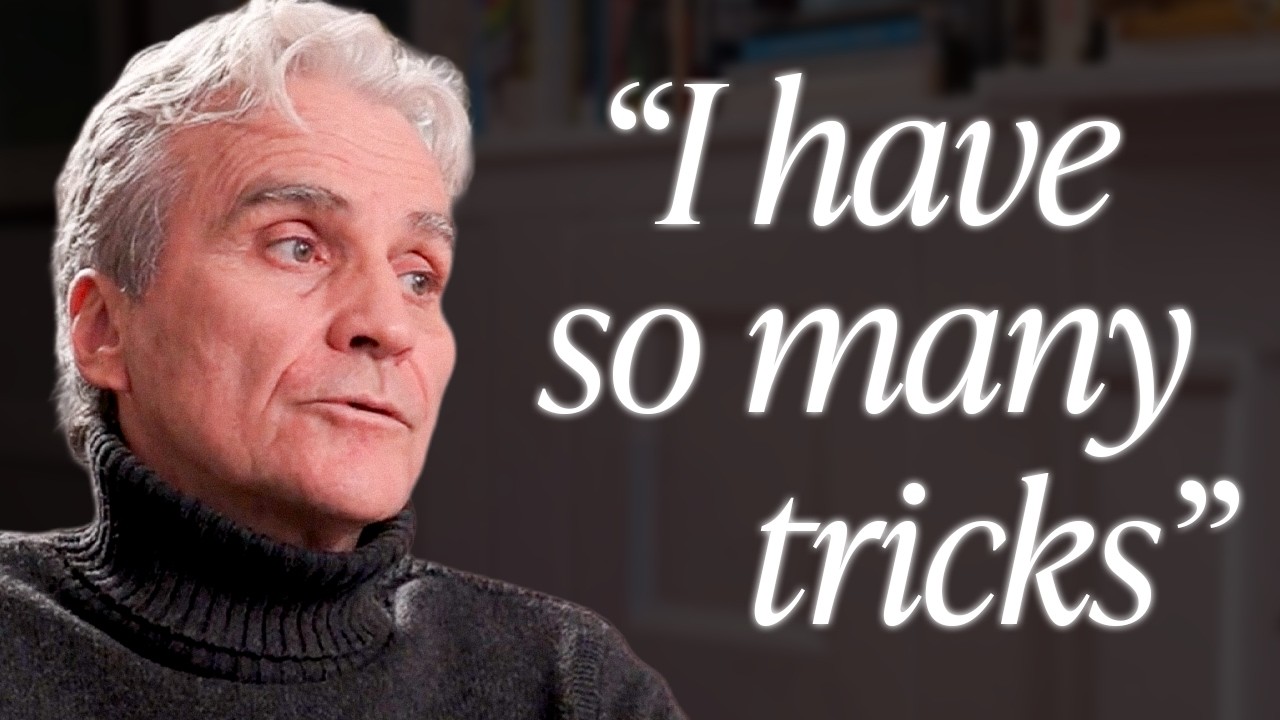
Tom Junod is a legendary long-form magazine essayist known for pieces like The Falling Man (about 9/11) and his iconic profile of Fred Rogers. This conversation explores his philosophy of writing: how he finds stories, constructs sentences, and uses writing as a tool for thinking and truth-telling. The episode builds toward a powerful climax where Junod describes organizing his personal bookshelf chronologically—from the Bible to Finnegans Wake—as an act of bearing witness to humanity’s contradictions, which becomes a metaphor for why human writing matters in the age of AI.
The art of a sentence
Junod’s guiding principle when writing is to make the hair stand up on his arms—a visceral, almost physical reaction to a sentence that feels alive.
He describes writing as walking a tightrope between privileged knowledge (deep understanding of a subject) and discovery (not knowing where the sentence will go until it arrives).
Great sentences emerge from rhythm, word choice, and balance—but not through systematic rules. For Junod, it’s intuitive and emotional.
The Falling Man: Bearing witness to the unspeakable
The piece centers on a famous photograph of a man falling from the Twin Towers on 9/11—appearing almost peaceful, “like an arrow” hurtling through the air.
Junod saw the photo the next day and immediately knew he had to write about it—but assumed someone else would. No one did.
The image became taboo: newspapers stopped running it, and the public averted their eyes. People didn’t want to confront that hundreds jumped to their deaths—a fact many found unbearable.
Junod was drawn to the contradiction in the photo: the man appears serene, even free, while accelerating toward death at 150 mph.
His writing moves fluidly between clinical objectivity (“accelerating at 32 feet per second squared”) and grand metaphor (“the creation of a new flag”), mirroring the tension between horror and grace.
The paragraph describing the falling man is a masterclass in observation: every detail—his posture, clothing, alignment with the buildings—is rendered with precision and reverence.
“Say the unsayable”
Junod’s core drive is to say what others won’t—not for shock value, but because silence distorts truth.
He’s drawn to stories marked by unresolved tension: beauty alongside corruption, goodness coexisting with violence.
This impulse began in childhood: his glamorous parents hid painful secrets (like his father’s affairs), teaching him early that what’s unsaid shapes reality.
His writing seeks to reconcile contradictions—e.g., Obama as both a good man and a drone strike author—not to resolve them, but to hold them honestly.
Ellipses and voice
Junod uses ellipses extensively—not as a stylistic tic, but as an homage to his father’s musical, pause-filled way of speaking.
His father was charismatic, vain, and deeply influential: a man who worshiped the sun, wore turtlenecks religiously, and spoke in dramatic cadences.
Junod’s book is written “in Pop’s language”—blending direct quotes with his own rhythmic prose shaped by that inheritance.
Why long-form?
Junod didn’t know magazine journalism existed after college. He sold handbags, wrote on business cards at night, and stumbled into his first assignment the weekend before his wedding.
His opening line—“Okay, I admit it. I wanted to skewer him”—was bold for a beginner, and the editor recognized raw talent.
He fell in love with long-form because it allows deep immersion, emotional complexity, and the space to explore moral ambiguity.
Lessons from Fred Rogers
Profiling Fred Rogers in 1998 changed Junod. Rogers had an almost telepathic emotional awareness, sensing what each person needed—trust, comfort, honesty.
Meeting Rogers opened a spiritual dimension in Junod’s work. He realized goodness is as mysterious as evil—and equally worthy of exploration.
Before Fred, Junod wrote mostly about human darkness. Afterward, he could write about redemption, compassion, and grace without sentimentality.
He credits Rogers with giving him the courage to write The Falling Man with love, not just objectivity.
Writing as thinking
Junod says he can’t think without writing. It’s how he processes chaos—“hammering a pillar into the ground” and tying himself to it.
He’s an “inertate rewriter,” constantly revising to find the “tonic chord”—the moment all discordant ideas resolve.
Early drafts often miss the point. One abandoned book draft was 230,000 words—and hadn’t even introduced the main characters.
Practical tricks to break through blocks
“This is a story about…”: Write a paragraph where every sentence starts with this phrase. It forces clarity and often reveals the story’s true core.
Write in second person: Cuts out extraneous material and creates immediacy.
Use caps, curses, Q&A formats—anything to bypass resistance and access raw honesty.
The goal isn’t polish; it’s getting the good stuff in. Many writers fail not from lack of skill, but from leaving out what matters most.
On endings
Junod doesn’t end on quotes if he can help it. He wants the final sentence to earn the right to stop.
A great ending doesn’t summarize—it resolves the emotional or intellectual tension built throughout the piece.
Truth as the core imperative
Junod grew up in a family of secrets. His father’s hidden life taught him that silence enables lies.
For him, writing is an act of truth-telling—not ideological, but personal and moral.
He’s drawn to stories where something is being hidden or denied, and his job is to name it without flinching.
Comic books and transformation
As a child, Junod devoured comic books—not for visuals, but for their narrative arcs of transformation and redemption.
Heroes like Batman and Spider-Man live with trauma and secret identities, trying to make right what went wrong.
This shaped his belief that storytelling is about bearing witness—to pain, joy, failure, and hope.
The bookshelf as anti-AI manifesto
Junod organized his shed library chronologically, from ancient texts to modern works.
This arrangement tells humanity’s story: a cycle of brilliance and atrocity, innovation used for war, religion twisted into tyranny.
Yet through it all, writers bear witness—grappling with suffering, recording truth, giving meaning to chaos.
He calls this the soul: not a metaphysical entity, but the human need to testify—to ourselves, to history, to something greater.
In an age of AI, he argues, this is the one thing machines cannot do: write from the soul, driven by lived experience and moral urgency.
To give up human writing is to abandon the only thing we’ve ever done right: bear witness to our own existence.