Lee Child, the English author of the Jack Reacher series (over 200 million books sold, a new copy sold every 9 seconds on average), explains how he writes commercially successful thriller novels — from choosing America as his setting, to structuring page-turner prose, to building a recurring hero, to the role of violence, dialogue, and clothing in fiction. He treats writing as both an art and a job, emphasizing propulsion, rhythm, instinct over planning, and the accumulated internal database built from a lifetime of reading and living.
Why America as the setting
Child chose to set his stories in America after being fired from his television job in Britain due to industry changes favoring Rupert Murdoch’s satellite business — he wanted to escape, at least narratively.
British crime fiction at the time was tightly focused, psychological, and geographically small (a few streets in London, a few square miles in Edinburgh), which didn’t suit his ambitions.
He wanted a mythic, legendary feel — the mysterious stranger wandering into an isolated community — which required a vast, frontier-like geography that Britain couldn’t plausibly provide.
He had visited the US 100 times over 24 years before immigrating in 1998 (his wife is from New York), giving him enough familiarity to write about it with an outsider’s fresh eye.
Creating a sense of place
He doesn’t plan locations in advance with index cards or plot-specific research; instead, he starts with a vague feeling — temperature is his primary instrument (hot vs. cold, hard vs. soft).
He thinks of it like a composer choosing a musical key: G major for cheerful, E-flat minor for melancholy.
The location and its temperature dictate what kind of story is plausible — indoor vs. outdoor, wandering vs. confined — almost setting the physics of the narrative.
He draws on impressions accumulated over decades of travel, never doing research specifically for a single book.
No outlines, no planning
He has never written an outline, synopsis, or plan for any of his books — not even a two-line-per-chapter summary.
Planning the story in advance would bore him; he needs to discover the story as he writes it, the same way a reader discovers it.
He starts with a location and a temperature, then improvises from there.
This is not as reckless as it sounds: after reading tens of thousands of books, he has an enormous internal database of plots, character types, and structures that guides his instincts.
The annual writing cycle
He starts every book on September 1st and delivers the manuscript in March or April, publishing one book per year.
After finishing a book, he goes through a period of self-doubt and creative emptiness in the summer, convinced each year that he’s washed up.
By late August, ideas start returning; by September 1st, a first line pops into his head and he’s running again.
The imagination is “biddable” — it can be quieted down and cranked up as needed.
Living for pleasure, not virtue
Child deliberately lives recklessly — he doesn’t exercise, he smokes, he does whatever he wants — as a reaction against a repressive, longevity-obsessed family upbringing.
At age eight, he decided his goal was to have more fun in 60 years than others would have in 100.
He belongs to what he considers the luckiest microgeneration in human history: born in post-war Britain with free education, a functioning NHS, no war, no secret police, no bombs — the first truly free generation.
That freedom is why the 1960s produced an explosion of creativity in Britain — the talent had always been there but was previously suppressed by necessity.
Writing as a commercial art
He treats writing as a job, not just a muse — he was fired and needed to make a living, so he approached it commercially and strategically.
He learned from theater that a show only exists if someone watches it; a book only exists if someone reads it. The audience must be part of the calculation.
He wants the maximum number of people to enjoy his work, which means satisfying both habitual, skilled readers at the center and the outer rings of Saturn — people who read one or two books a year.
This requires a style that is propulsive: the rhythm of each sentence must always tip forward, gently pushing non-habitual readers through without them noticing.
Propulsion: the key to page-turner books
Sentence rhythm is the primary tool of propulsion — each sentence’s beat pushes the reader to the next, like a great pop song that subtly speeds up (as Beatles live performances did with Ringo driving the tempo).
It’s like a carnival ride: once the reader is in the polished tube, there’s no getting out.
Question-and-answer structure is the easiest part of plotting: imply a question (any question) and readers will stick around for the answer. This is how television adapted to the arrival of the remote control in 1990 — by posing trivia questions before commercial breaks.
He absorbed this technique from 40,000 hours of television work; it’s baked into his DNA.
Chapter endings are instinctively obvious to him — he just knows when a chapter is done, sometimes realizing mid-scene that the entire book is finished.
The power of absorption
The goal is to make the writer feel the same thing the reader feels: desperate to know what happens next, angry at having to put the book down.
He once hoped his daughter wouldn’t come home on Christmas Day so he could keep reading — that’s the power of story he wants to create.
The secret to immersion is paradoxically to not try too hard — a lesson from David Mamet about actors: the worst thing a character can do is beg to be liked; the best is to be indifferent to whether the audience likes them.
If you like your own character, chances are a substantial proportion of readers will too — we share more culture than we think.
Believing two contradictory things at once
Writing requires believing two things 100% simultaneously (mathematically impossible but necessary): it is a noble art in a great tradition, AND it is a job your family’s income depends on.
He initially wrote out of financial necessity, but once successful, the contract became emotional — readers had invested in the series, and he owed them consistency and quality.
This means discipline and structure: showing up every September 1st, delivering every spring, never missing a year.
Building a main character
You cannot design a character to be liked — the more you try, the worse it gets. You also cannot design one to be hated (except for villains).
You must create an honest, authentic portrayal and hope for the best.
With Jack Reacher, Child thought nobody would like him — a filthy, dirty barbarian who shoots people in the back, lies, cheats, steals, never changes his clothes. He thought maybe some men would like him but women wouldn’t.
The key insight: he liked Reacher. And since he shares culture with millions of others, if he liked Reacher, many others would too. (He was right.)
Hannibal Lecter is the closest example of a main character you “should” hate but can’t — there’s something compelling about him.
Writing good dialogue
Real conversation is incoherent, stop-start, full of placeholders, with people jumping between subjects and long gaps — nothing like written dialogue.
Written dialogue is the ultimate illusion: it must feel natural while being structured and information-exchanging in a way real speech never is.
Rhythm and emphasis are key: construct sentences so the stress falls on the right word, the way a speaker would emphasize it, without needing italics.
Repetition creates emphasis naturally: “I need my money. I lost my money.” — the repeated words dissolve and the key words land.
In moments of high emotion, language becomes primal and simple, almost like song — reverting to rhythm and repetition, which may be humanity’s oldest art form.
The skill comes from listening: eavesdrop on trains, watch movies, watch TV, immerse yourself in how people actually talk.
Beginnings and endings
Don’t start when the earth cooled — many beginning writers give too much backstory (where the character grew up, went to school, who their parents were). Start in media res, in the middle of things, with something intriguing.
End when the story is over — judge this on a gut, instinctive level.
Readers want all loose ends tied up. Child experimented with leaving things unexplained, letting readers decide what happened to a minor character — readers hated it. They want the author to do the work.
On timing your career: don’t start too young. Read for 20 years first. You need life experience and content. But also know when to finish before you get worn out and boring.
The internal database of a creative
Successful writers in his genre almost always have a first career (journalist, lawyer, etc.) that involved writing for an audience.
By the time you reach the writing phase, you’ve internalized structure, plot types, character archetypes — not from outlines but from consuming tens of thousands of books.
Great creatives are total consumers first: Martin Scorsese watched a movie every night; musicians can recall how different countries sound; interior designers know every type of tie.
Writers write one book a year but read hundreds — they are predominantly readers, and their internal supply of reference and stimulation is enormous by midlife.
Writing violence
Real violence is over quickly and has terrible medium-term effects — if you get hit in the head, you’re sick and dizzy for a week, not bouncing back for another round.
Bar fights are lame — no style, no technique, just swiping and brawling.
Violence in fiction is an illusion, like dialogue, but readers want it because civilized society’s rules (law, due process, rights for the accused) are frustrating when someone has wronged you.
Readers are committed to liberal civilization but love the consolation of seeing fictional violence as a release — getting the satisfaction without real consequences.
Child grew up in a manufacturing city where every dispute became a fight, so he has personal experience to draw on, but mainly he’s tuning into people’s secret hidden desires.
His bookstore event line: “The reason you like Reacher is that even though you are good, civilized people, you all have a list of 10 people you would cheerfully shoot in the head.”
Clothing and physical details as character shorthand
Clothing is a quick symbolic reference: a long gray ponytail and double denim signals one type of person; lace-up Oxfords and pleated chinos signal another.
Teeth work the same way — a snaggletooth, missing teeth, wolf-like teeth — a dental hygienist fan wrote to him about every teeth reference in his books, revealing he was doing it instinctively.
These are efficient ways to sum up a character through a single visual detail.
Can writing be taught?
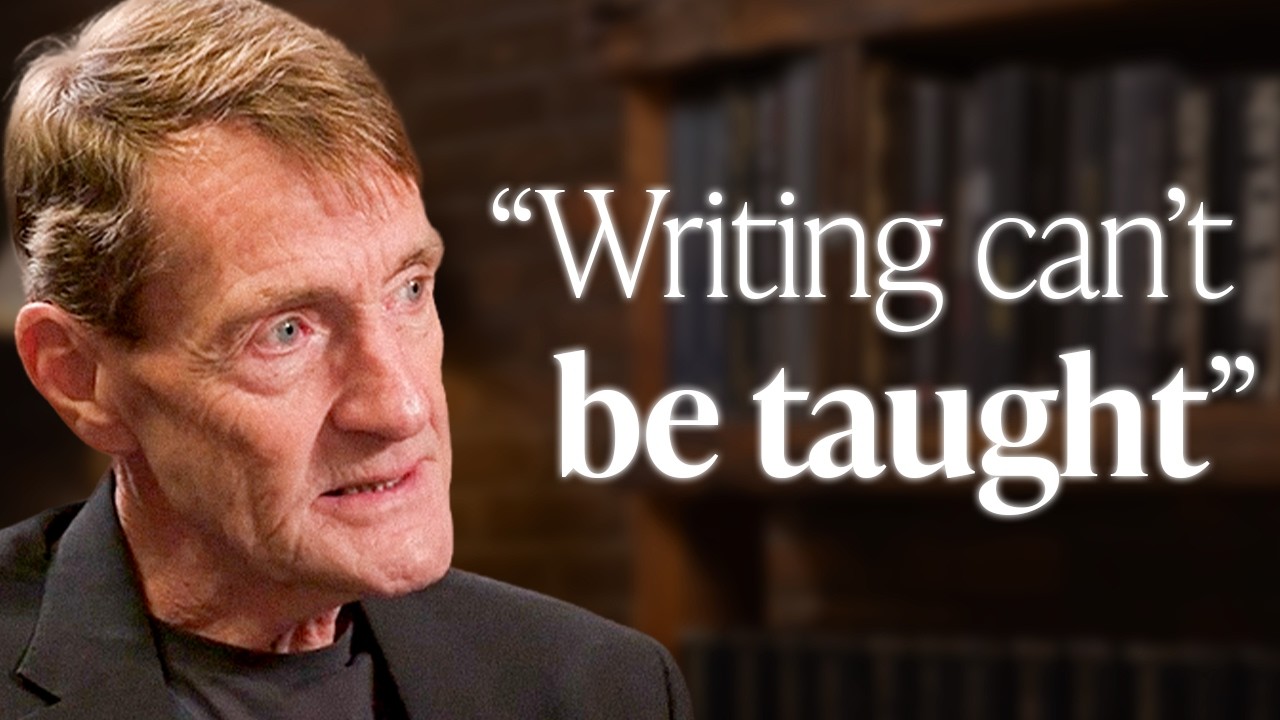
Child would turn down a university teaching gig. He doesn’t think writing is teachable, though the business side (getting an agent, avoiding pitfalls, relating to publishers) absolutely can be.
You can learn to write, but mostly through doing it — reading tens of thousands of books and figuring it out over years. A teacher might accelerate that slightly, but only partially.
It’s like being a musician: the neural pathways are either there or they’re not. Some tubes in the brain are open, others are collapsed flat.
He made a CD with musician friends (he wrote lyrics, they did music) and observed that their brains are wired differently — different tubes open, different tubes closed.
Why the UK produces so many good writers
Scotland: feels neglected and resentful of England’s power concentrated in London, so Scots build up an alternative culture that’s theirs.
Ireland: gives everyone a chance. In a pub, if you start telling a joke or a story, people will listen — maybe only 5 or 10 seconds, but you get the stage. If you’re crap, you lose it, but you got the chance. This makes people grow up feeling they will be heard, which emboldens them.
Child’s Irish friends all know how to tell a joke and a story — if you can hook people in a pub, you’re part of the squad.