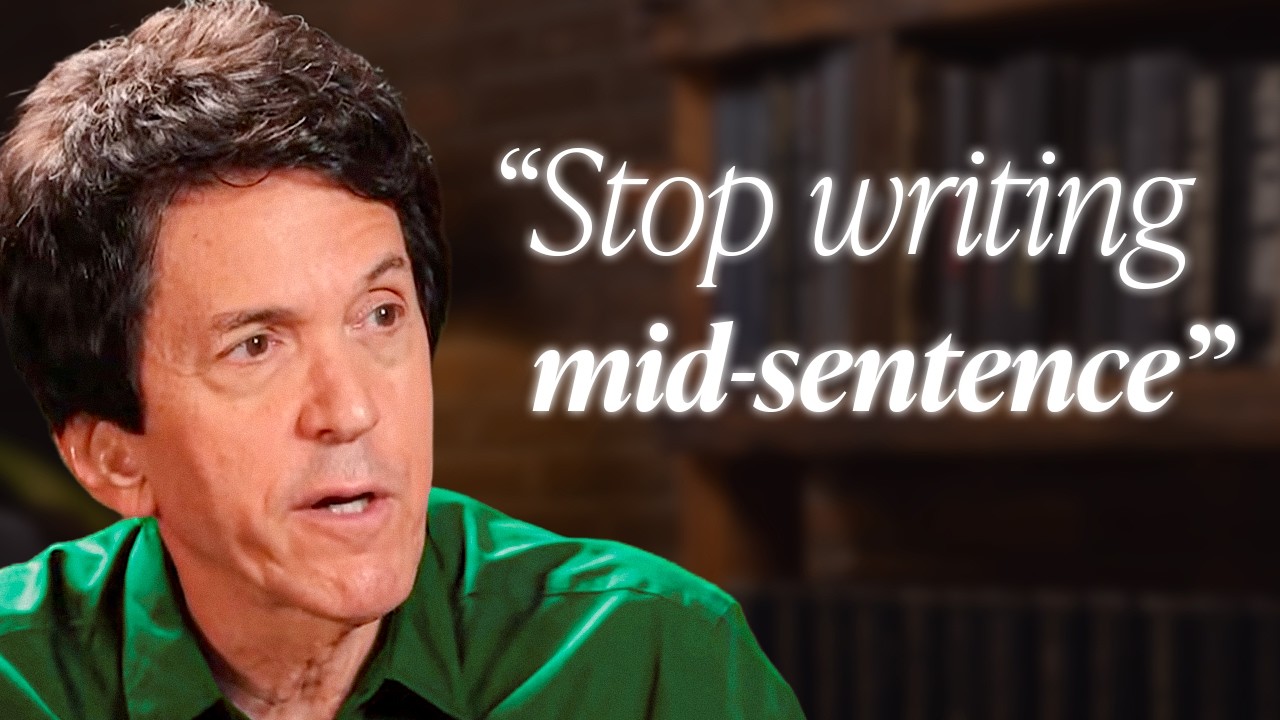
Mitch Albom is a bestselling author of 14 books, including Tuesdays with Morrie and The Five People You Meet in Heaven, with over 40 million copies sold across a 45-year writing career. He joined the show to talk about the craft of writing: how he builds characters, hooks readers, develops themes, and structures stories.
Serve the story above all else
Albom’s core principle is to always serve the story, whether writing novels, nonfiction, or journalism. He stays tethered to one central idea and avoids wandering too far from it, even when tempted by interesting anecdotes.
In journalism, the first and last paragraphs work together, creating a clear arc. In novels, he always knows the ending before he starts, even if the middle changes. This gives him a “north star” to sail toward.
He learned storytelling at the dinner table growing up, watching his immigrant relatives tell stories. His aunts got bogged down in details; his uncles pushed the action forward. His uncle Eddie’s war stories, told with vivid immediacy, became his model.
Working with children at the orphanage he operates is another training ground: you can see in their eyes when attention fades, which teaches you to stay on track.
Slow parts fast, fast parts slow
Albom agrees with the storytelling maxim of moving quickly through slow parts and slowing down for the fast, dramatic moments.
As a young writer, he was criticized for taking too long to make points, so he overcorrected by whittling his sentences down. His books are now notably short and tight, sometimes half the length they’d be at standard formatting.
He acknowledges he may now err on the side of moving too quickly, compensating for his early tendency to linger.
Theme first, then story
Albom always starts with a theme, not characters or plot. He identifies a universal idea he wants to explore, then builds a story around it.
The Five People You Meet in Heaven was not about heaven; it was about people who don’t think they matter. Heaven was simply the vehicle to deliver that theme.
His newest book, Twice, explores the idea that the grass is always greener, specifically in love. The premise, a man who can relive any moment twice, was invented to serve that theme. The critical rule in the story is that he must live with the consequences of the second try, which becomes the mechanism for the lesson: if you keep correcting mistakes without learning from them, you never grow.
He knew from page one that his character would make a mistake with love, discovering that true love, once walked away from, can never be reclaimed.
What makes a good premise
For Albom, a good premise is one that makes readers think about their own lives after they finish reading. He doesn’t aim to be praised as a literary artist; he wants people to say, “I couldn’t stop thinking about that.”
Tuesdays with Morrie was written to pay medical bills for his old professor, but it resonated because Morrie’s words touched universal themes. Readers have told Albom it changed their lives, reuniting them with loved ones or helping them face terminal illness.
He aspires to make each book make readers think about at least one theme the way Tuesdays with Morrie makes them think about many.
Writing simply and tightly
When writing Tuesdays with Morrie, Albom realized he couldn’t match the poetic, flowery writing of other authors who had written about death. Instead, he chose to write as simply and directly as possible, letting Morrie’s words carry the story.
The book was contracted for 320 pages but came in at 160. The publisher decided to print it as a small-format book, which became Albom’s signature style for all subsequent works.
He admires Joan Didion’s writing, described as so “tightly it cuts the flesh,” and adopted that as his own goal: say only what needs to be said.
He self-edits obsessively, rereading his work so many times he can recite it from memory. He rewrites beginnings many times, though an editor once told him he was being too much like a sports writer, trying to hook readers in the first paragraph. The editor reassured him that book readers give you more than one paragraph.
By the time he turns in a manuscript, he has usually removed far more than he has added. He keeps editing until the publisher physically pulls it from his hands.
Building a writing routine
Albom’s deadline discipline comes from his years as a sports writer for the Detroit Free Press, where early printing deadlines in Michigan’s Upper Peninsula meant writing columns before games even ended. He once wrote both a winning and losing column simultaneously during a championship game, switching back and forth with every basket in the final minutes.
He treats writing like a job: he writes every day, typically three hours in the morning starting around 7 a.m., with no music, news, emails, or internet. He stops around 10 a.m. when his “gas tank” is empty.
He tries to stop mid-sentence or mid-paragraph, on a positive note, so he’s excited to return the next morning rather than dreading a stuck point.
Through his band, the Rock Bottom Remainders, which includes Stephen King, Amy Tan, Dave Barry, and others, he observed that nearly all successful writers treat it like a job, showing up daily rather than waiting for inspiration.
Finding the story in everything
In journalism, Albom looks for stories away from the main action. He cites Jimmy Breslin’s famous JFK assassination column, which focused on the man digging Kennedy’s grave rather than the grand national narrative, capturing the nation’s grief through one small, meticulous detail.
At the Barcelona Olympics, while other reporters focused on Carl Lewis, Albom saw Derek Redmond pull a hamstring during a 400-meter heat. Redmond’s father ran from the stands and carried his son around the track to finish. The father explained he had taught his son to run by putting the boy’s feet on his own feet. Albom chose that story over the Lewis race, and it became one of his most famous columns.
The key is finding the universal human theme that everyone can relate to, even if the specific event is obscure.
Pacing and rhythm
Albom thinks about pacing like a movie: monitoring whether the reader’s “heartbeat” is getting too fast and inserting quieter moments to provide relief. In The Little Liar, set during the Holocaust, he added a gentle scene about a grandfather taking children to a tower to give readers a breather from relentless darkness.
He works hard at chapter endings, stopping at a suspenseful moment and switching to another thread, keeping the reader wanting to return.
Structure varies by book: multiple voices, dual timelines, reverse chronology. Each requires different rhythmic choices, but all come down to rhythm.
His background as a musician gives him an innate sense of rhythm in writing. His wife noticed he rocks back and forth when writing is going well and stops when it isn’t. He rereads constantly for rhythm, ensuring sentences and ideas flow into one another without disturbing the reader’s natural cadence.
He compares this to how the body responds to music before the mind does, tapping a foot before consciously recognizing a song. Good writing works the same way.
Writing for the reader, not yourself
Albom writes 98% for the reader. He doesn’t pursue personal passions unless they overlap with what readers will care about. He loves 1950s doo-wop music but won’t write a book about it because music is hard to convey in words and the audience would be limited.
He collects book ideas by emailing himself with the subject line “book idea,” then reviews the file when it’s time for a new project. He has never suffered from writer’s block.
He frames even small details for the general reader. Instead of saying a batter hit .333, he says “one out of three times he comes to the plate, something good happens,” so a grandmother in North Carolina can relate as easily as a diehard fan.
Characters must transform
Albom’s main characters must undergo a transformation; otherwise the story isn’t interesting. He establishes where they start and where they end up, then figures out how to change them along the way.
In The Five People You Meet in Heaven, Eddie begins as an 83-year-old maintenance worker who feels like a nobody. Albom spends the first chapter establishing his loneliness through small, quiet moments, then transforms him through the discovery that his life had meaning he never knew about.
In Twice, the main character is introduced at the end, already older and arrested, then the story moves backward to show how he got there. Other books, like The Magic Strings of Frankie Presto, follow a character linearly from infancy to old age.
Humility in writing about faith
Writing about faith and God requires humility, Albom says, and that humility produces the most beautiful writing. When you’re caught up in the majesty of life rather than your own ego, different words come out.
He admires Marilyn Robinson’s Gilead, a novel about a dying pastor writing to his young son, for its exquisite humility.
In Have a Little Faith, he tells the story of a rabbi who kept a file labeled “God” filled only with questions and notes, which Albom came to see as perfect: God is a series of questions and the answers we believe we’ll one day hear.
The rabbi left a tape to be played at his funeral in which he said he’d been asked two questions most: Do you believe in God? (Yes.) What happens when we die? (By the time you hear this, I’ll know, but I can’t tell you. You’ll have to find out for yourself.) Albom sees this as the essence of faith.
Love as a theme
Twice is Albom’s first book where love itself is the central theme. He explores the universal tendency to second-guess our love lives: wondering about the person we didn’t pursue, whether someone else’s relationship is better, what would happen if things changed.
He believes he couldn’t have written this book earlier in life; it took decades to understand the difference between passion and love, lust and love, crushes and love.
Most love stories focus on the “combustible” part, how the flame gets lit. Albom is more interested in the nurturing part: how you keep the flame going, blow on the embers, and maintain a warm fire for life. A flame can be extinguished or burn down the house; what you do with it after ignition is the real story.
The novel’s protagonist, Alfie, has the magical ability to relive any moment twice. He and Gianna fall in love as children, reunite in college, and build a happy life. But years later, in a moment of anger and temptation, he uses his power to walk away and try something else, only to discover that true love, once rejected, cannot be reclaimed. Gianna still exists in the world, still knows him, but the feeling is gone forever.
Albom contrasts loss of life with loss of love: in loss of life, the person is gone to another place; in loss of love, the person is right in front of you, but what you yearn for is gone. He references the song “Trying to Get the Feeling Again” to capture that yearning.
He read the finished book to his wife (who hasn’t read any of his books in the usual way) and she responded with a kiss and a hug at the end. He dedicated the book to her, acknowledging that he hasn’t always appreciated the constant love she has provided.
He reflects on two real moments that illustrate his theme: an elderly couple who come to a restaurant every Saturday, where the husband gets his frail wife a vanilla ice cream with quiet devotion; and a 62-year-old man, divorced over a decade ago after his wife’s affair, who still carries the agony of lost love in every word he speaks.