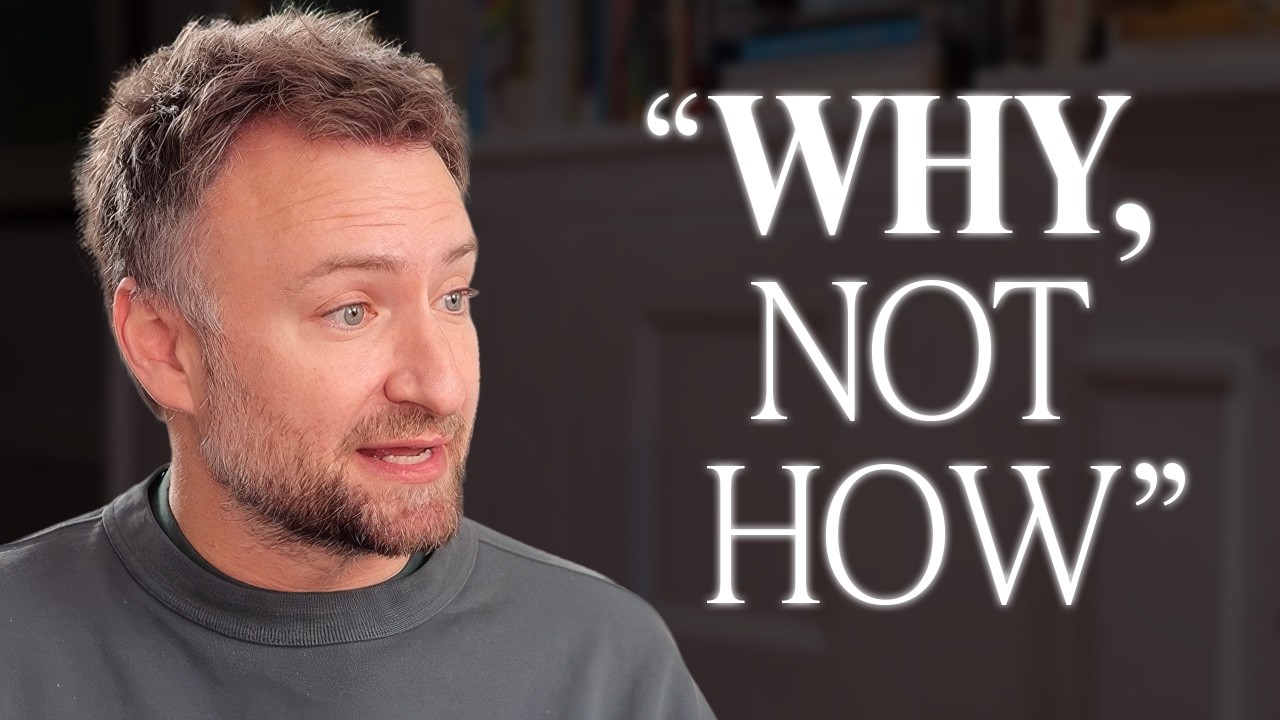
David Gelb is the director of Jiro Dreams of Sushi and the Netflix series Chef’s Table, and this conversation explores his philosophy of documentary storytelling, how he brings characters to life, and the craft of making cinematic nonfiction. The core idea running through the episode is that great storytelling—whether documentary or fiction—is fundamentally about character, emotion, and transformation, not information. Gelb’s approach has been shaped by decades of intimate access to the world’s greatest chefs, and the lessons he draws from them apply far beyond food.
Character First: The Foundation of Story
Gelb’s central lesson, learned during the making of Jiro Dreams of Sushi, is that all good storytelling is character-driven. He originally conceived the film as being about sushi as a subject—different styles, techniques, and traditions—but realized during production that the characters were what made the material resonate.
Information alone is forgettable; emotion makes it stick. Rather than explaining step-by-step how egg sushi is made, Gelb shows the apprentice attempting it hundreds of times, weeping when he finally earns the master’s approval. When that egg sushi lands on the bar at the end, the audience feels its weight because character emotion has been infused into the object.
This principle carried directly into Chef’s Table, where viewers learn almost nothing about how to cook anything but come away understanding why these chefs cook—which is what makes the show endure.
The Origin Story as the Key to Motivation
Gelb is deeply influenced by comic book storytelling, particularly the concept of the origin story. He directed the Stan Lee documentary and draws a direct line between superhero mythology and documentary character work.
Spider-Man’s origin—a bullied teenager who gains power, uses it selfishly, and only discovers purpose after his uncle’s death—is Gelb’s model for understanding any character. The line “with great power comes great responsibility” only lands because the audience has witnessed the origin.
In Jiro, the origin story reveals why Jiro works with such obsessive dedication: his father was an alcoholic who died young, and Jiro never learned how to be a father himself. This absence explains both his devotion to craft and the personal cost of that devotion.
For every Chef’s Table episode, the team seeks the formative moments that explain why a chef does what they do—not just how they do it. The “why” is the mystery each episode tries to solve.
Planning Versus Discovery
Gelb’s process balances preparation with openness to discovery. For Chef’s Table, the team researches each chef thoroughly and builds an outline of their life story before filming begins. But the real story often emerges during production.
The Grant Achatz episode (Season 2, Episode 1) is a prime example. The hook—a chef who loses his sense of taste—was known in advance, but the emotional depth of the story emerged through long, probing interviews conducted over two weeks of filming.
Directors on Chef’s Table conduct very personal, extended interviews, sometimes sharing their own vulnerabilities to create reciprocity. Many chefs have described the experience as being like therapy because the questions go deeper and last longer than typical food media interviews.
Gelb’s mantra is to “lean into the truth”: if the story turns out differently than expected, the filmmaker must have the humility to follow what actually is rather than forcing the material into a preconceived template. Audiences can sense when something has been fabricated or shoehorned.
The Tools of Cinema: Elevating Craft to Reflect Craft
Gelb’s visual and sonic philosophy is rooted in the idea that the filmmaking should match the level of mastery being documented. If a chef is pursuing perfection, the film should pursue excellence.
Cinematography: For Jiro, Gelb used the Red One camera, then a breakthrough in digital cinema, to achieve a visual quality that honored the precision of Jiro’s work.
Music: Gelb builds playlists at the start of every project to establish a sonic landscape, then shares them with editors who may add their own discoveries. For Jiro, he drew heavily on Philip Glass, whose repetitive, escalating refrains mirror Jiro’s own philosophy of incremental improvement—“two steps forward, one step back.” Classical music (Mozart concertos) was also used to draw a parallel between Jiro’s sushi and a musical performance.
Temp music and collaboration: Gelb’s long-standing relationships with editors and cinematographers (his Jiro editor was his high school roommate) create a shared aesthetic language. They audition music tracks, feel the energy, and iterate.
Passion, Not Perfection
Jiro’s own philosophy—that perfection is unattainable but the pursuit itself gives life meaning—is central to Gelb’s worldview. He references Ira Glass’s “taste gap” concept: creators have a level of taste that their current skills cannot yet match, and the pain of that gap causes many people to quit. The only way through is to keep doing the work.
Gelb is candid about the emotional arc of making a film: dailies feel exciting, the assembly (first full cut) is “the worst thing you’ve ever seen” and triggers self-doubt, and the real work of editing is finding something new that neither replicates the original vision nor abandons it entirely. The finished film ends up somewhere in between.
He emphasizes the importance of finishing and moving on rather than getting stuck in endless revision. Therapy, he notes, helps manage the disappointment inherent in the creative process.
The Tables Turn: Surrendering to the Work
Gelb describes a critical moment in every creative project where the creator must stop forcing their original vision and start listening to what the work itself wants to become. In documentary, this is especially important because real people and real events will not conform to a script.
He calls this “leaning into the truth”—if the story is not what you thought it was, you make the movie about what it actually is. The audience can detect inauthenticity, and forced narratives are unsatisfying.
Quantity First: Shooting for the Edit
Gelb follows the cinematographer Cesar Charlone’s principle of “quantity first”—shoot a great variety of material rather than repeating the same takes. More choices in the edit reveal what’s working and where the holes are.
Jiro was shot in two phases: Gelb shot what he thought was the complete film in a month, went through the despair of the assembly, identified what was missing, and then built the second half of the movie based on what the edit revealed. This two-stage process is central to his method.
Hooking the Audience: The First 10 Minutes
Gelb thinks carefully about openings. While Chef’s Table doesn’t need to grab viewers in 10 seconds (as on YouTube), it must hook them within 10 minutes, because on Netflix the friction to switch to something else is essentially zero.
He models his openings on James Bond cold opens: drop the audience immediately into something gripping—action, drama, or a compelling question—before the credits roll.
In Jiro, the opening poses the philosophical question “What is deliciousness?” while showing peaceful, meditative images. In the Massimo Bottura episode, the cold open is the earthquake that destroyed thousands of Parmigiano-Reggiano wheels in Modena—a dramatic hook that doesn’t even need to fit neatly into the episode’s overall arc.
When openings feel cheesy or forced, Gelb says it’s because the filmmakers are not leaning into the truth—they’re trying to manufacture excitement rather than finding what’s genuinely compelling about the character.
Landing the Ending
Gelb considers the ending the most important element and recommends figuring it out as early in the editorial process as possible. Knowing where you’re going shapes every decision along the way.
In Jiro, the ending crystallized around the relationship between Jiro and his son Yoshikazu, who works in the restaurant and must live in his father’s shadow. The discovery that Yoshikazu was the one who actually earned the Michelin stars provided proof that the mantle had been passed. But the deeper lesson of the film is that the journey itself is the destination—the effort of chasing an unattainable dream is what makes a life worth living.
Lessons: Implicit Versus Explicit
Gelb distinguishes between films with clear themes and those with ambiguous, layered meanings. Jiro has a clear theme—persistence, dedication, craftsmanship—that resonated powerfully with American audiences unfamiliar with that level of devotion. But Hayao Miyazaki’s Spirited Away operates differently: its themes are more like a Zen koan, open to interpretation.
Gelb challenges the common reading of Spirited Away: Chihiro is not optimistic at the start—she’s anxious and depressed about moving. Her “special power” as an outsider in the spirit world is that she hasn’t been conformed to its power dynamics, so she can act with clarity and compassion (inviting No-Face onto the train, for instance) where others are paralyzed by fear.
The plot goal in Miyazaki’s films is always clear (save the parents, get home), even when the thematic meaning is ambiguous. In Chef’s Table and Jiro, the goal is more abstract: the pursuit of perfection that can never be reached. The drama comes from watching someone commit to that impossible task and revealing the sacrifices it demands—Jiro’s son not recognizing his own father because he was never home.
The False Victory and Story Structure
Gelb is a strong advocate for understanding conventional story structure, particularly as laid out in Blake Snyder’s Save the Cat, which breaks down the beats of successful films with specific page numbers and plot points.
The false victory (or midpoint) is a moment where the protagonist seems to have achieved their goal, lulling the audience into a sense of security before things get much worse. In Titanic, it’s the romance blossoming just before the iceberg hits. In The Lord of the Rings: The Fellowship of the Ring, it’s the formation of the fellowship and moments of hope before the ring begins to divide them and Gandalf falls.
The dark night of the soul follows: all is lost, the hero is at their lowest point, and they must look inward to discover the lesson they were supposed to learn. This self-awareness propels them into the third act.
The broad principle: a character enters a story wanting something, but what they want is not what they need. The film’s journey is them discovering this and accepting who they truly are. In documentary, the audience itself becomes a character on a journey—they think the film is about one thing, and then it becomes about something else. Exit Through the Gift Shop is Gelb’s example: you think it’s about Banksy, but it becomes about Mr. Brainwash.
Cinematic Versus Informational
The core distinction between a cinematic documentary and an informational one (like a YouTube explainer) is emotion versus information. Gelb initially thought Jiro would be informational—teaching viewers about sushi—but realized he wanted to make a movie with a story.
People remember information because of the emotional context surrounding it. A purely informational documentary is forgettable; a character-driven one endures.
Chef’s Table deliberately teaches almost nothing about cooking technique. Its longevity comes from being about character journeys, not facts.
Writing Throughout the Process
In documentary, writing happens at every stage, but the heaviest writing is at the end, in the edit.
Pre-production: Writing takes the form of an outline—a biographical backbone that guides interview questions. The team selects chefs because they can see a hero’s journey arc in their lives: talent discovered, used wrongly, a lesson learned, and then purpose found.
Production: Writing happens through the choices of what to film. Schedules are built (interviews, cooking sequences, hometown visits), but room is always left for improvisation and unexpected discoveries.
Post-production: The real writing is in choosing which words appear on screen. Editing is writing. Gelb’s principle for dialogue is “what are the fewest words to get the idea across?”—cutting in service of clarity and forward momentum.
Pacing: The Feeling of Boredom
Gelb’s approach to pacing is intuitive: “make it not boring.” His method for calibrating pace is to watch the film with another person. The presence of another viewer dramatically heightens sensitivity to slow or dull moments.
His editing process is self-correcting: the assembly is too long, the second cut is too aggressive (overcorrected), and the right pace is found somewhere in the middle.
He acknowledges that faster is not always better. Cinematic pacing requires comfort with space and oxygen—moments where the audience can breathe. The key is knowing where to place those moments.
Creators have so much context that they may overestimate or underestimate how interesting something is to an audience. Watching with others and getting trusted feedback closes this gap.
Feedback: The Doctor-Patient Relationship
Gelb has a specific framework for processing feedback: treat it like a doctor-patient relationship. The audience (the patient) can tell you where it hurts, but they shouldn’t prescribe the treatment.
When receiving notes, he asks: “What did the movie mean to you?” “What was the story?” “Were there parts you didn’t understand?” He wants to know where he’s losing the audience, not what specific changes they think he should make.
The symptom (confusion, boredom, misunderstanding) must be separated from the prescribed solution. The filmmaker’s own taste and intuition must determine how to address the problem. Overcorrecting based on feedback leads to a fragmented, people-pleasing work that loses coherence.
He references the concept of Gesamtkunstwerk—the total work of art, where every element is harmonized under a single creative vision (as in Frank Lloyd Wright’s Guggenheim, where even the water fountains echo the building’s spiral motif). The challenge is maintaining that unity while still being responsive to genuine problems.
The Courage to Be Difficult
Gelb notes that many of the greatest filmmakers—David Fincher, James Cameron—are known as difficult because they are uncompromising about their vision. When a studio told Cameron to cut the flying scenes in Avatar because each minute cost $10 million and the scenes didn’t advance the story, he refused: “Because I want to see it.” The film made billions.
There is a balance: Gelb also acknowledges the need to be flexible and willing to change (he cut four rice scenes down to one after watching with an audience). But the changes must come from the filmmaker’s own judgment, not from trying to please everyone.
When making something new and different, you will get notes that it doesn’t feel like anything people have seen before. That may be exactly why it’s good.
Editing Dialogue and Scene Construction
Gelb’s editing principle for dialogue is to use the fewest words possible. Every scene must move the story forward. He thinks in terms of “cutting to something, not away from it”—each cut should advance momentum rather than requiring the audience to rebuild it.
He prefers cutting to a response rather than back to a reaction, keeping the scene moving forward. Great actors can convey intention without words, and some of the most powerful scenes are entirely wordless—he cites the record store scene in Before Sunrise, where two potential lovers communicate everything through eye contact and body language in under a minute.
His film school at USC required early student films to have no dialogue, forcing students to tell stories through visuals and interaction. “To show without saying—that’s the dream.”
What Makes a Good Scene
Gelb defines a scene as a moment in time where something changes. A character enters a scene with a goal or expectation and must leave with something different. If nothing changes, the scene has no purpose and the story has nowhere to go.
This applies to both present-moment scenes (filmed in real time) and biographical scenes (described in interviews and illustrated with archival material). The interweaving of these two types of scenes is how Chef’s Table builds its narratives.
For Chef’s Table, the team uses structural “buckets”—types of scenes that are known to work (cold open, opening credits, critic’s analysis, farm visit, hometown reflection)—and finds nuance in how to connect them.
At the level of the entire film, the same principle applies: the audience enters thinking the story is about one thing and leaves having discovered it was about something else. That gap between expectation and revelation is what creates satisfaction.
Knowing the Rules to Break Them
Gelb’s defense of studying formulaic screenwriting books like Save the Cat is that you need to know conventions before you can meaningfully break them. Understanding structure allows you to subvert audience expectations in ways that feel fresh rather than confused.
Snyder’s breakdowns of major films help Gelb understand why sequences of events unfold as they do, how themes stated early pay off later, and how beats like the false victory and dark night of the soul function. This structural literacy is a skeleton, not a straitjacket.
The Trap of “Be the Best”
Gelb closes with a personal reflection on a family mantra passed down from his grandfather: “You can do anything in the world you want—just be the best at it.” While inspiring on its surface, Gelb has come to see “be the best” as a trap.
If your identity depends on being the best, you’re constantly comparing yourself to others, and it will never be enough—“best” is subjective, and even if you achieve it, you won’t hold it forever. The healthier approach is to focus on doing the thing rather than worrying about whether you’re the best at it. This connects back to Jiro’s philosophy: the pursuit itself, not the attainment, is what gives life meaning.