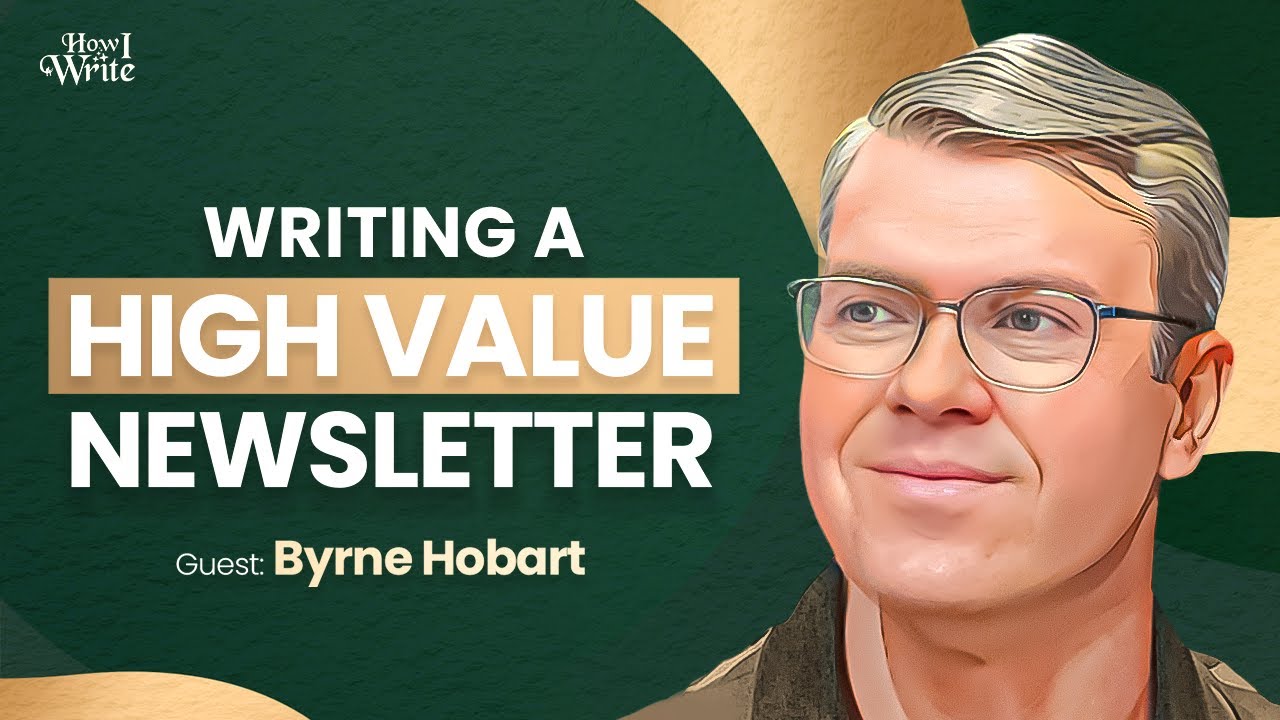
Byrne Hobart is a full-time newsletter writer whose Substack, The Diff, has over 50,000 subscribers — many of them startup founders, venture capitalists, and highly curious knowledge workers in Silicon Valley. He writes deeply analytical pieces on tech, finance, and business, often uncovering non-obvious structural insights about industries and companies. Before going full-time, he wrote the newsletter while working a full-time job, waking up at 5 a.m. every day to write. The conversation covers his process for generating ideas, his views on writing as a technology for thinking, the economics of newsletters, work ethic, and how he thinks about audience, quality, and creative output.
Building and storing ideas
Byrne maintains a large running file of ideas — some are one-sentence prompts like “look into company X,” others are questions, and some evolve into paragraphs with links, quotes, and arguments.
The writing process is often just copying from the notes file and shaping it into a post.
Other times, a post starts as a topic and accumulates research, quotes, and points over time before being hammered into a coherent piece.
His viewpoint sometimes shifts mid-draft, which he sees as a good sign that the thinking is evolving.
Links as leading indicators
His Saturday links newsletter sometimes signals upcoming writing, especially when he’s reading books to build background on a company or industry he plans to cover.
But many long-form links are just things he enjoys reading on weekends — not everything is a signal.
He tries to add commentary to the links, asking meta-questions like “why did this get written?” and “who is talking to the journalist and why?” — because understanding the incentives behind a story is as important as the story itself.
Why scandals make better business writing than success stories
Success stories are inherently less dramatic: a company grew, hired VPs, made shareholders happy.
When a company fails, former employees have free time and motivation to talk, each framing the story to absolve themselves.
This means scandal-era sourcing is rich but biased — every source has an incentive.
Even in non-scandal reporting, if a scene involves two people and one looks bad, the other one is likely the source.
Depth of understanding and reading
When you’re new to a topic, you retain maybe 30–40% of what you read. As an expert, you can understand 150% — because every sentence connects to a web of existing knowledge, letting you see through surface claims.
Byrne argues that reading is superior to video for information density and for cognitive affordances like backtracking, Ctrl+F, highlighting, and annotating.
Video is better for tacit knowledge — things like assembling furniture or fixing a drain — where watching someone’s hands matters.
His heuristic: if you’re optimistic about economic growth and a services-oriented future, be a reader. If you’re pessimistic and think we’ll need to repair things ourselves, be a video person.
Corporate writing cultures
Amazon uses six-page memos. Meetings start with everyone silently reading. Bezos always finished last — partly careful reading, partly signaling that nothing should be skipped.
Bill Gates at Microsoft sent multi-page emails to journalists the day after receiving questions, with thorough supporting information.
A key insight: companies get in trouble because early ambitious communications (emails, PowerPoints) come back years later when the company is bigger and more threatening.
GitLab (fully remote) uses a wiki-based reference culture — static documentation that makes processes and roles legible and transferable.
Amazon and Microsoft use a “working memory” model — writing loads knowledge into decision-makers’ heads for specific decisions, then the document becomes a husk.
This feels wasteful but the process of writing is where the real value is — forcing clarity, anticipating objections, and stress-testing arguments.
Writing flattens hierarchy: in a meeting, people defer to the boss; in a memo, you can’t tell who wrote what, so ideas are judged more on merit.
Should companies be weirder?
Yes, especially when small. Companies should optimize for the culture they want and cap headcount if necessary.
There’s no point sacrificing lifestyle gains for money you don’t have time to enjoy.
Companies like pre-IPO PayPal and Bridgewater had reputations for flat hierarchies where entry-level employees could (and did) push back on CEO memos — and were rewarded for it.
The hit rate of such criticisms may be low, but the alternative — a CEO insulated from ground truth — is worse.
Effort, output, and what makes a piece successful
Byrne wishes the correlation between effort and impact were higher. His favorite, most labor-intensive pieces don’t always perform best.
There is a slight correlation between length and performance — longer pieces are more likely to become the definitive take that people cite and share.
He aims to be the last important piece on a topic, not the first. Being first is a one-dimensional race (speed); being last important is two-dimensional (timing + quality), which is more winnable.
He can’t fully predict what will resonate. The gas station piece — about how stations make money on foot traffic, cigarettes, and lottery tickets rather than gas itself — did extremely well, and he attributes much of it to the “huh” reaction: filling gaps in people’s knowledge that they didn’t know they had.
The Diff’s evolution and network effects
Started as a free side project while he was employed full-time. Went paid in early 2020 when COVID made job interviews unlikely.
The timing was excellent: white-collar workers suddenly had extra time from eliminated commutes and were consuming work-adjacent content.
After about a year, he noticed incredibly smart readers — founders with contrarian theses, deeply curious non-founders — and started connecting them.
This network has grown faster than the subscription business and has different math: if subscribers double, the writing’s value roughly doubles, but the number of possible connections more than doubles.
Retention, memorization, and writing as a thinking tool
Byrne was motivated to write partly because he felt he wasn’t retaining what he read. Writing about things as he reads them dramatically improves retention and comprehension.
His version of spaced repetition is contextual: thinking about what he’s read in light of something else he’s read, finding parallels and contrasts.
He’s a strong advocate for memorization over pure lookup. Having facts at your fingertips increases intellectual mobility and the speed of making connections.
Cites a blog post about a team from an IDF information warfare unit that memorized everything because they worked in secure environments without Stack Overflow — and it made them far more fluent.
Work ethic and the decision to go all-in
Byrne’s principle: pick a domain where effort can be the differentiator, because only at the extreme tails does talent separate people — everywhere else, it’s work.
On a micro scale, this means choosing a narrow enough topic that you can become the person who has worked hardest on explaining that one thing.
He acknowledges the family caveat: extreme success means nothing if you’ve ignored your kids.
He draws a parallel to Robert Caro’s multi-volume biography of LBJ — Caro moved to Texas hill country for two years, interviewed people who only talked because LBJ was dead or because they had dementia, and pulled every possible thread. That level of effort is a form of cheat code.
On comparing work ethic across people: it’s nearly impossible, because some cultures brag about effort and others perform effortlessness, and subjective experience of effort varies (ultra-marathon runners may not feel the 20th mile the way others would).
His practical strategy for maximizing output: block the day into calls, deep research, and email, and recognize that there is no hidden time — if it’s 4 p.m. and the calendar is full until kids come home, the work has to happen now.
Distractions (social media, games) are always getting better, so resistance strategies must keep evolving.
Voice, style, and the writing process
Byrne doesn’t consciously cultivate a voice. He’s developed tricks over time through volume of writing, but he can’t easily dissect how a great sentence got that way.
He admires David Foster Wallace’s specificity — Wallace would describe a 1974 tennis racket with the exact string quality, not just “a tennis racket.” His notes (archived at UT Austin) show him pulling descriptions from eBay listings into his prose.
Ben Cutatralle’s line: most writers have an iPhone photo of what’s happening; Wallace has a 13K resolution image you can zoom into in 3D.
Byrne’s own writing style trades maximum compression for a high density of distinct insights per paragraph — more “pop rocks of ideas” than a single thesis unpacked at length.
This works because his audience already has context on tech and finance; he doesn’t need to explain what AWS is.
In less-covered industries (like liquid natural gas), the tradeoff between technical depth and accessibility becomes much harder — and the risk of getting an angry email from a 30-year industry veteran is real.
Titles and discoverability
Titles matter but Byrne doesn’t have a reliable system. Sometimes he lucks into a good one (a friend wrote “Back That SAAS Up” in a research report on Microsoft’s cloud move).
He sometimes writes the title first and discovers it no longer fits the piece — the core idea ended up as a deleted footnote.
In a Twitter-centric world, the headline matters less than individual sentences people will quote-tweet or paragraphs they’ll screenshot.
Social groups and idea generation
Byrne finds that conversations function as an algorithm for randomness — the back-and-forth produces thoughts he wouldn’t have had alone.
Writing the newsletter is itself a cheat code for this: it attracts knowledgeable readers who respond with corrections, alternative views, and deeper context.
He deliberately writes about topics he’s less certain about to invite feedback from people who know more.
He’s not particularly extroverted and doesn’t actively curate his social network — people ping him more than he pings them. Writing does the networking for him.
Closing thought
Byrne gets daily metrics on readership and direct feedback (both praise and criticism), which is highly motivating. The feedback volume is more predictable than its direction — five compliments usually means five complaints.
The most surreal and gratifying experience is hearing from someone that a piece changed their thinking, and realizing he doesn’t remember writing it. That’s the compounding return of producing a large body of work for a large audience.