Matt Haig, author of The Midnight Library (over 10 million copies sold, 288,000+ Amazon reviews), discusses his writing process, the tension between commercial and literary instincts, how AI reshapes the value of human creativity, and why trusting your own taste matters more than chasing bestseller lists.
Writing process: stop-start, percolation, and the impulse to rush
Haig describes his process as “90% stop, 10% start” — long periods of percolation where ideas linger in the brain, often while traveling or away from the desk, followed by intense bursts of drafting driven by fear of forgetting the idea.
Writer’s block for him is not a lack of ideas but an inability to choose which one to pursue; he often has to write an idea to discover whether it works.
Titles sometimes arrive before the story (e.g., “The Memory Thief” sat for years without a concept); other times the title comes last and simplifies the premise (e.g., The Library of Lost Lives → The Midnight Library).
He does not outline linearly; he knows the concept, title, and characters, then discovers the plot while drafting — “fishing in your own imagination.”
First drafts feel rushed (“every sentence starts with ‘and then’”); he even has “and then” tattooed on his wrist as a reminder of this habit.
The rush gets the story down; embellishment and depth come in editing.
Editor relationship: 15 years with Francis Bikmore
Haig has worked with the same editor, Francis Bikmore, for 15 years; the relationship matters because he knows Bikmore’s taste, can distinguish personal preference from general reader feedback, and can translate Bikmore’s sometimes-too-nice notes into actionable cuts.
Editing often reveals structural problems: a flagged paragraph may signal a character or premise that doesn’t belong.
With The Humans, Haig cut 40,000 words from an 80,000-word first draft and added 55,000 new words between drafts one and two.
First drafts feel complete to the writer because they’ve lived inside the book; the editor’s outside eyes are essential to see what’s actually there.
Diminishing returns set in around the fourth or fifth round — over-editing can make the book worse, like over-produced EDM that loses the “messy, chaotic, alive” quality of a live band.
AI vs. human creativity: mistakes, mutations, and the “human-made” premium
Haig’s optimistic take: AI will force humans to be more human. AI is a perfectionist that wheels out mistakes; life evolves through mutations and errors. Human creativity works the opposite way — “we create more beautiful mistakes.”
True creativity creates what doesn’t yet exist; AI only recombines what has existed. As AI floods the market with competent, backward-looking work, the value of “weird, messy, human” art will rise.
In 20–30 years, “human-made” may become a label like “organic” or “fair trade.” Readers will crave the feeling of another consciousness behind the work — art as a way to feel less alone.
If art’s function is to ease pain and create connection, AI (which isolates) cannot fulfill it. We’ll become more forgiving of imperfection, more hungry for voice and soul.
The risk: art becomes like modern art, chasing shock and novelty for its own sake. But AI can replicate novelty; it cannot replicate felt experience articulated in a new way.
Short words hit harder: “sparrows fly higher than peacocks”
Haig favors monosyllables — home, sky, love — over the British literary tradition of valuing the rare, “elevated” word.
Simple words carry “infinite archetypal power” because they are the most shared and understood; they connect readers across difference.
Ending a chapter on a word like sky or home leaves a note of universality.
No word is forbidden by virtue of being common (“nice” has subtleties); it’s about how you use it.
First drafts vs. editing: fishing imagination vs. monotonous familiarity
First drafts are exhilarating because everything is new — the writer is the first reader, dictating from imagination. Fiction lets you write “what you don’t know you know,” entering a dreamlike flow state where interesting, unplanned material surfaces.
Editing is inherently repetitive and familiar; the novelty is gone. The challenge is to keep the book alive while fixing structural flaws.
Non-fiction first drafts are confined to known facts; fiction accesses the subconscious — “entering your own dreams.”
What a story is for: a vehicle for emotion, not just plot
Plot is the vehicle; the payload is a feeling or thought the writer wants to deliver. Early books (e.g., The Possession of Mr. Cave) were bleak reflections of Haig’s depression; later work seeks “authentic optimism” — light found inside darkness, not easy unicorns-and-rainbows hope.
A concept must be simple enough to articulate in a sentence. The Midnight Library arrived as a simple idea that became simpler with the right title.
Two traps derail writers: the commercial trap (people-pleasing, chasing the market) and the literary trap (writing to impress, win awards, be taken seriously). Pure writing means finding an inner voice immune to both.
Trying to be commercial fails because publishing looks backward (books on tables today were conceived years ago). The only reader you truly know is yourself — write the book you’d want to read.
Breakthrough via The Humans: being dropped, writing for yourself
The Midnight Library was roughly Haig’s 20th book. He’d been rejected and dropped by publishers; with a newborn, zero money, and debt, financial pressure might have pushed him toward a “safe” commercial book.
Instead, the “devil-may-care” freedom of having nothing to lose led him to write The Humans — a genre-blending, tonally strange novel about an alien in a human body. It didn’t fit any market category but was “very much me.”
That book became his biggest UK success at the time. Writing from nervousness and self-consciousness, pushing past it, signals the work that will resonate.
The alien premise gave him distance to write intimately: readers later told him it captured the autistic experience. Years later, Haig was diagnosed autistic himself — he had written what he didn’t know he was living.
Children’s books as the purest writing
Children are the best readers: close to imagination, willing to follow a unicorn down a London street without a quantum-physics explanation. Adult novels demand justification; children’s books demand only belief.
When stuck on an adult novel, Haig asks: “What’s the children’s story version of this?” The Midnight Train began as an AI dystopia; borrowing the “magical train” trope from The Polar Express, Harry Potter, The Railway Children unlocked it.
Winnie-the-Pooh is “the ultimate self-help book.” A.A. Milne, traumatized by WWI (PTSD), created the Hundred Acre Wood as a safe world. Each character maps to a mental state (Piglet = anxiety, Eeyore = depression, Tigger = ADHD, Owl = dyslexia/narcissism, Pooh = addiction, Christopher Robin = mass hallucination). Troubled minds often create the most comforting worlds.
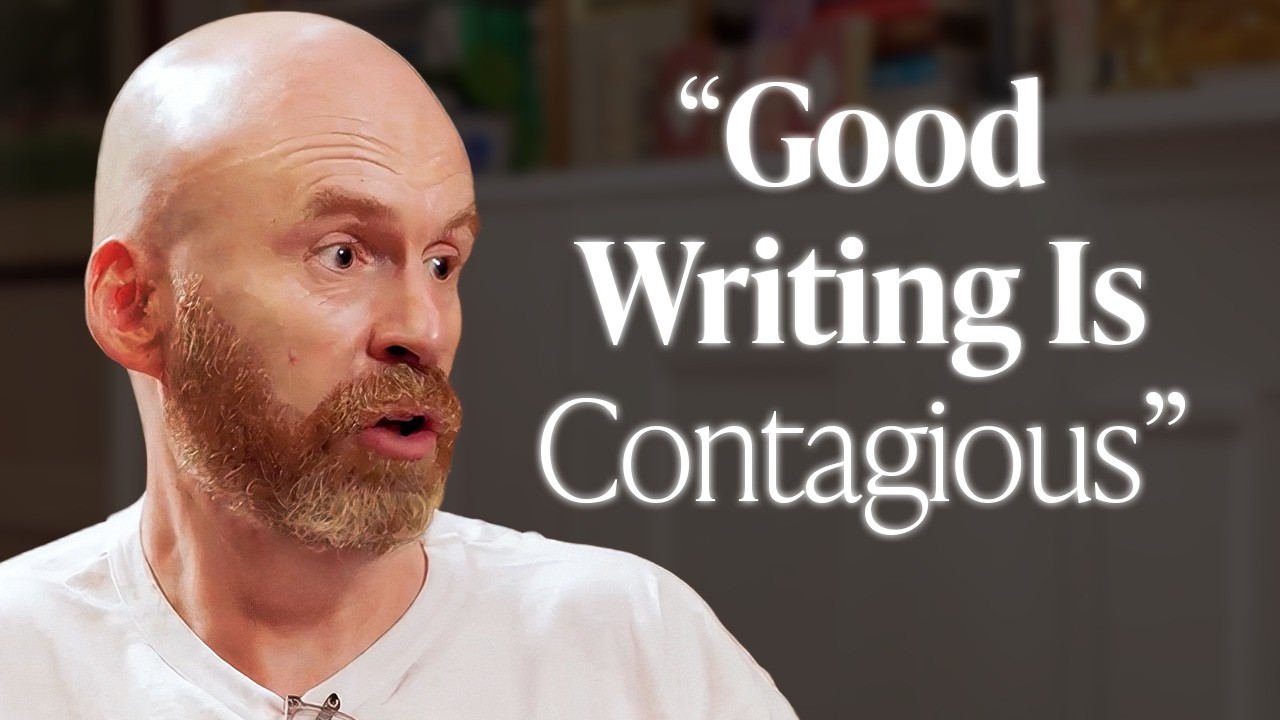
Feelings are contagious: what the writer feels while writing, the reader feels while reading. Enjoyment in the drafting phase transfers to the page; duty-driven word counts don’t.
Originality, ADHD, and not boring yourself
There are no new stories, only new ways of telling them and new emotional truths carried through them. Haig’s ADHD drives an originality contest with himself — he won’t reuse character names, won’t bore himself.
The hardest narrator to write is someone like him (middle-aged man). In the first draft of The Midnight Library, the protagonist was Adam, a man; Haig nearly quit because he couldn’t see him — “you don’t know what you look like because you’ve seen yourself too much.”
Switching to Nora (different gender, age, location) paradoxically let him pour more of his own mental illness, regret, and guilt into her. Distance created intimacy.
Ambition and the “always another level” trap
Haig admits: “If we were number two in the bestseller charts, the only book we’d think about is the one selling more.” Before publication, he thought a book deal would bring permanent happiness; each milestone (bookstore tables, bestseller lists, foreign rights, NYT #1, adaptations) revealed a new horizon.
The drive isn’t purely crude status or money; it’s partly about being understood. As a troubled teenager, he wrote to find others who shared his “weird thoughts.” Success = “I’m not that weirdo, or I found the other weirdos.”
He’s turned down more money (e.g., a non-fiction deal he wasn’t comfortable with, film adaptations that didn’t feel like him). Defining a career by what you say no to matters as much as what you say yes to.
Early in his career he wrote marketing/business books for a paycheck — it felt pointless, but the frustration fueled his desire to write what he actually cared about.
“I write to be read and understood as me. Writing for readers and writing for myself is the same impulse.”
Publishing, class, and finding your box
Haig grew up in a working-class town but felt “posh” (teacher mother, architect father); in publishing, he felt “not posh enough” (no expensive school, no top university). UK publishing is class-coded.
His literary influences span Virginia Woolf and T.S. Eliot and Choose Your Own Adventure, John Hughes movies, The Borrowers. Early on, a highbrow publisher made him self-consciously literary; being dropped forced him to find his actual voice.
He still doesn’t fit one box — and likes that. His proudest achievement: no specific demographic at his events (men, women, young, old). He writes for shared empathy across difference.
Trust your own taste
Haig demystifies the commercial/literary divide: commercial = they find what they’re looking for; literary = they don’t; a middle ground = they find it in the next unwritten chapter. “What’s wrong with comfort? What’s wrong with hope?”
Critics often treat sentimentality as the ultimate sin. Haig recalls a music magazine where critics savaged a band he loved; the song brought him joy — he trusted his feeling over their verdict.
Trusting your own taste, your own feelings, your own response — without needing a gatekeeper’s approval — is essential for a writer (and a human). Stubbornness protects the boundary around your work.
He tells his son: don’t check Reddit for the collective opinion. “What did you feel? That is your correct response.” Before sending a book out, Haig tries to remember his own unmediated feeling about it — because outside voices easily overwrite it.