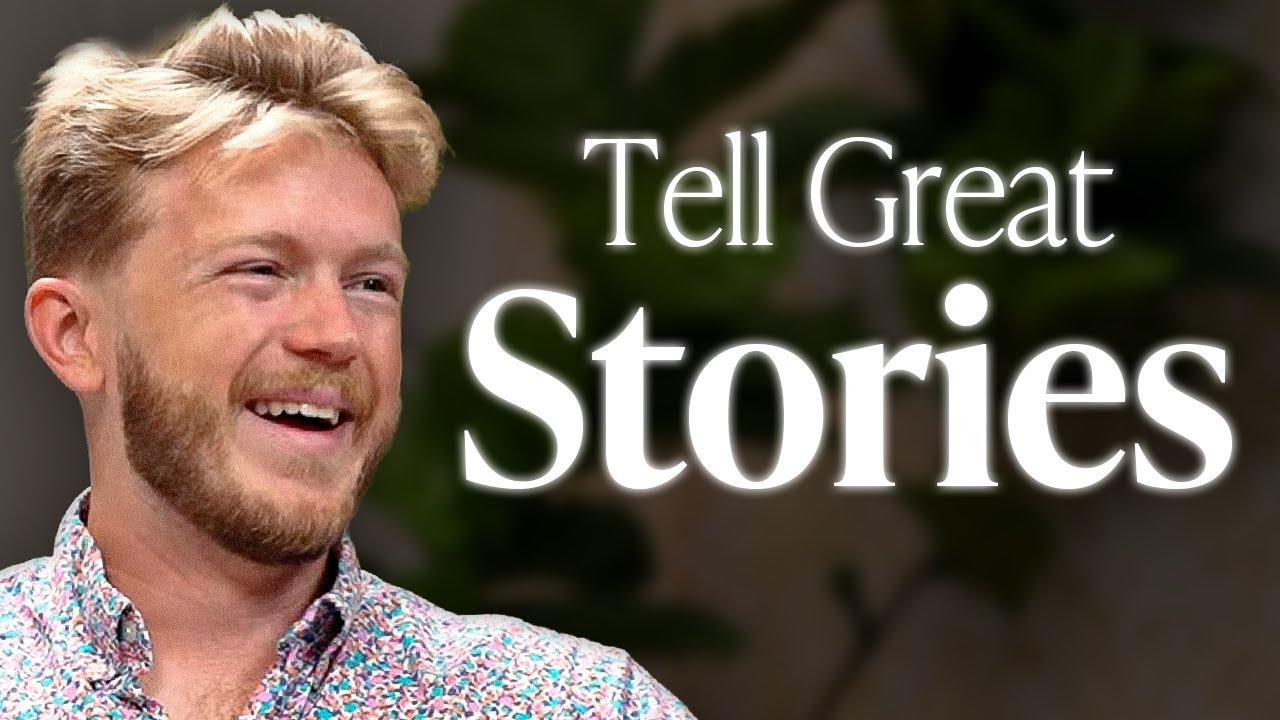
Nat Eliason spent two years reinventing his writing style—from concise how-to internet articles to emotionally rich, narrative-driven books—culminating in Crypto Confidential, a non-fiction book about the wild world of cryptocurrency told through personal stories, high stakes, and literary craft.
He realized that to truly captivate readers and spread ideas widely, he needed to master storytelling, not just information delivery.
This shift was driven by the insight that most people don’t read short manuals—they read stories, and stories are what endure culturally.
His journey involved studying great writers, rethinking audience, embracing vulnerability, and developing practical frameworks for compelling narrative.
Learning to write with emotional honesty
Nat was deeply influenced by David Foster Wallace’s willingness to expose raw, painful emotions—especially around addiction, despair, and suicide—without holding back.
Wallace’s power comes from honesty: he makes readers feel they’re not alone in their anxieties or inner turmoil.
Nat applied this to Crypto Confidential, writing scenes so emotionally intense he couldn’t reread them or even read them aloud without breaking down.
He credits a mutual friend, Nathan Bos, with pushing him to add more interiority—what he was thinking and feeling—not just action.
Example: A scene where his team debates launching a risky token. Originally flat, it became powerful when he added his internal conflict after receiving a brutal message from a crypto figure telling them to “quit being a pussy and ship it.”
That tension—between reckless industry norms and real human consequences—came alive only after he showed his hesitation and moral discomfort.
The Grammarly problem: preserving voice vs. conforming to rules
Nat warns against over-editing and relying too heavily on tools like Grammarly, which strip away stylistic uniqueness in favor of generic “correctness.”
Great writing often breaks rules deliberately: long sentences, missing dialogue tags, fragmented structure—all used to create mood or urgency.
Example: In Crypto Confidential, he wrote entire sections with no dialogue or setting tags—just rapid-fire quotes—to mirror the manic, chaotic energy of crypto trading.
He argues that hiring too many editors or following formulaic advice (like private equity optimizing a company) kills artistic distinctiveness.
Pop music analogy: some artists engineer hits; others prioritize authenticity. You must choose which you want.
Writing for multiple audiences
Nat wrote Crypto Confidential for three distinct groups:
Crypto insiders – who lived through the events and wanted to feel seen.
Partners of crypto enthusiasts (mostly women) – who were bored or confused by the obsession.
Parents – who feared their kids were wasting their education on speculative tech.
He took feedback from non-crypto readers (especially women like his wife Cosette and sister) far more seriously than from experts, because they revealed where the story was confusing or dull.
This helped him balance technical depth with narrative excitement, using structural tricks inspired by Anthony Bourdain’s Kitchen Confidential: embed explanations in side chapters so they don’t slow the main story.
Promise, Progress, Payoff: the core of captivating stories
Nat adopted Brandon Sanderson’s framework: every good story has a promise (what the reader will experience), progress (movement toward resolution), and payoff (a satisfying conclusion).
The promise must be compelling immediately—or readers quit.
Example: Atlas Shrugged opens with “Who is John Galt?”—a mystery that sustains 1,000 pages despite weak dialogue.
Contrast: Dune had a slow, unclear promise; many readers dropped it early, though fans later evangelized it.
You can get away with a mediocre payoff or slow progress—but never a weak opening promise.
Creating stakes without melodrama
Stakes don’t require earthquakes or death—they can be psychological, relational, or existential.
The number one reason people stop reading is they don’t care about the conflict.
Nat opened Crypto Confidential with: “I’m getting thrown out of bed… my baby is crying… I’m about to lose $100 million of other people’s money.”
This creates multiple forms of “death”: financial ruin, loss of identity, relationship breakdown.
Even mundane situations can have stakes if something meaningful is at risk of ending—identity, trust, community.
Crafting effective dialogue
Good dialogue isn’t realistic—it’s purposeful.
Real conversation is 80% filler; story dialogue must advance conflict or reveal character.
Key techniques:
Tension: Characters should disagree or challenge each other—even friends.
Redirection: Instead of yes/no answers, surprise the reader (“We already scheduled two hours!”).
Non-verbal responses: A character leaving without speaking can be more powerful than any rebuttal.
Every scene should follow intention + obstacle: what the character wants vs. what blocks them.
Scenes end in “yes, but…” (success with a catch) or “no, and…” (failure with added consequences), raising stakes each time.
Braiding: the mark of advanced writing
Great writers weave together four elements seamlessly:
Action – what happens
Dialogue – what’s said
Description – sensory details of the environment
Interiority – thoughts and feelings
Bad writers use only one or two (e.g., action + dialogue in a “white box”).
Example of braiding: noticing the fridge’s organization while getting water, hearing records on the wall, thinking about sparkling vs. still—all in half-sentences woven into conversation.
Editors see braiding as a key differentiator between good and great writers.
Using AI as a writing partner—not a replacement
Nat uses Novelcrafter, an AI fiction tool, but emphasizes: out-of-the-box AI writing is bad.
Success depends on detailed prompting: feeding in plot synopses, character bios, 30,000 words of his best writing as a style sample, and a custom checklist of rules (e.g., “never use adverbs,” “show don’t tell,” “avoid ‘he said loudly’—use ‘he shouted’”).
AI helps most when he’s stuck: generating descriptions (his weakness), suggesting plot turns, or offering alternatives he can react to.
Analogy: Like Miranda Priestley in The Devil Wears Prada—AI doesn’t create; it presents options for a skilled editor (the writer) to accept, reject, or refine.
Over time, using AI this way helps close the “taste gap”—you absorb better techniques by seeing them applied in your voice.
The taste gap and the long game
Nat references Ira Glass’s “taste gap”: beginners know what good work looks like but can’t yet produce it—a painful but necessary phase.
He admits he’s still in it: he sees flaws in his work that others don’t notice.
Danger: if the gap stays open too long, it can destroy you (as it did David Foster Wallace).
Healthier mindset: “It’s good and it can be better”—not “it’s bad.”
Mastery takes decades:
Steinbeck called East of Eden the book he’d prepared for his entire life—Grapes of Wrath was just a warm-up.
Seinfeld is 70 and still improving; Cormac McCarthy published his final book a month before dying.
Nat has only been writing books seriously for two years—he’s okay with Crypto Confidential not being perfect, because he’s playing the long game.
Overcoming isolation in long-form writing
Moving from instant-feedback internet writing (tweets, newsletters) to a two-year book project was psychologically brutal.
No dopamine hits, no reader reactions, constant self-doubt.
He coped by building a TikTok following (reaching 100k+) to get validation—but eventually quit because it distracted from writing.
Solution: built a simple writing tracker app (like Strava for writers) to log daily word counts and share progress socially—giving small wins without publishing prematurely.
Final insecurity: will anyone care?
Despite finishing both Crypto Confidential and a sci-fi novel, Nat’s biggest fear is silence—not bad reviews.
A confusing Publishers Weekly review stung, but he reframed it: being reviewed at all is an achievement.
He accepts that most books aren’t finished by readers—and that’s normal.
His goal isn’t instant success, but continuous improvement: each book better than the last, reaching wider audiences over time.