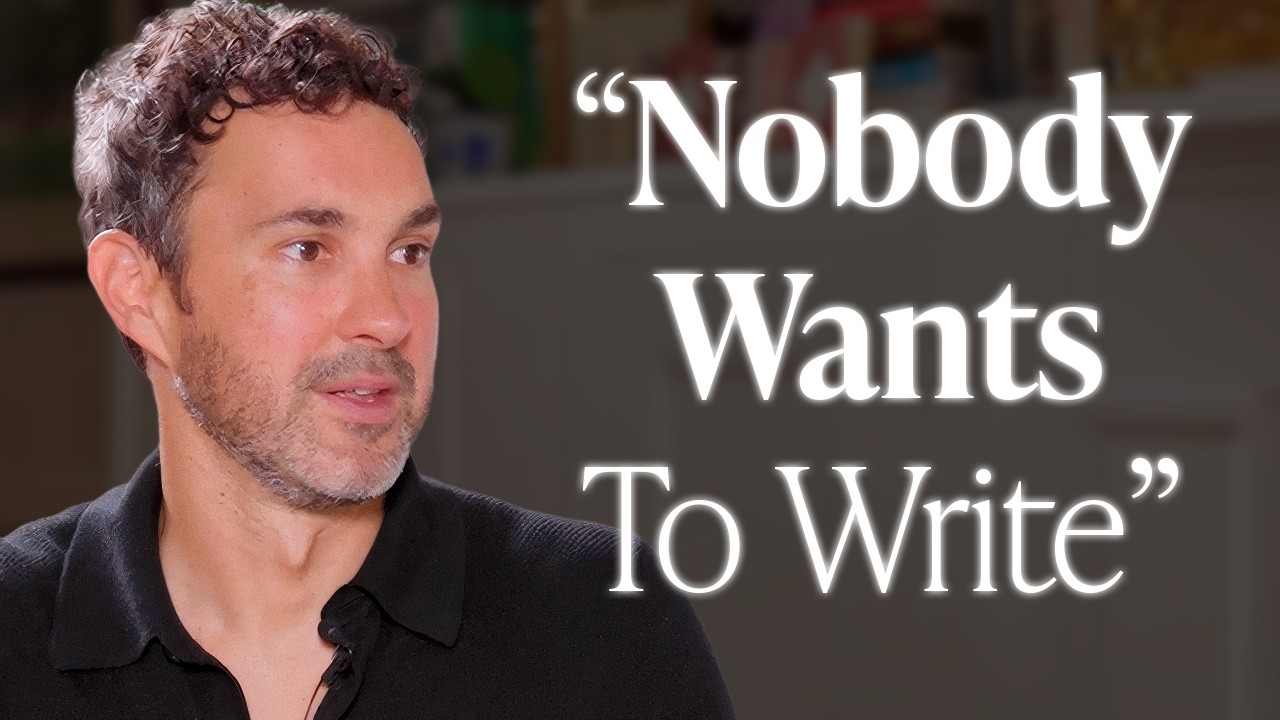
Mark Normand, a comedian with multiple Netflix specials who moved to New York in 2006 as an unknown, breaks down the craft of comedy writing — from generating premises to structuring jokes, learning from legends, and the grind of turning raw ideas into polished material that works on stage and screen.
Why comics avoid writing
Writing forces you to confront the blank page and prove you’re actually funny; most comics prefer “writing on stage” because it’s easier than staring at failure.
Normand paces while writing, holding a pen like a microphone, letting movement unlock ideas before transferring bullets to a larger notebook for full drafting.
He handwrites because screens feel restrictive — cursors, scrolling, and formatting interrupt the flow; paper lets him scratch, rearrange, and go anywhere instantly.
A joke is a “house of cards”: change one word and it can collapse, so once a version works, he memorizes it exactly and stops tweaking.
The process is iterative: write, perform, adjust a word or pause, repeat — sometimes thousands of times — until the phrasing is optimal.
What Mark learned from the greats
Groucho Marx: combined surreal, cartoonish physicality with sophisticated, tightly written one-liners (“I shot an elephant in my pajamas…”); proved silliness and precision aren’t mutually exclusive.
Jerry Seinfeld: mines humor from minutiae and everyday logic gaps (e.g., thanking the wrong person for a check); taught Normand to move on stage and hide the machinery — make it look like natural behavior, not a performance.
Larry David: goes darker — race, religion, taboo — and builds whole episodes around psychotic-but-true observations; showed how far you can push if the structure holds.
Chris Rock: values accessibility — when Demetri Martin called a Chappelle joke “a little easy,” Rock said “That’s why it’s good”; making a smart idea look simple is a skill, not a flaw.
Louis C.K.: masters the “of course, but maybe” structure — gets the audience laughing at safe premises, then escalates to uncomfortable truths, making them complicit; the payoff only works because the setup was meticulous.
Bill Burr: loses the room on purpose, creates tension, then reclaims it with a twist that retroactively justifies the discomfort; requires bombing repeatedly to learn the line.
How far a joke can go
The best edgy comedy uses sequencing: agree, agree, agree, then stretch — by the fourth provocation, the audience follows because they’ve been led there.
Normand admits he’s “a wuss” who wants a laugh every 10 seconds; fear of silence drives his faster pace, rooted in childhood need for validation.
Great comics “stay with problems longer” (Einstein) — they bomb repeatedly on a bit because they sense a core truth, trusting the process over the crowd’s immediate reaction.
Podcasts vs. stand-up
Podcasts are pure improv: you riff on what’s given in real time; stand-up lets you write, hone, and perfect a bit over months or years.
Many comics kill on podcasts but deliver weak live sets; the skills don’t fully transfer.
Late-night couch appearances are harder than stand-up — part prepared, mostly off-the-cuff, with cameras and a live audience; “killing on the couch is way harder than killing on stage.”
The industry has shifted: comics once waited for gatekeepers (Letterman, HBO); now they’re one-person media companies (clips, tweets, podcasts, road gigs), doing far more work for autonomy.
You have to dig deep
Nate Bargatze’s “George Washington” sketch exemplifies depth: takes a simple premise (founding the country) and drills down layer by layer — metric system, football vs. soccer, kicker exception — each level funnier because the structure forces the logic deeper.
Clean comedy hits harder because the idea itself must carry the weight; no “easy parachute” of shock or crudeness to fall back on.
Simplicity is necessary: the audience must click in immediately — no “wait, I get it now” — which is why stereotypes (however uncomfortable) function as shared shorthand.
Bargatze’s persona (“I’m kind of dumb”) lets the audience recognize their own dumb moments; the joke works because they feel seen, not mocked.
Rapid-fire round: anatomy of a joke
Setup: easy — just set the table simply and concisely.
Twist (punchline): the hard part — must surprise and make sense; requires thinking ahead of the audience’s expectations, which get savvier over time.
Example — WNBA joke: setup (wife likes lesbian porn, he likes interracial) → compromise (watch WNBA) → tag (“paid her horribly” — callbacks WNBA pay gap + prostitution frame). Every piece adds up; no one sees the combination coming.
Developed in a Baltimore hotel room after a show; tried it cold, it killed — but 9 of 10 ideas die on stage.
Tag: extra laugh on the exit, extending the premise (WNBA → pay gap → paying wife).
Chunk: multiple jokes under one umbrella (Gaffigan on ketchup, Jim Jefferies’ 15-min gun bit hitting every angle — pro, con, personal, statistical, then tying it together).
Misdirect: lead the audience one way, pivot sharply (Jewish dating app → “PayPal” — works because the stereotype is universally known; the audience realizes they made the association).
Seinfeld’s advice to Mark
“Move around. Be in the joke. Act it out.” — Normand thought standing still was “cooler”; Seinfeld showed him physicality serves the material.
“Don’t show them you’re doing comedy. Act natural.” — referencing Steven Wright: if the audience thinks that’s just who you are, it’s funnier.
Offstage: Seinfeld meditated (TM), invited Normand to hang in the green room, got pizza and wine after — treated him as a peer, not a subordinate.
The experience surreal: from janitor/mover/open-micer in 2006 to opening for his childhood hero at the Beacon Theatre; Normand walked 50 blocks at 2 a.m. to process it.
Make the crowd complicit
Great comedy makes the audience an accomplice: “I said it, I’m a piece of shit — but you laughed, so you are too.”
Louis C.K.’s “Of Course, But Maybe” and the wheelchair/Boston bombing bit force the crowd to confront their own selective outrage.
Comics need room to fail en route to truth; quick outrage kills the exploratory process — “let us get there before you write the article.”
The best comics (Louis, Burr, Rock) are like fighters who absorb punches (bombing) and still win; Normand prefers to end the fight fast.
The real craft of comedy
“Mostly failure.” Learning = doing. You only learn by bombing, adjusting, bombing again.
Seinfeld told him: “That’s the craft — figuring out an idea and packaging it so people can absorb it.”
Turning the joke backwards: sometimes the pieces are right but the order is wrong — flipping setup and punchline can make a flat joke kill (e.g., “PayPal sounds like a Jewish dating app” vs. “I was on a Jewish dating app… PayPal”).
A comedian’s routine
Mon–Wed: runs three weekly showcase shows (books, promotes, hosts) + 3 sets/night at clubs.
Thu: more club sets.
Fri–Sat: flies to a city for headlining club gigs (2 shows/night); booked through January.
Sun: flies home, dad duty (wakes at 7 a.m. with baby after 1 a.m. return).
Writing: constant mental tinkering; 5 new ideas in rotation at once. “Funeral” bit — dressed up for sad events? Pajamas make more sense. Big turnout? They just want to confirm you’re dead. Tried for 3 weeks, didn’t hit hard enough, cut it.
Process: idea → pocket notebook → office → big ringed notebook → pace & draft → stage test → rewrite weekly → either enters the act or dies.
Rehearsal: thousands of reps. Old “killer” jokes serve as barometer — new bits must match their laugh density to earn a spot in the hour.
Finding your unique voice
Took ~10 years. Can’t be explained — it’s a feeling, not a formula.
Tried analyzing 10 jokes for commonality; didn’t work.
Breakthrough: got heckled, went off on the guy, realized that was him — aggressive, in-the-moment, unfiltered.
Voice = comfort. “Bill Burr didn’t start killing till he stopped giving a fuck.” Desperation repels; indifference attracts.
Analogy: hitting on a hot girl — “just be yourself” is impossible when you’re panicked. Voice emerges when you stop performing and start being.
Joey Diaz = baby in the room: zero inhibition, impossible to look away. Everyone else is performing “supposed to be.”
Chris Rock’s hot take on easy jokes
Chappelle told a Mona Lisa joke; Demetri Martin: “Funny, but a little easy.” Chris Rock: “That’s why it’s good.”
Accessibility = skill. Making a smart idea look obvious (“I should’ve thought of that”) is the highest compliment — like Jalen Brunson’s three-pointer looking effortless.
Late night comedy
Dying. Bookers are nice, the experience is fun (celebrity guests, 30 Rock), but the ROI is gone: a Tonight Show set gets ~100K views; a club clip posted online gets a million.
Doesn’t put butts in seats anymore. An institution losing weight.
The two skills comics need
If teaching a semester: joke writing fundamentals + stage presence.
Writing: teach structures (misdirect, nostalgia, twist, chunk, tag), assign homework, make them perform in front of the class — lights, pressure, scatterbrain.
Stage: not joke-joke-joke; need through-lines, transitions, natural flow. The craft is both the architecture and the delivery.