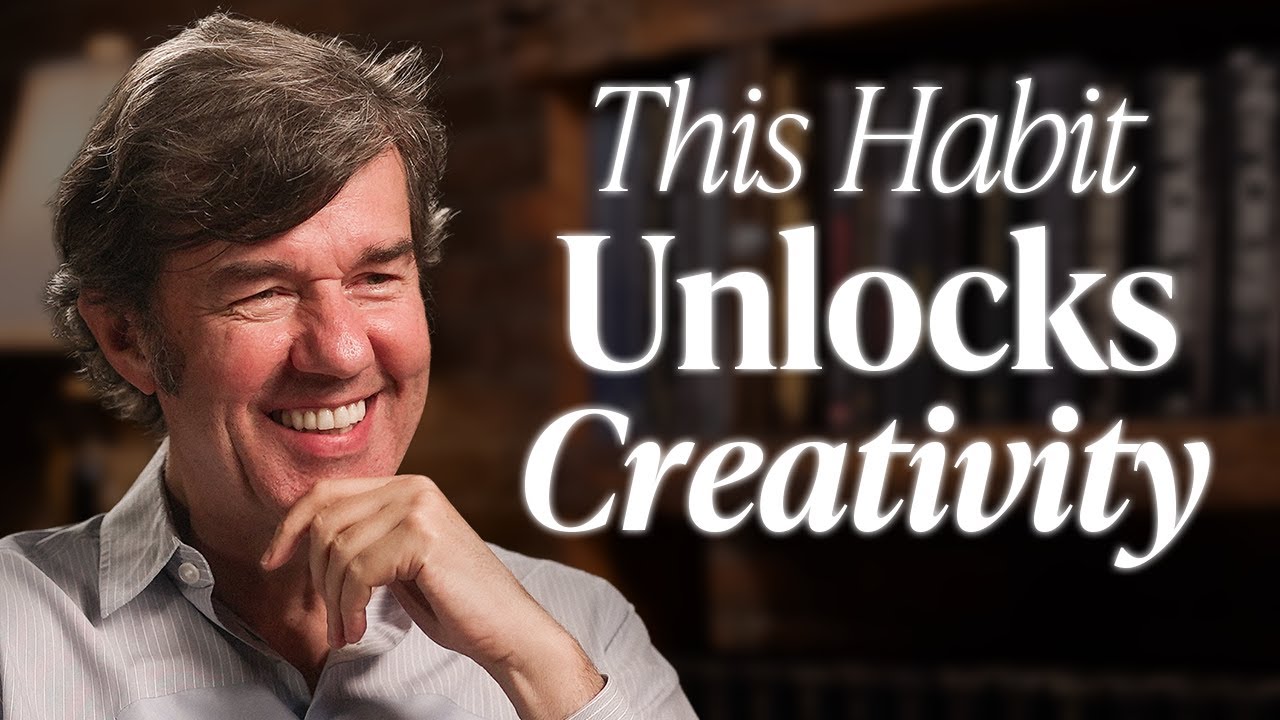
Stefan Sagmeister is a world-renowned graphic designer, known for album covers for artists like Jay-Z, David Byrne, and the Rolling Stones, as well as books exploring design, beauty, and creativity. This conversation covers his methods for generating original ideas, the role of diaries in refining his thinking, his philosophy on beauty and function, and practical strategies for creative growth.
Generating original ideas through random starting points
Sagmeister uses an Edward de Bono–inspired method: when designing something (e.g., a glass), he starts with a completely random object (e.g., a sock) rather than existing examples.
This forces the brain to form new synaptic connections instead of defaulting to familiar patterns.
Example: Starting with a sock led to the idea of an elastic, soft-bottomed drinking container that could stand on uneven ground—something he would never have conceived by studying existing glasses.
The brain is lazy and resists new thinking; random starting points disrupt habitual pathways and increase the chance of novelty.
Many designers repeat themselves because their strongest neural connections lead back to past work.
The role of diaries in developing a coherent worldview
Sagmeister has kept diaries since age 10–12, switching to digital format because his handwriting was illegible during emotionally intense periods.
Rereading old entries revealed patterns—e.g., wanting to change something in his life eight years ago and still struggling with it.
Diaries directly influenced his design work, especially during open-brief projects where he lacked external constraints.
He pulled a list titled “Things I’ve learned in my life so far” from his diary and turned one item into a typographic piece, ensuring personal truth in the work.
Writing diaries helped him develop clean, precise thinking—visible in the Q&A section of his website where he answers ~100 questions with clarity.
Typography as human expression
Sagmeister rejects modernist design’s machine-made aesthetic, which he finds cold and boring.
Modernism became the dialect of corporate communication, prioritizing function over humanity.
His studio emphasizes handmade typography—often hand-drawn—to signal human care and effort.
Example: A friend designed his restaurant logo by hand-drawing letters, then digitizing them.
Functionality alone is easy (e.g., readable type, ergonomic chairs); true design difficulty lies in combining function with beauty and contemporary relevance.
Designing a beautiful, functional, contextually appropriate chair is one of the hardest design problems due to 5,000 years of chair history.
Beauty as a functional force
Beauty is not decorative—it changes how people feel and behave.
People litter far less on the High Line (beautiful) than in the surrounding Meatpacking District (ugly).
At Elon University’s beautiful campus, students self-policed littering through social pressure.
Airports and train stations with better architecture (e.g., renovated LaGuardia, Grand Central) show measurably more positive public sentiment than ugly ones (e.g., Penn Station).
A Boston institute’s real-time sentiment analysis of geotagged tweets shows Grand Central consistently green (positive) and Penn Station consistently red (negative).
Sustainability and beauty are deeply linked: beautiful objects are maintained longer.
Sagmeister has used the same bag for 35 years, repairing it regularly because he finds it beautiful—more sustainable than disposable “eco” bags.
The Pantheon in Rome, continuously used for 2,000 years, survives because every occupying culture found it beautiful.
The sustainability movement often ignores beauty (e.g., ugly solar panels), but beautiful installations increase property value and public acceptance.
Translating music into visual form
Sagmeister typically visits bands during album production to listen to unfinished tracks and discuss the album’s emotional origins—not the cover.
He focuses on translating the music’s emotion and the band’s history into visuals.
For commercially driven acts like the Rolling Stones, practical concerns matter (e.g., Mick Jagger wanting cover art that looks good on merchandise).
Memorable anecdote: When asked about favorite Stones covers, Jagger listed Exile on Main St., Some Girls, and Sticky Fingers—but drummer Charlie Watts didn’t recognize Sticky Fingers, asking what was on it.
This revealed Watts’ singular focus on music over branding, contrasting with fans who consider Sticky Fingers one of the greatest covers ever.
Refining taste and the gap between experts and the public
Taste depends on exposure, context, and emotional state during viewing.
Critics and curators, having seen vastly more than the general public, often dismiss public art as “crap” (e.g., Jerry Saltz claims 99.9% is bad).
But public art serves the public—not critics—and should be judged by its audience.
Over-intellectualization creates a gap between expert and popular judgment.
Architects’ favorite buildings (e.g., boxy Bauhaus-style) are often hated by the public.
The hardest creative achievement is being both popular and good—e.g., films or books that reach mass audiences without sacrificing quality.
Sagmeister values creators who evolve (“changers” like Bowie, Warhol) but also those who deepen a single idea (“stay-the-samers” like James Turrell).
Turrell’s Skyscapes—rooms with ceiling openings framing the sky—have been refined over decades; newer versions are vastly superior to earlier ones.
Japanese craftsmanship exemplifies this: Edo temples are rebuilt every 20 years so each generation learns the craft, maintaining continuity through renewal.
Lessons from Sagmeister’s life and practice
“Everyone who is honest is interesting” (from Grant Crisp): Honesty bypasses the need for cleverness; audiences instantly detect dishonesty or cliché in speech or writing.
Writer’s block often stems from filtering truth through social expectations.
“If I want to explore a new direction professionally, it is helpful to try it out for myself first”: Low-stakes personal experimentation builds confidence before public execution.
“Trying to look good limits my life”: The desire to be liked restricts creative risk-taking; caring less about approval enriches life and work.
“Obsessions make my life worse and my work better”: Sagmeister’s addictive personality requires abstinence from substances (alcohol, cigarettes, cigars) but fuels professional excellence through obsessive refinement.
He coined the term “pushification”—pushing a project to the absolute limit of one’s current ability.
Excellence emerges from thousands of small, conscious refinements.
One may later see flaws, but at the time, it represented maximum effort.
Sabbaticals as structured creative renewal
Sagmeister takes a one-year sabbatical every seven years.
First sabbatical (1999, during the dot-com boom) was initially unproductive due to lack of structure.
He learned to plan the first 2–3 months with specific goals (e.g., learn X, explore Y), after which projects self-sustain.
Sabbaticals generate material for exhibitions and books (e.g., the “Things I’ve learned” series).
Surprising insight: He reads the same amount during sabbaticals as during busy periods—reading wasn’t the bottleneck he assumed.
Combating design homogeneity
Globalization has caused “sameification”—designs from London, Helsinki, and Johannesburg are indistinguishable.
Even “design hotels” repeat the same templates globally (e.g., bamboo in Kuala Lumpur vs. stone in Frankfurt).
War can trigger cultural rootedness: Ukrainian designers, facing existential threat, create work deeply tied to Ukrainian history, language, and patterns.
New publishers only publish in Ukrainian; design stores feature contemporary work with local roots.
Sagmeister advocates for locally authentic experiences—e.g., a hotel in Saigon that reflects Saigon’s real political, historical, and lived reality—rather than generic modernist spaces with identical lattes.
Weekly self-rating system for personal growth
Sagmeister sets annual intentions and rates himself weekly on specific behaviors.
Inspired by Benjamin Franklin’s virtue tracking, but weekly (not daily) to avoid burnout.
Uses a calendar reminder every Saturday morning to update his diary and review his list.
Some items receive poor scores for weeks—but the system serves as a reminder, not a punishment.
The building that moved him most
James Turrell’s Skyscape at Rice University in Houston is Sagmeister’s top recommendation.
It’s a room with a precisely engineered opening in the ceiling, making the edges nearly invisible—so the sky appears as a floating plane of color.
Most powerful at sunrise and sunset, when subtle color shifts in the sky become profoundly beautiful.
At night, the sky turns an impossibly deep, dark blue—unreproducible in print or fabric—that evokes awe.
The space naturally induces quiet, contemplative behavior without signage or rules.
It heightens sensitivity to color relationships (e.g., orange against blue), creating an almost psychedelic perceptual experience.