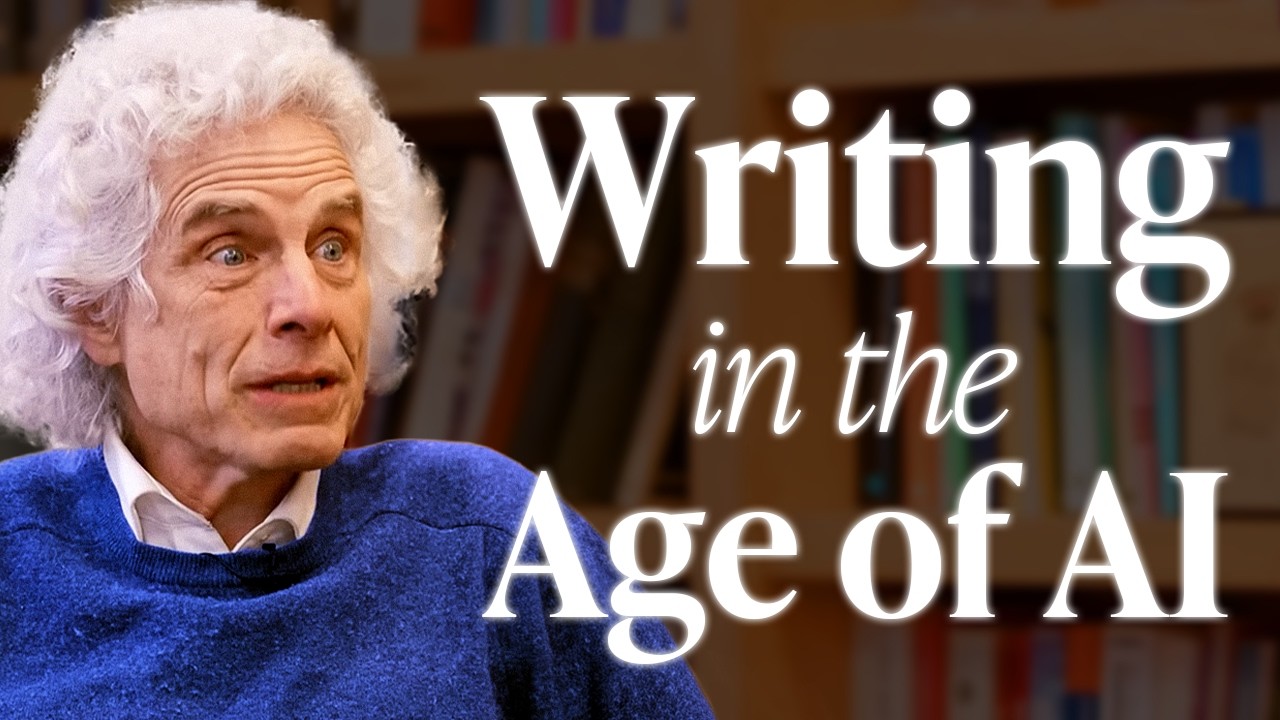
Steven Pinker, Harvard cognitive psychologist and author of nine books on language, cognition, and writing, explains why most writing is bad, how to fix it, and what AI means for the future of prose. His central argument is that the primary cause of bad writing is not malice or pretension but the curse of knowledge — the inability to imagine what it’s like not to know something you know — and that good writing requires both empathy for the reader and concrete, visual language that lets people form mental images.
Why most writing is bad
The curse of knowledge is the single biggest flaw in writing and communication: once you know something, you cannot easily simulate not knowing it, so you fail to explain what should be explained.
This manifests as unexplained jargon, undefined acronyms, and abstract language that the reader cannot form a mental image of — for example, writing “the level of the stimulus was proportional to the intensity of the reaction” when you mean “kids look longer at a bunny than a truck.”
It is a failure of theory of mind (egoentrism), not stupidity: brilliant people in any field can be clueless about what outsiders don’t know.
A molecular biologist at a TED talk launched straight into peer-level jargon and lost the entire diverse audience within seconds — obvious to everyone in the room except the speaker.
Hanlon’s Razor applies: bad writing is more often incompetence in communication than a deliberate choice to obscure.
Even within academia, insularity is extreme: students immersed in a tiny lab circle become unintelligible even to colleagues in the same building or department.
How to overcome the curse of knowledge
You cannot rely solely on imagining your reader’s perspective because you don’t know when you’re subject to the curse — what seems obvious to you may be invisible to others.
The only reliable solution is to show your writing to real people who are smart but outside your specific field.
Pinker used to show drafts to his mother, who was highly intelligent and well-read but not a cognitive psychologist — she represented his actual audience.
Editors at commercial publishers serve a similar function: smart generalists who flag what specialists take for granted.
Even academics in adjacent fields (economists, historians, political scientists) will say “I don’t know what you’re talking about” when writing is too insular.
Making writing visual and concrete
Understanding does not consist of words — it consists of mental representations that are often visual, motoric, emotional, or auditory. Language is a means to that end, not the end itself.
Good writing constantly allows the reader to form a mental image.
Don’t write “stimulus” when you mean “bunny rabbit.” Don’t write “paradigm” or “framework” when you can describe something the reader can see.
Visual metaphors are powerful: earlier writers said “the spirit of the hawk was kneaded into our flesh” instead of “aggression” — they had to appeal to shared images because academic jargon didn’t exist yet.
This is why writing from earlier centuries (the Bible, Shakespeare, the Declaration of Independence) often feels more vivid and gripping: writers were forced to use concrete, imageable language.
Abstractions are essential within a profession (they compress enormous knowledge into a few syllables) but become a liability when communicating outside it, because of the curse of knowledge.
Why writing is harder than speaking
Conversation provides built-in common ground: participants know why they’re there, share context, and can use deictic terms (“this,” “that,” “she”) that are clear in the moment.
Conversation provides real-time feedback: furrowed brows, quizzical expressions, requests for clarification, body language — all of which let you adjust on the fly.
Writing strips all of that away: the reader may be in a different country, may have no shared context with you, and may be reading your words after you’re dead. Everything must be on the page.
The balance of examples and generalizations
Generalizations without examples are usually incomprehensible — abstract words are too imprecise, and the reader cannot pin down what is meant.
Examples without generalizations are pointless — the reader doesn’t know what point the example is illustrating.
Good writing is a dance between compression (generalizations) and context (examples).
Example: saying “familiar phrases don’t mean what their parts suggest” is vague until you give examples — a bathroom isn’t a room with a bath, breakfast isn’t breaking a fast, Christmas isn’t Christ’s mass.
Richard Lederer’s wordplay illustrates how compounds drift from their origins: adultery is related to adulterate (introducing a foreign substance), but that connection is completely lost; olive oil is made from olives, but baby oil is oil for babies — the semantic relationship changes.
The right-brain dimension: beauty, sound, and rhythm
Good writing engages aesthetic sense, not just logical structure.
Sound and euphony: Pinker reads his prose aloud (or mumbles it) to test whether it flows smoothly — if he can’t articulate it smoothly, the reader won’t process it smoothly either.
Rhythm and meter: Language has a regular beat; disrupting it too much interferes with both speech and reading, even silent reading.
Sibilance: Too many s-sounds in a row make prose unpleasant; Pinker will pick synonyms to avoid clusters of sibilants.
Alliteration: Used sparingly, it adds a spark of pleasure and makes sentences roll past more easily — but if too conspicuous, it feels forced.
Why academic writing is so bad — and why it bothers Pinker
It is a waste of brilliant work: taxpayers fund research that is then locked away in unintelligible prose, accessible only to a tiny circle.
It causes confusion and wasted effort even within the profession: Pinker has to read paragraphs five or six times to understand what a colleague is saying, increasing the risk of misunderstanding.
It foregoes pleasure and beauty: well-crafted prose is enjoyable to read; stilted, turgid prose is annoying.
It is especially galling in linguistics and psycholinguistics — fields that study what makes sentences hard to understand, yet whose practitioners often write sentences that are needlessly difficult.
What children teach us about clear explanation
Children haven’t accumulated decades of jargon and abstraction, so they are forced to appeal to things they can see and that others can see.
Pinker’s grandson said “clouds are water vapor, smoke is fire vapor” — a fresh, poetic juxtaposition.
Children ask questions like “how deep is the ocean?” or “how high would a tower need to be to reach heaven?” — questions that cut through assumptions adults have forgotten they have.
A child thought clouds were produced by chimney-like structures — a creative, image-based explanation that reflects how children see the world before they “know the box exists.”
Brevity, humor, and the soul of wit
“Brevity is the soul of wit” (Hamlet) is itself a perfect example of what it describes — the word “soul” carries more resonance than “essence” or “foundation” would.
E.B. White’s first rule of writing: omit needless words — another example that embodies its own advice.
When forced to compress an article to a word limit, the prose often improves “as if by magic” because every word must earn its place.
Brevity reduces cognitive load on the reader and forces concrete language over woolly idioms and clichés.
Humor depends on brevity and freshness: comedians pare down jokes because dragging them out lets the audience anticipate the punchline or step on it themselves.
Why older writing feels more beautiful — and what has been lost
Historical figures like John D. Rockefeller, Thomas Edison, Herbert Spencer, Oliver Wendell Holmes Sr., and Charles Darwin wrote beautifully despite not being professional writers.
They were educated on the classics and had many good models to draw on.
They lacked centuries of ready-made abstractions and clichés, so they were forced to use vivid images and metaphors.
Writing was how you presented yourself publicly — there was no telephone, radio, or social media — so prose was cultivated the way one arranges oneself in a mirror.
A long-term process of informalization has shifted cultural values away from crafted prose:
Dress, forms of address, and language have all become less formal (first names instead of Mr./Mrs., profanity in everyday speech).
Romantic values of authenticity, spontaneity, and naturalness are now prized over careful craftsmanship.
Fancy language is now perceived as pompous, stilted, or distancing — so people avoid the effort of crafting prose the way earlier generations did.
AI and the future of writing
LLM output is peculiar: it is well-written in structure (plain sentences, orderly progression, clear introductions and conclusions) but is generic, prosaic, and instantly recognizable as bland.
It is a pastiche of billions of examples, designed for average competence, not freshness or style.
It may benefit from the same effect that makes composite faces more attractive than individual ones — averaging out all the awful convoluted constructions of human writing may produce something clear if unbeautiful.
Whether LLMs can be prompted or trained to produce genuinely fresh, vivid, or beautiful prose remains an open question.
AI may exacerbate the trend toward generic, abstraction-heavy communication by making it even easier to produce competent-but-bland prose without the effort that forces originality.
If Pinker were rewriting his nine books today, he would give greater weight to the power of pattern extraction from massive input (the lesson of neural networks and LLMs) and less to the rule-based, algorithmic approach of classical cognitive science and Chomskyan linguistics — though he does not believe the human mind is simply an LLM, since children learn language through situated interaction with the world, not just passive text processing.