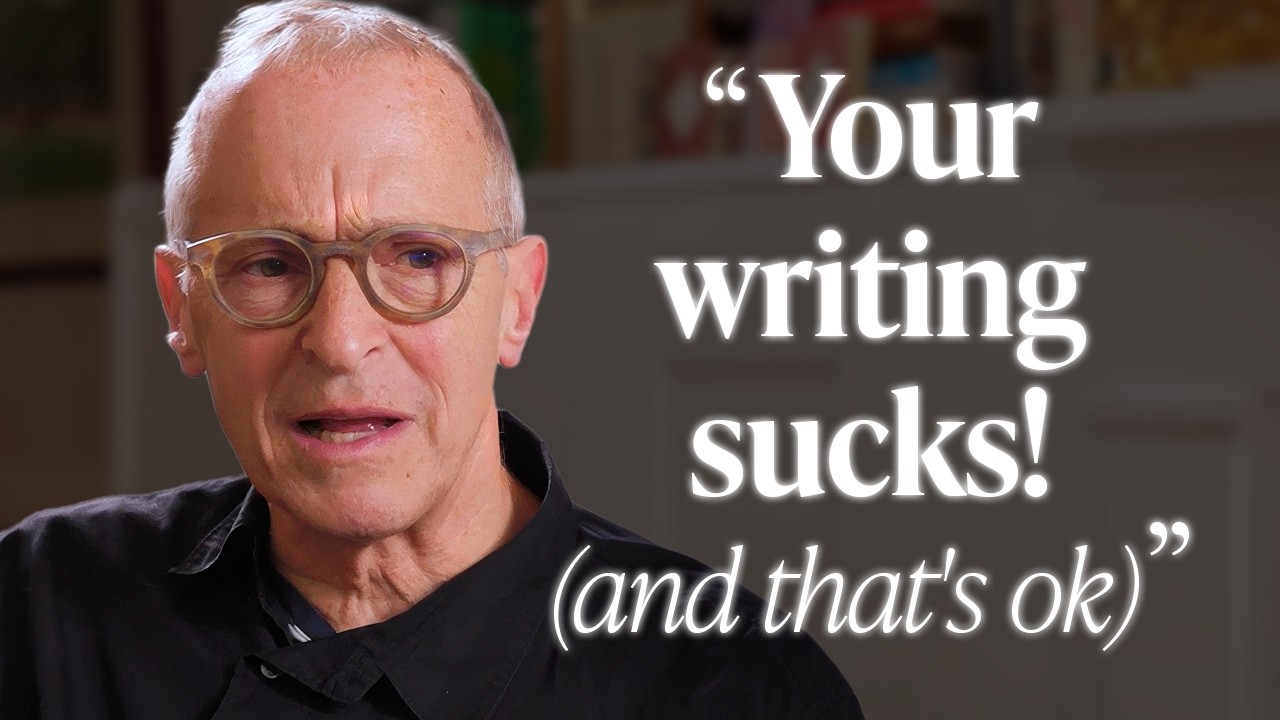
David Sedaris, bestselling humorist with over 16 million books sold and a 30-year New Yorker contributor, shares his unconventional path and craft philosophy: write privately for years without publishing pressure, observe relentlessly, read aloud to live audiences as your primary editor, and build a career on being unapologetically yourself.
Writing vs. publishing: separate tracks, different timetables
Sedaris kept a diary from age 20, didn’t take a writing class until 28, and felt zero pressure to publish early — he believed his teacher who said “just write and the rest will take care of itself.”
He distinguishes writing (a daily practice) from publishing (a later outcome) and never felt like a failure for having day jobs; he viewed limited writing hours as reason to keep a job, not quit.
His advice to young writers: “this is your time to suck… enjoy it and just use this time to take chances and to learn” — thinking about publishing at 20 means you’re on the wrong path.
Finding premises: the ridiculous hiding in plain sight
Pieces often start from a moment of self-awareness about his own absurd perspective — e.g., touring the Anne Frank House and thinking “we should move the kitchen here” while apartment-hunting in Paris.
He looks for situations where his “scanners are on” and he notices what others miss: a DMV clerk rejecting a mother for “protruding nipples,” a t-shirt reading “I wasn’t always a dick. Just kidding. Fuck you,” a post office conversation with a Sir Lancelot-haired clerk in Alabama.
The best material comes from saying yes to experiences others optimize away: going to the post office instead of using FedEx, striking up conversations, complimenting strangers’ nails or haircuts as entry points.
The diary system: capture now, curate later
Writes in his diary every morning; maintains a separate “diary guide” for observations that might be useful later — “loaded” moments rich with potential (the DMV nipple incident, the regenerating-nipple myth, decades of t-shirt slogans).
Keeping a diary teaches you what you’re actually interested in: early entries perform for an imagined reader; over time you drop the performance and write what genuinely catches your attention.
Observation is a muscle: walking the same block as another person yields completely different notebooks; his artist friend Ingred sees Margaret Atwood in a leaf fragment — “she can’t turn off her artistic self.”
Characters over people: thermostats, not thermometers
Good characters make good writing; good people don’t necessarily — his father was “a horrible person and a good character” (never wrong, confident buffoon); Hugh (his partner) is a good character because he’s responsible and uptight, a perfect foil.
Good characters: divisive, brash, less sensitive to social norms, “thermostats” who set the room’s energy rather than “thermometers” who reflect it; people who can’t read the room, offer unsolicited opinions, or make everything about themselves.
You don’t need to be funny yourself — “if you’re writing humor, all you need to know is some funny people. And you can quote them… you’re importing the laughs.”
Reading aloud to audiences: the ultimate editor
Audiences are his editor: their laughter, coughing, drifting attention, and silence tell him everything — pacing, rhythm, repeated words, false endings.
Reading to Hugh serves a different purpose: “a way of killing it” — he reads a paragraph, Hugh gets bored, Sedaris throws it away.
On stage, he can feel when an ending isn’t working: if he has to tamp down papers to signal the end, he failed; a real ending lands like a plane — smooth, inevitable, surprising.
He tests endings by type: emotional choke-up, big laugh, thoughtful silence — and structures shows to vary these “noises.”
Editing: many private drafts, then the editor
Does 15–17 drafts before sending to his New Yorker editor — “I’d rather give her the 15th and then we go two more” than bore her with early versions.
Looks for rhythm, pacing, momentum, humor, and an ending that feels earned; cuts anything “not worth the breath it takes to read it.”
Learned from radio: don’t populate the “stage” of the listener’s mind with names that don’t pay off (Chekhov’s gun for characters); economy of detail.
Performance craft: respect the audience’s attention
Index cards over sheets of paper: each card holds a full story beat with laugh lines, creating boom-boom-boom pacing; never let the audience see your page count.
Dress up — “proving to them that this meant something to you” — and rehearse; so much works against you (uncomfortable seats, phones, standing crowds), so control what you can.
Common mistakes: not rehearsing, acting like it’s a cold read, underdressing, showing the stack of pages.
Precision: specific beats generic, language without thesaurus
“Potato chip bag stuffed into a hollow of a tree. An elderly mitten caught in the embrace of a blackberry bush” — “embrace” beats “stuck” because it conveys the physical struggle of removal.
Not a fancy writer; admires poets but accepts his own voice — quick character sketches (mustache, unibrow, star-shaped pimple patch) let the reader see the speaker without a paragraph of description.
Real details beat invention: chicken thighs abandoned next to produce, a fingernail in an airplane seat cuff, a doll’s head in a seat pocket — “whatever it really is that’s in there is more interesting than anything I can make up.”
Essay vs. fiction: outrageous vs. real
His fiction veers completely over the top (woman shot 17 times, head falls off); he admires quiet realism (Anne Beattie) but can’t write it — “incapable of it.”
Non-fiction came via radio: NPR required truth, forcing him to learn in public — early radio pieces were “awful, awful,” like being a child actor.
Radio taught economy: don’t name six dinner guests if only two speak; the listener’s mind is a stage — don’t overcrowd it.
Actors reading his work: a special hell
Hates when actors overperform: slowing down for fake gravitas, adding French accents, highlighting jokes — “it makes you just hate what you wrote… it’s embarrassing.”
The problem is trying too hard for laughs; he did the same in early books — “nudging people in the ribs: Do you get it? Do you get it?” — took years to trust that silence ≠ disengagement.
Trusting the audience and planting bombs
Early on, he thought no laughter meant no listening; learned they listen even when quiet — “if they drift away, you can feel it.”
Plants “little bombs”: details that only pay off later if the audience stayed with him — if they laugh at the callback, he knows they tracked the setup.
Some setup is necessary (place-setting, description) but only for so long before coughing starts.
Humor toolkit: observation, word choice, restraint
Stretching truth used to be acceptable (Hunter S. Thompson, Mark Twain); James Frey/Oprah ended that — now humor is held to memoir standards.
Be a great observer: real grocery-store details (chicken thighs in the chip aisle, dropped items abandoned) beat invention; headphones are worse than phones for killing observation — they remove spatial awareness entirely.
Choose funnier words without looking like you used a thesaurus: avoid “feline creature,” “pussycat,” adverbs, lazy dialect (“gonna,” “gotta”) — “mark of an amateur.”
Put in the hours: wrote daily for 15 years before first book; read incessantly — “you’re going to learn so much from books… it’s not fair to expect people to read yours if you don’t read theirs.”
Friends are useless critics: they’re nice, they don’t read, they don’t know what the inside of a book looks like.
Recognize boring vs. interesting: “just cuz this happened to me doesn’t make it interesting” — if you’re boring someone, you should feel it.
Q&A “running mouth” on stage generates material: a riff on Blue Jays became his biggest laugh in a new essay — “I wouldn’t have got it at my desk.”
Flannery O’Connor’s compass
“Anybody who has survived his childhood has enough information about life to last him the rest of his days. If you can’t make something out of a little experience, you probably won’t be able to make it out of a lot. The writer’s business is to contemplate experience, not to be merged in it.”
O’Connor and Mavis Gallant are underrated as comic writers — “falling-out laughter,” not polite chuckling.
Self-expression as survival and strategy
Father tried to mold him (guitar lessons, be the life of the party); growing up gay in the 1960s–70s meant constant hiding — “the worst thing that could happen if anyone really knew you.”
Career built on “being completely myself… it never occurred to him that myself was a money maker.”
Peeling off layers over time; audience detects insincerity and virtue signaling instantly.
Willingness to take chances: moving to NYC, moving to Europe without the language, feeding crows daily until an essay emerges — “making something out of nothing… I’ve never been afraid to take a chance and it’s gotten me far.”