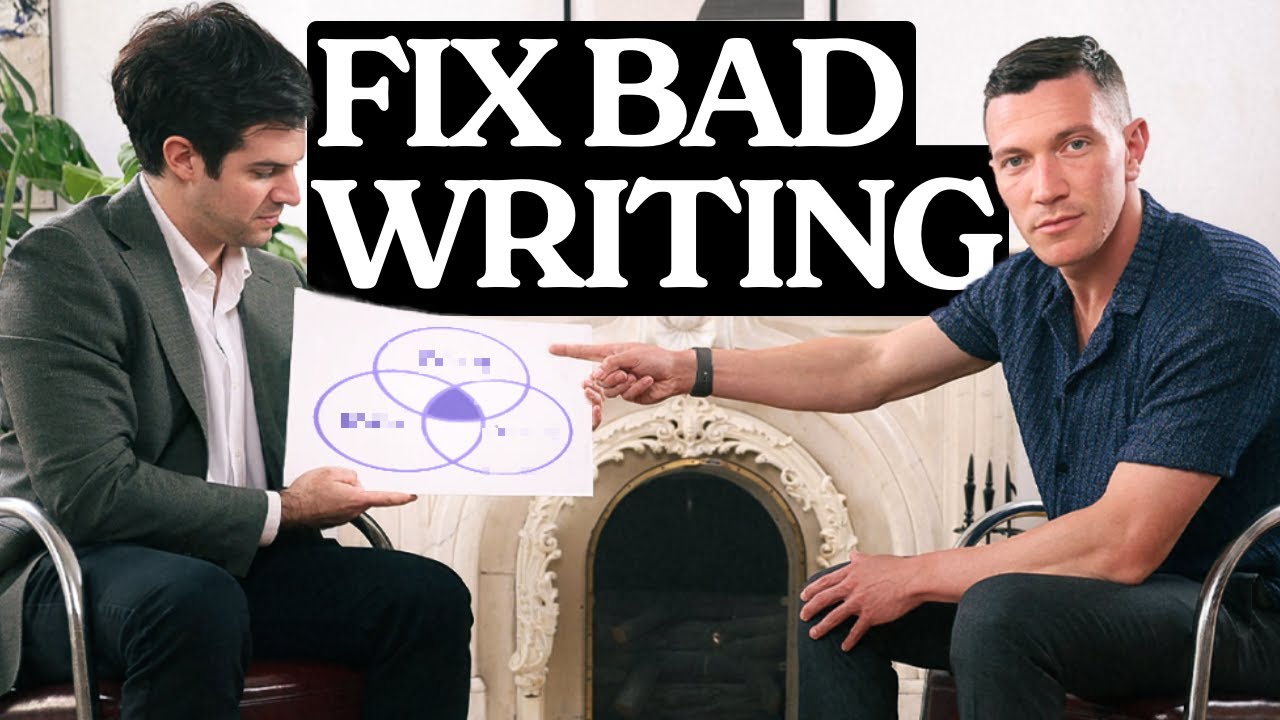
Michael Dean, a former architect and VR specialist, has spent years analyzing the hidden structural patterns behind great essays, developing a 27-point framework called “Essay Architecture” that he uses to objectively evaluate writing quality. He argues that beneath the surface variety of styles, topics, and voices, all strong essays share fundamental design constraints — and that understanding these patterns gives writers X-ray vision into what’s working and what isn’t in their own work.
The case for objective writing quality
Writing quality is both objective and subjective: grammar has clear rules, but what makes writing “great” seems ambiguous because readers have different tastes, preferred topics, and stylistic leanings.
Dean argues that underneath all variety, there are fundamental design problems every writer faces: scoping ideas, setting boundaries, crafting form (beginning, middle, end), and developing a voice that permeates every sentence.
The value of an objective system is that it helps writers find blind spots — when a draft “feels off” but you can’t articulate why, a structured framework gives you the language to diagnose and fix it.
Dean scores every essay he reads on 27 criteria (sometimes 81, with sub-patterns), rating each 1–5. He’s read over a hundred classic essays and thousands of new writer drafts, and the patterns hold across all of them.
Essay Architecture: the framework
The framework has 3 dimensions, each with 3 elements, each containing 3 patterns (27 total):
Idea: Material, Thesis, Title
Form: Paragraphs, Structure, Tension
Voice: Spirit, Sound, Sight
A pattern is not a template or a rule — it’s a question that arises in every essay across time. You have creative liberty to answer it however you want, but objective criteria can still measure whether your answer is good or bad.
The framework is inspired by Christopher Alexander’s A Pattern Language (1978), which maps 253 universal patterns in architecture. Alexander’s key insight: a pattern is a recurring design constraint, not a fixed solution — within any pattern, there can be infinite valid solutions.
How great writers start: the power of specificity
The number one problem Dean sees in new writers is scope ballooning — starting with a thousand words and ending up with 15,000 because the topic keeps expanding.
David Foster Wallace’s Consider the Lobster demonstrates the fix: zoom into a specific microcosm that represents a bigger idea. Instead of writing about animal ethics broadly, Wallace focuses on the 2002 Maine Lobster Festival — a tangible, oddly specific experience that lets readers absorb his ideas about consciousness and pain without being preached to.
This is what Alberto Eco called the “pick one volcano principle”: if you want to understand volcanoes, don’t study all of them — study one volcano in extreme detail, and you’ll understand volcanoes generally. The key is picking the one that is emblematic of more than itself.
The paradox: by getting more specific, you actually write about more. It’s “less but better.”
Paragraphs as atomic units
The paragraph is the atomic unit of composition (per E.B. White). Every paragraph should represent one distinct idea; a paragraph break signals a topic shift.
Modern online writing advice says paragraphs should be 1–3 sentences for short attention spans, but Dean argues this misses the point — paragraphs are a punctuation device for ideas, not a formatting choice.
A flexible rule for paragraphs: every paragraph needs a hook (something that makes you want to read it) and a punch line (something in the subtext that rewards you for reading — not necessarily funny, but emotionally resonant, surprising, or provocative).
When editing, check each paragraph: does the opening sentence create a micro-hook with some mystery? Does the last sentence land with a subtextual explosion? If a paragraph starts and you don’t know what it’s about until midway through, the frame isn’t set.
Maximalism vs. minimalism in Wallace
In one paragraph of Consider the Lobster, Wallace includes 37 different examples — and makes it dynamic rather than boring by:
Mixing general details (parade, carnival rides, lobster ravioli) with absurdly specific ones (the William D. Atwood Memorial Crate Race, the Maine Sea Goddess Beauty Pageant)
Including numerical details (25,000 pounds of lobster, 100,000 attendance)
Clustering details by category (musical acts, attractions, food) rather than listing them randomly
Varying the resolution of examples — sometimes a three-paragraph immersive example, sometimes a one-paragraph example, sometimes 37 things in one paragraph
Only 3 of the essay’s 33 paragraphs are this maximal. If the whole essay were, it would be unreadable. The lesson: vary your example types and resolutions to keep the reader engaged.
The effect: reading Wallace is like looking through a 15-megapixel camera when your brain is 3 megapixel — it captures so much reality in such a small space that it’s almost overwhelming.
The three pillars of personal writing: biography, interiority, outlook
Personal writing means putting yourself on the page in a way that only you can write. Dean breaks this into three elements:
Biography: A camera in the room — the visible, filmable details of your life. What you did, where you sat, what you said, your body language. More than resume-level; the specific texture of your experience. (Example: Charlie Bleecker never tells you how she feels — she shows you.)
Interiority: What’s going on in your head that no one else can see. Cinema can’t capture this, but literature can — rendering your consciousness on the page.
Outlook: Confessing a belief you hold that might not be standard. This is the riskiest element, and most people default to it thinking it’s enough on its own. It’s not — you need to show the experiences and interior calculations that led you to that belief.
These three also model transformation: an experience changes your outlook, which leads to new experiences, which change your outlook again.
What goes wrong: writing that is “gushy and sentimental” but generic — you could swap the author’s name and no one would notice. Personal writing requires the specific context of your life, not just depth of feeling.
How Wallace and Orwell execute experience differently
In Consider the Lobster, roughly 50% of paragraphs have no personal content — Wallace is geeking out on etymology and animal consciousness. But flashes of biography appear (at the festival, in a cab), moments of interiority (questioning whether boiling lobsters is weird), and his outlook only emerges at the very end as a question: “Is Gourmet Magazine promoting a medieval torture fest?”
In Shooting an Elephant, Orwell weaves all three throughout: he starts with biography (his position in Burma), moves to interiority (his conflicted feelings about empire and the locals), continues through action (the elephant’s rampage), returns to interiority and outlook (realizing he’s a cog of the empire), and ends with biographical action (shooting the elephant) followed by reflection.
Both score 5/5 on experience. There is no one right way to satisfy the pillar.
Tension: the engine of engagement
Dean uses “tension” instead of “storytelling” because tension applies to both narrative and idea-based essays.
Intention: What does the character want? (Who are they?)
Obstacle: What’s in the way? (A good obstacle has multiple possible resolutions.)
Consequence: What happens depending on which path is taken?
Climax: One of the consequences is realized.
These three work in sequence — an obstacle won’t register unless you understand the character’s intention. The tension comes from being suspended in the unknown between obstacle and consequence.
Simple generative tool: “What do they want? What’s in their way?” Repeat.
Threads (for all essays): Multiple conflicts should overlap. There should never be a point where no conflict is being advanced.
Hook: The opening conflict. The best hooks contain invisible questions in their subtext that become the outline of the essay.
Orwell’s hook: “In Moulmein, in Lower Burma, I was hated by large numbers of people — the only time in my life that I have been important enough for this to happen to me.” Invisible questions: Why is he in Burma? Why is he hated? How will this hatred lead to the elephant situation?
Charlie Bleecker’s hook: “Usually I only steal one or two pills of Adderall from my best friend, but this time I stole the whole orange bottle.” Invisible questions: Who is she? Why is she stealing Adderall? What is the relationship with her friend? Will the friend find out?
The hook often can’t be written first — you need to write the draft, identify the main pieces, turn them into questions, and then bake those questions into the subtext of the hook.
Question-and-answer as organizing principle
For idea-based essays (like Consider the Lobster), tension works through invisible questions rather than character conflict.
The title contains the driving question: “Consider the Lobster” → “Is eating lobsters wrong?”
The essay is organized into mid-level questions: How have lobsters gone mainstream? Is it alright to boil sentient creatures alive? Is Gourmet Magazine promoting a medieval torture fest?
Each section is organized by further sub-questions (How does PETA protest this? Can lobsters feel pain? How do cooks feel about this? Are there alternative methods?), and Wallace plants these questions in one paragraph and answers them in the next — often without stating the questions explicitly.
Practical advice: At the top of your document, write the core question you’re answering. As you draft, identify sub-questions. Through reverse outlining, decide which questions to double down on and which to cut. The goal is to get a tighter and tighter question until the answer is obvious.
Sound: rhyme, rhythm, and phonetic resonance
Rhyme in prose isn’t just end-of-line — it’s interline rhyme, where phonetic resonance moves through sentences.
Hunter S. Thompson would pay friends to read his work out loud so he could hear how it sounded from someone else, then rewrite based on what he heard.
Even when reading silently, your inner ear picks up on prosody and phonetics.
Orwell’s first paragraph in Shooting an Elephant is rich with S sounds building toward “hideous” and F sounds building toward “laughter” — and “hideous laughter” is a key theme, since it’s the fear of laughter that drives Orwell to shoot the elephant. The phonetic planting makes the phrase land harder.
Strategic use: find three high-leverage moments in your essay and edit the words in those passages to create phonetic resonance. Don’t splatter it everywhere.
Repetition: How often you use a phrase to loop and expand an idea.
Rhythm: The containers for your ideas and how you change them over time — vary paragraph lengths, vary the immersion of examples.
Rhyme: Nearby words with similar sounds (not exact repetition). Alliteration falls here.
None of these should be maximized in isolation — it’s the ensemble that matters. Asking AI to make everything incredibly rhyming would be ridiculous.
Word choice: concision, precision, inventiveness
Concision: Be economical. Cut clutter. (William Zinsser: “Clutter is the disease of American writing.”)
Precision: Pick the word with the best undertone, even if it’s longer. “Illumination” vs. “light” — there are situations where the less concise word is right.
Inventiveness: Use rare or foreign words when the context gives the reader clues. “Alpenglow” instead of “illumination” when talking about mountains.
These three are in tension with each other. No single rule is correct in isolation — you need to understand when to prioritize which.
Writing process: practice analytically, perform intuitively
Dean is anti-template when it comes to process. He refuses to commit to a single method and tries never to approach the same thing twice.
First draft: Write for yourself. Don’t think about patterns or structure. Chase the material down and discover what the thing could be. This is the mystical, emergent phase — it’s better if you don’t know where it’s going.
Second draft: Write for the reader. Now use Essay Architecture to make the idea more legible and resonant. This is where the analytical framework comes in.
The framework is an editing philosophy, not a writing philosophy. It’s what you use when you’re stuck with a draft and something isn’t coming through.
The deeper principle: practice analytically, perform intuitively. Study the mechanics so deeply that they become absorbed into your DNA, then perform without thinking about them.
The Grateful Dead are the ultimate improv band, but Jerry Garcia practiced banjo scales 10 hours a day and Phil Lesh studied music theory. They kicked out Bob Weir for not practicing hard enough.
Jack Kerouac is mythologized as a spontaneous writer, but for 10 years before On the Road, he wrote a million words in plain, traditional novels.
Picasso’s museum in Barcelona shows his early work: super formal, classical paintings. He mastered the basics before inventing his own style.
Stephen Curry practices his dribble and shot form obsessively — then in games, he’s in flow.
The point of studying patterns is eventually to forget them. The system is a method to help you understand which basics you need to shore up.
Editing with the framework
Instead of editing top-to-bottom with a general sense of “fix things as you go,” use a razor lens: focus on one pattern at a time.
Example: go through your draft and highlight every moment where voice pops through (in orange). Don’t look at structure, ideas, or thesis. Then look at the color coding — if a whole section has no highlights, the voice is disappearing there. Rewrite those passages.
For voice specifically: you can reverse-engineer it from famous writing, but you can’t mechanically insert it. Rewrite the paragraph with voice patterns in mind, analyze the result, and keep looping until it works.
Why voice matters
Reading is inherently friction — unlike a movie, it requires mental work. Voice shapes language to be more compelling to digest.
Concrete imagery triggers hallucination-level engagement (you’re seeing it in your mind’s eye). Sound triggers the inner ear. Spirit (attitude, personality, emotion in the subtext) gives the sense that there’s another person at the other end.
Good writing lets you put on somebody else’s brain — see the world how they see it, think how they think. This is why essays about New York by cab drivers or residents of Hell’s Kitchen are compelling: you lived there but never had those thoughts.
The deepest level of voice: articulating things you’ve always known or felt but never made explicit. When this works, it produces a feeling of surprise and epiphany — “I always knew this, I can’t believe I just put that to language.” That feeling of surprise verifies the thought came from within, not from cultural consciousness.
Being aware of who might read your work is the easiest way to shut down your voice. Dean writes under a half-pseudonym (Michael Dean is his middle name, not his legal name) to reduce self-consciousness. He also maintains secret corners of his website where he writes about death, religion, and politics — ideas that marinate in private before pushing public.
Fernando Pessoa had 75 pseudonyms. The idea: by creating contexts to explore different sides of yourself, they move from subconscious to consciousness and eventually integrate into the main self you present publicly. You need both a public practice and a secret one.
Getting feedback like a comedian
Instead of asking editors “help me fix this,” ask for flash feedback: read this, and when you like something, highlight it green, give an emoji, say LOL. If it’s confusing, tell me. Make reactions as granular as possible.
Give each reader a separate document so they can’t see each other’s responses. Then create a master document: if three people independently love the same sentence, it’s dark green — a strong signal to keep it or move it up. Anything that’s red needs fixing first.
If a stretch of paragraphs gets no reactions from anyone, that’s a sign to cut or compress — nothing notable happened for any reader.
This mirrors how stand-up comedians test jokes on independent circuits before the big show.
How Dean reads
First pass: read normally, highlight what’s remarkable or well-articulated.
Second pass: go back only to the highlights and deconstruct why they work. Come away with a principle.
After doing this a hundred times, you have a big list of principles. The question then becomes how to organize them into a framework — which is how Essay Architecture was born, using Christopher Alexander’s pattern language as the organizing structure.
Pattern language explained
Christopher Alexander’s A Pattern Language (1978) maps 253 universal patterns in architecture, from how to scale cities (2–10 million people) to how to hang stuff in your living room.
Patterns are connected — zoom into any pattern and it links to others. A greenhouse pattern connects to shelving, storage, compost, and vegetable gardens.
Once you see the patterns, you can’t unsee them. Example: a balcony less than six feet deep won’t be used. You see it everywhere — four-foot balconies have no furniture; eight-foot balconies in warm weather are full of people.
A pattern is more than a heuristic but less than a rule. It’s a recurring constraint, not a fixed solution.
Dean’s framework has 27 patterns (vs. Alexander’s 253). Within each pattern, there are many types — none better than another. The goal is to master all 27, because they touch all corners of the human psyche.
The essay as a universal form
Dean loves essays because they make you a writing generalist. Fiction and poetry specialize and isolate; essays fuse:
The soul and experience of a memoirist
The research of a journalist
The thesis and argumentation of a philosopher
The hook and call to action of a marketer
The stakes-building of a novelist
The imagery and rhyme of a poet
An essay is these six archetypes in one thing, giving it universal and timeless appeal.
Title patterns: mystery, target, phonetics
Mystery: Does the title contain invisible questions that draw the reader in?
Target: Does the title accurately distill the thesis? (Calling Star Wars “Wookie Warriors” would optimize for the wrong thing.)
Phonetics: Does the title sound good out loud? Is it shaped with rhyme and rhythm so it sticks in memory?
Jane Austen loved phonetics: Pride and Prejudice, Sense and Sensibility.
Snakes on a Plane: both “snake” and “plane” share the “a” nucleus, and “on” is a simple syllable (nucleus + coda only), creating symmetry and punch.
Every syllable technically has three parts: onset, nucleus, coda. You can go infinitely deep, but the practical basics are what matter for shaping a title’s sound.
Reader trance
The main point of composition is to establish reader trance — a state of concentration where the reader tears through the piece and can’t put it down (misses their train because they’re so locked in).
Reader trance operates at three scales:
Macro (tension): Something is unknown, and the reader keeps moving forward to resolve it. Humans hate the unknown.
Midlevel (paragraphs): Each paragraph has a hook and a punch line — a repetitive trance-like loop. If you break it, the reader asks “why keep going?” Meanwhile, a separate element is constantly changing (paragraph length, example immersion) to prevent monotony.
Micro (imagery and sound): Concrete hallucination — the reader isn’t reading, they’re internally rendering vivid images. This is the deepest level of trance.
Dean’s maxims
Understand the fundamentals of your genre before you develop taste. Taste matters, but taste blindness is real — you can become so obsessed with a specific aesthetic or pattern that you lose sight of basics. (Example: spectacular curved buildings where you can’t find the front door.) Start with fundamentals; taste will arise from there. Writers who always use the hero’s journey or always write in short blocky paragraphs are limiting themselves — there are hundreds of possible sequences.
The main point of composition is to establish reader trance. (See above.)
Practice analytically, perform intuitively. (See above.)
AI and writing: current state
Dean still writes every sentence himself but uses AI extensively throughout the process:
Research: Feed AI your draft and ask for highly specific references (examples of a concept between 900–1200 AD). AI acts as a matchmaker, connecting you to relevant figures and time periods.
Structural compression: Ask AI to rewrite a 3,000-word draft in 10,000 words, 100 words, or one sentence. This reveals the essence and shows what’s possible — if AI can convey the idea in 10% of the space, why are you rambling?
Midlevel ideation: Ask AI to write a paragraph five different ways. The outputs spark ideas — you might see something in output #2, #7, and #8 that you weave together.
Word choice: Custom GPTs with specific criteria for each word decision.
AI covers the full stack from big-picture thesis down to precise word choice. What it can’t do yet: synthesize a long list of instructions into a cohesive piece (it short-circuits and focuses on one rule while ignoring the rest). It also conflates voice with content — ask for a Hunter S. Thompson impression and it writes about Las Vegas.
Dean primarily uses ChatGPT for its context and memory, with custom GPTs for specific tasks. Sometimes uses Claude for experiments.
AI’s current limitations
No consistent judgment of quality: AI can’t reliably distinguish great writing from slop. One study had AI rewrite Paradise Lost and then judge the two versions — it preferred the AI slop. Dean’s own testing shows AI feedback is about 50% accurate, essentially a random guesser.
No recursive self-assessment: AI writes at ~400 words per minute and can’t look back at sentence #8 and realize sentence #2 needs to change. It can’t challenge its own original prompt. If it could loop and think for hours, it would be much better.
No true sense of quality: LLMs are amazing association machines (spatially mapping every sentence in a hypercube and finding probable matches), but they lack a barometer of quality.
Dean is building a system to test prompts and score patterns reliably, creating an orchestra of different AI models for different patterns (Claude for experience, GPT-4.5 for arguments, O1 Pro for rhyme). Each pattern will have a confidence score.
Why schools should ban ChatGPT
It’s not about the output — it’s about what changes in your mind when you commit to writing and editing. “Editing is not rewiring words, it’s rewiring your synapses.” (Yuval Noah Harari)
Through slow-cooking in an idea, you develop skills to critically examine yourself, your identity, and your ideas.
Dean’s own experience: architecture school banned software for the first three years. He had to manually draw every line, hand-trace Vitruvius, and render a 4x5 ft map of Manhattan out of individual dots (100+ hours). He resisted and transferred to a modern school — only to realize the slow, inefficient way had fundamentally changed his mind. When he finally used software, he was far better because he understood how buildings go together.
Kids will resist this, but the slow act of writing is where the cognitive development happens.
The writer’s apocalypse: Dean’s extreme thought experiment
Instead of quibbling month-by-month about what AI can and can’t do, assume the most extreme possible outcome in 15–20 years. If you’d still write in that scenario, you don’t need to stress about incremental improvements.
Three reframes of the extreme scenario:
Quality becomes unimaginably good — not just better than the best living writers, but extraterrestrially good. Even the masters will look at it and be stunned. The problem isn’t a tsunami of slop — it’s an overwhelming volume of incredible work.
It will be insanely popular — AI creators could dominate social media and even replace the canon. The chess analogy (humans still prefer watching humans) may not hold. Some of the most popular creators could be AI.
Replicas of your own mind — if you write a million words of your day-to-day thoughts and document your core memories, an AI replica could mirror your mind to an alarming degree. This creates a new incentive to write: the more you write, the more personal and aligned your replica can be. Writing becomes a way to make your thinking machine-legible.
New forms will emerge that were never possible for humans alone. Example: the autozone — 10,000 writers each answer a prompt, and an AI synthesizes all 10,000 voices into a single cohesive work. A hive mind of writing that has never existed before.
Niche humor: AI could produce comedy tailored to the culture of Austin, Texas from 2020–2025 — hyper-specific humor that no single comedian could create.
People are locked into thinking about the LLM paradigm, but future architectures (e.g., symbolic logic layered on top of neural networks) could produce emergent capabilities nobody is anticipating.
Why Dean isn’t discouraged
He’s run the thought experiment to its extreme and asked: would I still write? The answer is yes, for reasons that have nothing to do with career or external validation:
To make sense of his life
To document his memories
Because writing is a linguistic puzzle he loves being immersed in
Because he enjoys the process of watching himself get better every month
If replicas handle the business side and write two million words a day, that frees him to spend a hundred hours locked in and editing the one idea that really matters.
The core reason he writes is aligned with something no technology can replace.
The deeper purpose of writing
Writing is half expression, half communication — but the communication is often with yourself. You write out fuzzy thoughts, edit them, and teach yourself valuable principles. The process clarifies your thinking.
Even if an AI agent writes millions of words for you, it doesn’t count unless it loops back and actually changes you.
Learning composition through writing doesn’t just change your essays — it rounds out your own psyche. People tend to lean toward one mode (personal, observational, playful) with big weaknesses in the others. Taking those weaknesses seriously changes your whole lens on reality.
Dean’s hope: what used to take 10–20 years to master can be compressed to 6–12 months with AI as a coach that finds your proximal zone of struggle — while you still insist on writing all your own sentences.
The future of writing education
Education has been mass dissemination — every kid learns the same thing at the same rate. Future curricula will be self-driven.
The way to teach writing: start by doing. Write a draft first, then upload it. Only then do we know your weaknesses and what’s worth learning. Learning becomes active and always relevant to what you’re working on.
AI becomes a companion that knows you intimately — it has years of your writing, sees your patterns, remembers your weaknesses, and provides a level of resolution on writing quality that no human teacher could match (not just grammar, but how you structure ideas, tell stories, communicate tension).
The goal: make learning writing more approachable without replacing the act. You become a well-rounded writer who fuses classical baseline skills with crazy new technological possibilities.
Restating the thesis
Writing quality is objective because there are recurring patterns underlying all strong essays. These patterns can be identified, studied, and scored.
Because the patterns are objective, AI can be trained to see and score them too. Dean is building an orchestra of AI models, each scoring different patterns with calibrated confidence levels.
The result: a mirror that shows writers their strengths and weaknesses with high resolution, making the learning process faster and more approachable — while preserving the irreplaceable cognitive benefits of writing and editing by hand.