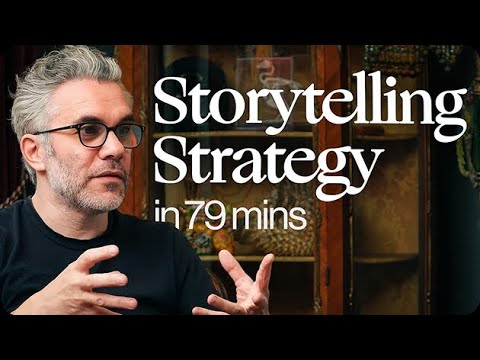
Nick Bilton is a journalist and author of narrative nonfiction books like American Kingpin and Hatching Twitter, and in this episode he breaks down the storytelling techniques he uses to make nonfiction read like a thriller — drawing on screenwriting, murder mystery writing, and obsessive on-the-ground reporting to create books that feel like movies.
The Core Principles of Storytelling
Everything is story — Bilton argues that every interaction in life, from politicians pitching policies to friends at dinner, is a form of storytelling, and what makes any story work is emotion, tension, and compelling characters.
Tension from the first line — A story must create drama and tension immediately; otherwise the reader has no reason to keep going. Every page needs something that pulls you to the next.
Know your theme before you write a word — Bilton won’t start a book until he can describe its theme in a single sentence (the “elevator pitch”). Every scene, character, and detail must tie back to that central throughline or the reader is lost.
Big story about something small, or small story about something big — The best narrative nonfiction sits at one extreme: either a massive topic made personal and actionable (like An Inconvenient Truth), or a tiny story that reveals something much larger (like Tiger King reflecting the American dream). Stories in the middle don’t work.
Learning from Screenwriting and Murder Mysteries
Screenwriting taught him economy of words — In a screenplay, one page equals one minute of film, so every single word must count. There’s no room for meandering. Bilton applies this discipline to his books, cutting ruthlessly and trimming scenes down to only what’s essential.
Get in late, get out early — A core screenwriting principle: enter a scene as late as possible and leave before everything is resolved. Instead of showing a character walking into a house, sitting down, and explaining their problem, you start mid-conversation and cut away before the answer is given — the next scene reveals it.
Murder mysteries taught him how to make readers care about bad people — The techniques that make Hitchcock’s villains compelling apply directly to writing about real-life criminals:
Every murderer has a mother who loves them — showing the human, relatable side of even terrible people.
Murderers still lose their car keys — small, mundane, universal human moments (dropping groceries, forgetting mail) let readers identify with characters they otherwise couldn’t relate to.
Show the good intentions — even when characters do evil things, showing what they were trying to achieve creates nuance and a well-rounded character.
Building Characters Readers Remember
Introduce characters one at a time — Bilton spaces out character introductions so the reader is never overwhelmed with names. You meet the main character first, get comfortable with them, and only then meet the next person.
Give characters a memorable physical trait or habit — Jared, the HSI agent, always has a Rubik’s Cube on his keychain. The IRS agent reads every email three times. These small, repeated details act as anchors so readers instantly recognize who’s on the page without having to flip back or check character lists.
Never judge your characters — Bilton quotes screenwriter Charles Randolph: you must “look out with” your characters, not “look down on” them. The worst writers are the ones who judge their subjects. You have to remove your own opinion and make every person human, even the villains.
Nuance over good-and-evil — Ross Ulbricht was willing to have people killed to protect his empire, but he also bought flowers for the woman working at the flower stall because he figured no one ever did. Both truths coexist, and that’s what makes a character real.
Painting the Room: Visualization and Sensory Detail
“Painting the room” — Bilton learned this from overhearing Andrew Ross Sorkin report a story about a secret corporate deal. Sorkin couldn’t learn the deal’s details, so he asked the source to describe the boardroom: mahogany desk, chocolate croissants, view of the Statue of Liberty. The reader felt like they were there, even though Sorkin knew nothing about the actual transaction.
Go to the places — For American Kingpin, Bilton went to the San Francisco library where Ross Ulbricht worked, sat in his chair, ordered the same sushi he ordered with his girlfriend, and visited the campground where Ross went on a weekend trip — which he identified by calculating drive times from Google Maps and then walking the site himself.
Use smell, not just sight and sound — Most writers describe what they see and hear but forget smell. Bilton deliberately includes scents (pine needles, smoke) because they powerfully pull readers into a scene.
A few details are enough — The brain is excellent at inferring a full scene from just two or three well-chosen sensory details. Over-describing (“purple prose”) kills the momentum. Bilton trims big descriptive paragraphs down to tiny, precise seeds.
Structure, Pacing, and Cliffhangers
Short chapters with cliffhangers — American Kingpin has 58 short chapters, each ending with a hook that makes you think “just one more.” This was a deliberate response to the trend toward shorter-form content and shrinking attention spans.
Seed the future, but don’t wait too long to pay it off — Early in American Kingpin, Bilton tells the reader that Ross will soon face decisions about having people tortured and killed. This plants a question in the reader’s mind, but the payoff can’t be 200 pages away or the reader forgets. The pacing of seeding and paying off has to be carefully managed.
Slow down after the crescendo — After the SWAT team raids the library in American Kingpin, Bilton’s editor told him the story needed to breathe. The next chapter steps back in time to follow the physical laptop being manufactured in Korea — a deliberate deceleration that gives the reader space before the next intense sequence.
Think of pacing like music — There are fast, intense moments and slower, quieter ones. Knowing when to speed up and when to slow down is what separates well-paced writing from poorly paced writing.
Research and Reporting as Detective Work
Build a database of everything — For American Kingpin, Bilton obtained two and a half years of chat logs from Ross Ulbricht’s laptop (the Dread Pirate Roberts side), then combined them with interviews, social media posts, emails, text messages, photos with geolocation data, and timestamps — all in one searchable database.
Think of it as Tetris — All the reporting pieces start scattered. You move them around, set some aside, and slowly they start connecting. The timestamps line up, the locations match, and the story emerges from the assembly.
Follow the digital trail to physical places — By analyzing the time stamps on photos Ross posted (standing by a car in San Francisco, crossing the Golden Gate Bridge, arriving at a campground), Bilton calculated the drive time, identified the likely campground on Google Maps, visited it, and walked the site so he could describe it in the book.
Writing Dialogue and Navigating Truth
When sources disagree, check the facts — For Hatching Twitter, Jack Dorsey remembered meeting Biz Stone at Whole Foods inside while it was raining; Biz remembered meeting at the Japanese tea garden outside in the sun. Bilton checked the weather almanac to determine which account was more accurate.
If you can’t verify it, don’t write it — When the truth is genuinely unknowable and the detail matters, Bilton leaves it out. When it’s trivial (what color shirt someone wore), he picks one and moves on.
Dialogue should show, not tell — Avoid expositional dialogue where characters explain things to each other that they both already know. Good dialogue reveals character and moves the scene forward without the reader feeling lectured to.
The Opening and the Ending
Fiction and nonfiction are flipped — In a magazine feature or news article, you lead with the most important information (the lead) and end with the kicker (the most creative, resonant moment). In fiction and narrative nonfiction, you start with a vivid scene and explain everything at the end.
The ending is your parting gift — Bilton loves writing endings the most. The reader has spent hours inside a world you created, and the ending is your goodbye. Leave them with something to think about. His Elon Musk piece ends with Musk’s own question — “Does a crazy person ever look in the mirror and know that he’s crazy?” — and the line: “Perhaps this is really the most important mission Musk is on: to never have to answer that question.”
Never tell the reader what to think — Bilton deliberately presents Ross Ulbricht’s good and bad sides without guiding the reader to a judgment. The most common question he gets is whether Ross deserved his sentence — and he intentionally has no answer. The reader must decide.
Adapting to Different Mediums and Publications
Each publication has its own style — Vanity Fair uses long, flowing paragraphs. The New York Times uses short paragraphs of one or two sentences. The New Yorker has its own conventions. Bilton adapts his formatting and structure to fit each outlet without changing his fundamental voice.
The magazine feature has changed because of the internet — Thirty years ago, magazine writers spent 800 words describing what places looked like because readers had no way to see them. Today, anyone can Google the Eiffel Tower in seconds. Writers who still describe what things look like are writing for a style that no longer makes sense — unless the place is truly unseen (like Apple’s secret hardware labs).
Find creative new ways into stories — For his Elon Musk cover story, instead of describing SpaceX (which everyone has seen), Bilton opened with a rapid-fire repetition of Musk’s missions (“He’s on a mission to Mars… to save humanity… to dig tunnels…”) to paint the room of Elon’s mind — a mind that believes it can do anything but gets in its own way.
Voice, Self-Awareness, and the Writing Process
Lean into what you’re good at — Bilton knows he has a strong visual memory (he can still picture the Rubik’s Cube dangling from a keychain) but is terrible with names. He structures his writing to play to his strengths and works around his weaknesses.
Write in pieces, assemble later — Because of his ADHD, Bilton writes in bursts — six paragraphs here, two there, a whole chapter somewhere else — then copies, pastes, and assembles them like a puzzle. The hard part is forcing himself to pull it all together at the end.
Don’t be precious about your writing — Bilton has written millions of words and doesn’t remember 98% of them. The thing that holds most people back is treating every sentence as precious. “It’s just words. There’ll be another one tomorrow.”
Voice can’t be manufactured — You can’t create a voice artificially; it emerges naturally. But you can dilute it through fear or self-doubt. Bilton’s advice: tell the voice of doubt in your head to go to hell.
Read voraciously — Gabriel García Márquez believed you shouldn’t start writing until you’ve read 2,000 novels. Bilton treats reading as active work — processing, absorbing, and learning — even when he’s not typing.
Lessons from Being on the Other Side
Being written about changes how you write about others — After Gawker ran a weekly series targeting Bilton, and after receiving hate mail (including one person wishing he’d die in a plane crash), he developed a thicker skin and a deeper empathy. He now tries to remember that there’s a human being on the other side of everything he writes.
Pick fights you can win — Former New York Times editor David Carr told Bilton: “Pick a fight you can win.” Bilton’s successful campaign to get the FAA to allow Kindles and iPads during takeoff and landing is a perfect example — he did the testing, wrote the columns, and the rule changed. Bezos even thanked him in an earnings call.
The challenge of a successful first book — A Hollywood screenwriter friend read an early draft of American Kingpin and told Bilton: “You’re never going to get a story this good ever again.” The pressure of following up a breakout success is real, and Bilton is still searching for his next great narrative nonfiction subject.
Bringing Abstract Ideas to Life
Use analogies to make scale tangible — Citing Robert Kurson’s Rocket Men, Bilton highlights how Kurson explained the precision of Apollo 8’s orbit (69 miles above the lunar surface) by comparing it to throwing a dart at a peach from 28 feet away and grazing the fuzz without touching the skin. Everyone can visualize that instantly.
Concrete over abstract — Mathematical formulas and raw numbers don’t stick in readers’ minds. Visual, human-scale analogies do. The key question for any writer: “What’s my dart? What’s my peach?”