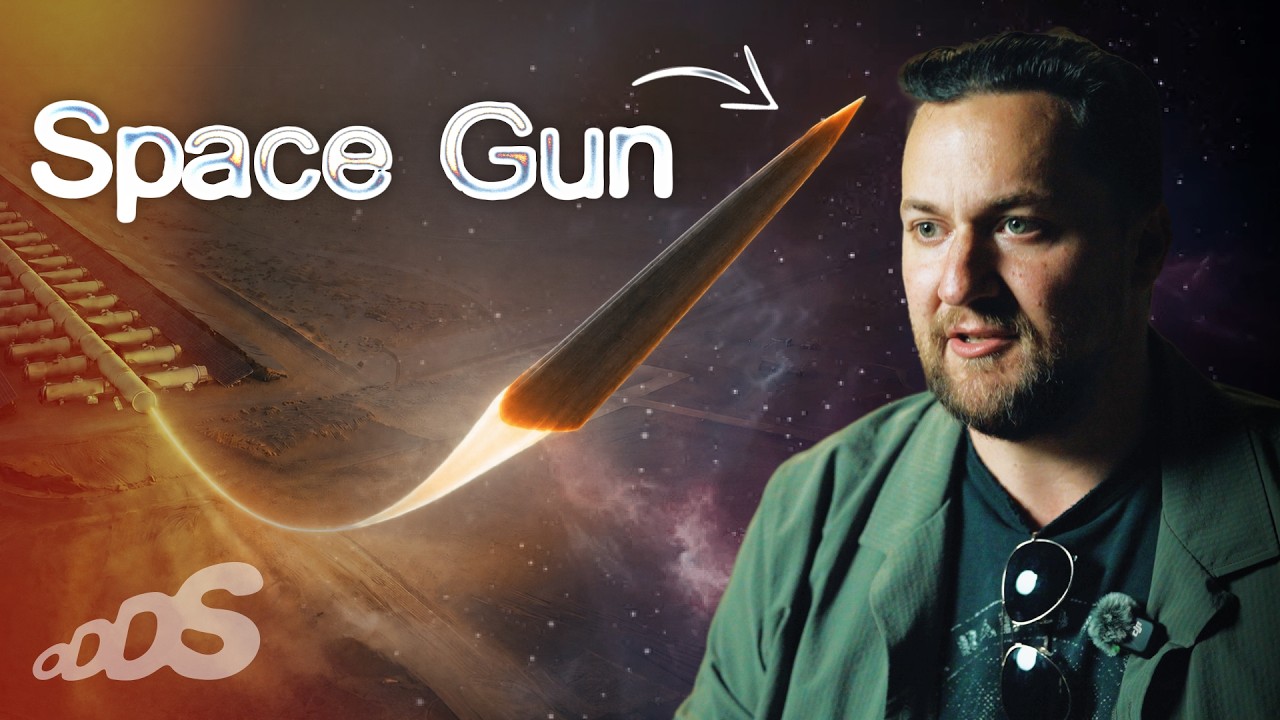
Longshot Space is building ground-based “space guns” — multi-injection gas accelerators up to half a kilometer long — to throw payloads into orbit at a fraction of rocket cost, starting with a Mach 5 demonstrator in Barstow, California.
The Core Concept: A Cargo Ship for Space
Rockets are the “airplanes” of space launch: expensive, low payload fraction, wrong tool for bulk transport.
A space gun is the “ship”: fixed ground infrastructure that uses cheap compressed gas to accelerate 100 kg payloads to hypersonic speeds, dramatically lowering $/kg to orbit.
Civilization in space requires moving massive tonnage (fuel, food, air, tools); airplanes alone cannot sustain a colony — Hawaii imports 10 tons per person per year by ship, not air.
Why Rockets Won the History Lottery
Rockets dominate not from first-principles superiority but because the US and USSR spent ~$4 trillion developing ICBMs to deliver hydrogen bombs after WWII.
Marginal launch cost was irrelevant for nuclear delivery; the resulting workforce and infrastructure locked in the paradigm.
Longshot’s approach uses only 1970s-era technology (compressed gas, steel tubes, burst discs) — no new physics, just a different economic optimization.
Founder Mindset: “Everyone Else Is Wrong”
Mike Grace (CEO/co-founder) grew up in poverty, didn’t learn to read until 12, and made a conscious decision to reject societal expectations.
That nonconformity is a prerequisite for a startup asserting a contrarian truth: “everyone is wrong about this one thing, and I’m right.”
Most nonconformists fail, but for outlier success it may be a necessary condition.
From Backyard Potato Gun to Air Force Funding
Started with PVC potato guns in a backyard, then a Mach 1.8 prototype built from Home Depot irrigation pipe and dumpster ABS plastic.
That “bad prototype” proved the team could build and iterate — convincing AFRL to award a Phase II SBIR.
Co-founder initially refused to build the ugly prototype, embarrassed it wasn’t “real engineering”; Mike argues proving you build things matters more than pretty designs.
The 60-Pitch Fundraising Gauntlet
First 60 pitches failed because Mike couldn’t articulate an intermediate business (hypersonic testing for DoD) between “potato gun” and “orbital launch.”
Silicon Valley investors won’t fund a 10-year pure space play; the hypersonics market provides near-term revenue and credibility.
David Kempson’s $20k check at 5.5 months (after Mike’s wife supported him through grad school) kept the company alive.
Three Near-Death Experiences
At least three times within ~3 months of bankruptcy; Mike paid himself $1k/month for a year on that first $20k.
Transparent finances: every employee knows every salary and equity grant, including Mike’s (which was $0 for a full year during one crisis).
Openness is a form of compensation when cash is below market; no surprise layoffs when runway ends.
150+ Test Shots: Failing Every Way Imaginable
The 6-inch accelerator has fired 150+ times; each failure teaches something (burst discs, pressure sensors, projectile disintegration).
Once saved 300 PSI of expensive helium by suiting up and plugging a leaking sensor mid-fill with VIPs watching — company survival depended on not wasting the gas.
Gun scaling to 13–14 km/s (orbital velocity) is straightforward physics; the vehicle is the bottleneck.
Max-Q (peak aerodynamic heating/pressure) occurs at the muzzle, not aloft — Mach 25 at sea level, a flight regime no vehicle has ever survived.
Solution: iterate vehicles daily by firing into a berm, no flight permits needed; cheapest hypersonic testbed on Earth.
Test Fire Execution
Procedure: evacuate barrel, load projectile on rails, fill kickstage to 750 PSI, arm capacitors, fire.
Result: projectile traversed barrel, impacted catch tank (carpet/concrete safe), sheared as expected on deceleration — baseline successful.
Think Like an Economist, Not an Engineer
Mike holds an economics degree; Elon Musk (also econ undergrad) similarly attacked price ruthlessly with 1970s tech (Falcon 9 could have been built analog).
Rule: pick one — hard problem OR technical novelty. Combining both kills deep-tech startups.
Minimize new technology; solve the specific economic problem (cost/kg) with existing physics.
Success Metrics: Not a Defense Contractor
First payload idea: launch a Tesla as homage to Elon, watch it pancake at 200g — “pretty funny.”
Selling Longshot as a hypersonics defense contractor for billions = failure; the mission is space access for ordinary humans.
Vision: kids (not astronauts/billionaires) choosing to start new lives on Enceladus; Earth becomes a garden, industry moves off-planet.