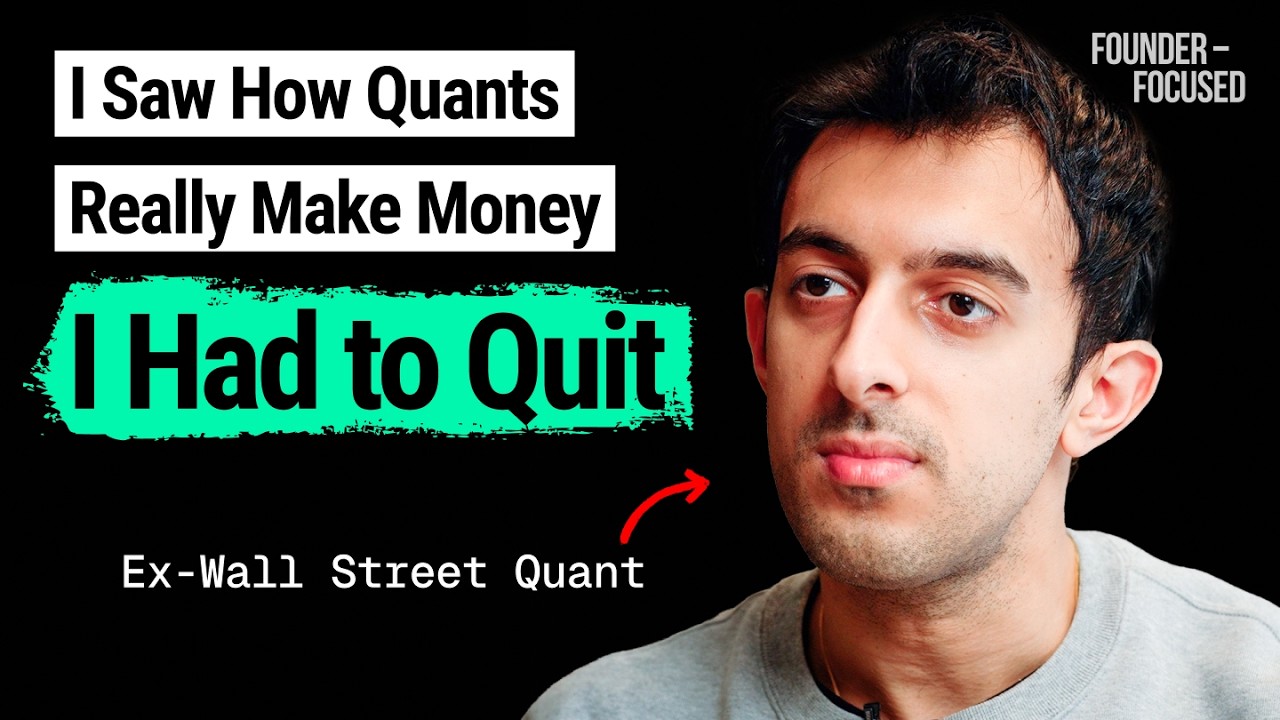
Annanay Kapila left a lucrative career as a high-frequency trading (HFT) quant—where he managed strategies responsible for up to $10 billion in daily trades—to co-found QFEX, a startup building a 24/7 global stock exchange designed to fix what he sees as deep structural flaws in traditional financial markets.
He worked at top HFT firms including Flow Traders and Tower Research Capital, earning large paychecks but growing disillusioned with an industry he believes extracts value from investors without adding real economic value.
His motivation stems from firsthand experience: HFT profits often come not from insight or risk-taking, but from exploiting arbitrary market design flaws—like futures contracts that expire unnecessarily, forcing investors to pay transaction costs and creating profit opportunities for HFT firms on the other side.
He describes this as a form of value extraction, not value creation, and notes that many brilliant colleagues—often math Olympiad medalists or top engineering graduates—are trapped by “golden handcuffs”: high salaries that make it hard to leave, even when they don’t find the work meaningful.
Why Traditional Markets Are Broken
Unnecessary intermediation: A single stock trade (e.g., buying Tesla) typically involves three separate entities—the exchange (NASDAQ), the broker (Robinhood), and a clearing house—each adding cost and complexity.
QFEX aims to consolidate this into one efficient, transparent system, reducing friction much like Stripe did for payments.
Opaque pricing and profit-sharing: Traditional exchanges often profit from hidden arrangements with market makers; QFEX charges only transparent, minimal fees and even returns fees to users through referral incentives.
Artificial market inefficiencies: Features like quarterly futures expiration (originally tied to agricultural cycles) persist despite no modern justification, creating recurring costs for investors and guaranteed profits for HFT firms.
From Idea to Startup
Kapila had the idea for QFEX about six months before leaving Tower, driven by a desire to redesign markets so HFT couldn’t profit from structural flaws.
He pitched it to his longtime friend and co-founder Josh, a former Citadel engineer, who immediately recognized the potential and quit his job to join.
They applied to Y Combinator (YC), where they were grilled on problem depth and timing—not probability of success. YC funds big ideas if the team is right, even with low odds.
They were accepted and received funding, enabling them to build full-time.
Early internal launch during YC went awry: a bug caused simulated accounts to show $1M gains/losses despite starting with $100, forcing the team to manually reconcile balances and absorb losses.
This near-failure underscored the extreme reliability required for a 24/7 exchange—any real-world failure would be catastrophic.
Fundraising and Vision
QFEX raised a seed round at a $95 million pre-revenue valuation from major investors including General Catalyst and Next Ventures Partners.
Kapila argues VCs only back startups aiming for massive scale—exchanges are winner-take-all, so the business must be huge or nothing.
He contrasts Silicon Valley’s impact-driven mindset with London/New York’s focus on personal wealth: in SF, people care more about legacy and change than salary or net worth.
This cultural shift helped him reframe his mission: not just to make money, but to build something worth telling his grandchildren about.
Advice to Young Professionals
For those in high-paying jobs (especially in finance or tech), Kapila urges honest self-reflection:
Ask: Is this what I want to be doing in 5–7 years?
Most people say no—but stay anyway, trapped by comfort and compensation.
He advises prioritizing learning and growth over early earnings, especially when young.
The real cost of a high salary may be stagnation, guilt, and missed opportunity to build something meaningful.