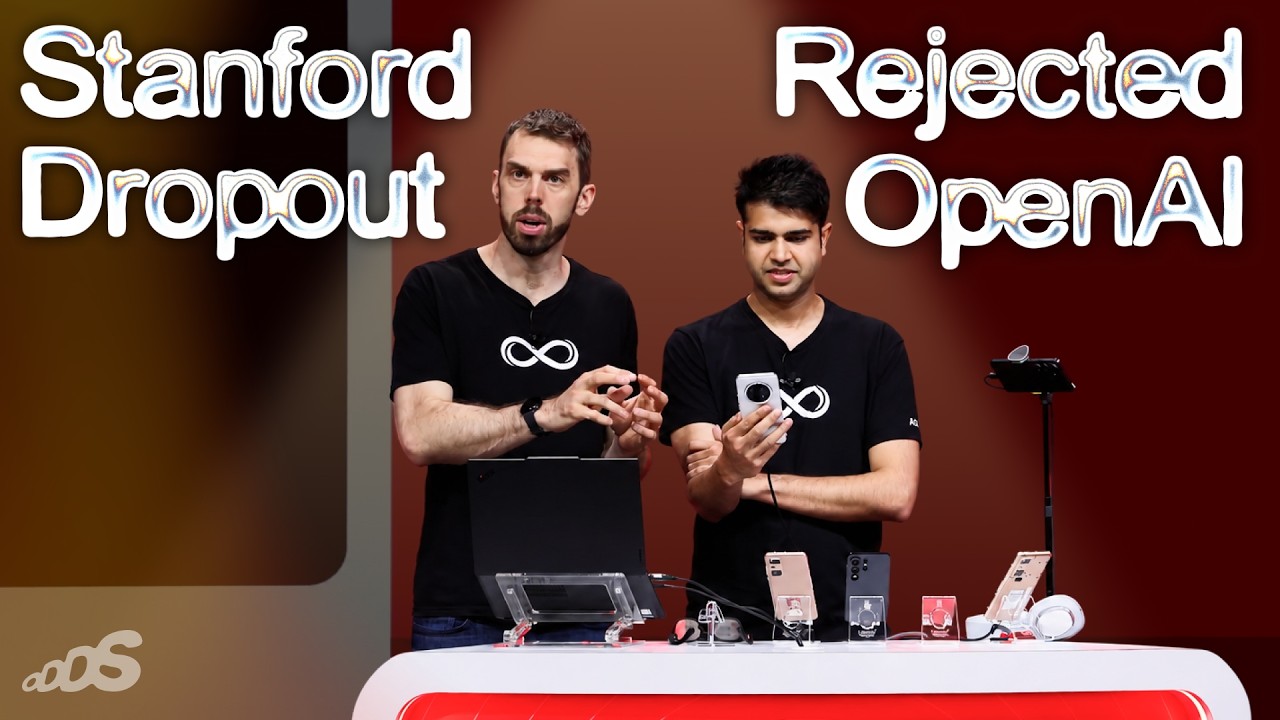
AGI Inc. is a startup building truly personal AI agents that run entirely on-device — on phones, smart glasses, watches, and custom wearables — so users own their model and data, unlike cloud-dependent offerings from OpenAI or Anthropic; the company was founded by Div Garg, who dropped out of a Stanford PhD and turned down a billion-dollar OpenAI offer to pursue this vision of a Jarvis-like assistant that equalizes access to an “army of agents” for everyone.
Origin and founding vision
Div Garg studied physics and CS at Cornell (International Physics Olympiad gold medalist), then joined Stanford for graduate studies where he co-created the university’s first Transformers course (CS 25), recruiting lecturers like Geoffrey Hinton, Anthropic co-founders, and OpenAI researchers by cold-emailing them.
He dropped out of his PhD and declined a billion-dollar offer from OpenAI because he believed building on-device personal AI is “the most impactful thing we can do for the whole humanity right now” — removing the gap between billionaires who have human assistants and everyone else by giving each person an army of AI agents.
The core analogy is Jarvis from Iron Man: a personal AI butler that knows you, takes ambiguous requests, understands underlying intent, and eventually acts proactively — all while keeping data on the device so there is “no cloud to trust.”
Technology stack and on-device differentiation
The stack has three layers: application layer, agent harness, and inference engine; the agent receives a task and a screenshot, predicts the next action (click, type, scroll), executes it, and loops until the task is complete.
Current bottleneck: getting the full inference pipeline on-device — right now it runs in the cloud, and shrinking the model reduces capability; the research challenge is maintaining accuracy and speed on edge hardware.
Memory and context are the new rate limiters: the system must understand the user well enough to handle ambiguity, recognize intent, and eventually act proactively; trust enables users to share more context, which increases capability.
Compounding error problem: a 90% single-turn accuracy drops to ~40% over 20 tasks; AGI Inc. focuses on solving this reliability gap for production use, which is why partners like Qualcomm come to them.
Benchmarks: currently number one on Android World for on-device agent performance.
Product capabilities and demos
Hands-free voice control of any app: demonstrated ordering a customized Chipotle bowl via DoorDash — the agent opened the app, selected steak, brown rice, lettuce, corn, guac, salsa, sour cream, cheese, and confirmed the $91 order with a guardrail prompt.
Accessibility focus: enabling grandparents to order food or FaceTime grandchildren by voice alone, without navigating complex UIs.
The goal is a new operating system for devices that lets people look at screens less and spend more time in real life — the phone stays in your pocket while the AI acts in the background.
Hardware and wearables strategy
Will leads growth, wearables, and hardware; the team is experimenting with form factors including pendants you speak into (modern-day pager), “mini phones” (chunky iPod-like devices), and partnerships with chip companies like Qualcomm.
Qualcomm and other device makers partnered after seeing tech demos: “Wow, I’ve never seen a phone do that before” — and it was running on their chip.
The unusual path: instead of competing in crowded markets like spreadsheet automation, AGI targets edge-device inference where device makers have a need no one else was filling.
Business model and competitive positioning
Fundamental difference from frontier labs: AGI sells/runs models on the user’s device — you own the model, you own the data; OpenAI and Anthropic’s business models depend on cloud inference, so they “don’t want” to ship on-device models.
Not renting a model on someone else’s cloud; the vision is billions of personalized, self-learning models that improve over time and are fully trusted because they never leave the device.
Partners and customers are device manufacturers who need on-device agent capabilities; AGI remains “the best in that category” per partner feedback.
Technical challenges: demo to production
The gap between a demo (works 10% of the time) and production (billions of users, robust edge-case handling) is like self-driving cars: Waymo and Tesla took over a decade to go from concept to road-ready.
Real-world chaos: users ask unpredictable things (e.g., “file my taxes on my phone”), apps change, screens vary; the agent must handle this reliably across 10–20 step tasks without compounding failures.
Current focus: improving per-turn accuracy and memory/context systems so multi-step tasks stay reliable; this is the core value proposition for partners.
Company culture and team
Work style: “996 type of company” — 9:30 AM to 9:30 PM most days; founders and team say “if you love what you’re doing, it doesn’t matter” and describe it as a meaningful sacrifice for something valuable.
Night owl culture: many work late (2 AM+) for distraction-free focus; autonomy is high — people own decisions and unleash creativity as long as they perform.
Hiring: “hire really slow, fire very fast” — culture fit is paramount; every person adds to the culture, which “cannot be enforced” but forms organically.
Trials before full-time: new hires (like Shariq on day one) get a year’s worth of feature implementation as a test, evaluated on handling ambiguity, product intuition, and iteration speed.
CK described as “big brother of the company” and central to culture; team events (co-working sessions, trips releasing mini phones) build serendipity and recruit researchers.
Creative freedom: early on, people identify strengths and get ownership; e.g., one member’s first contribution was the mini phone project, which became a conversation-starter at events.
Future vision
Billions of personalized models — each person buys and customizes their own model that learns preferences over time, like modifying your own car rather than sharing one generic car for humanity.
The AI relationship may become “more influential than any human relationship or at least as influential”; choosing the design of that AI is critical.
Ultimate goal: contribute to making the world better by equalizing access to AI agency, reducing screen time, and letting people be more present in real life.