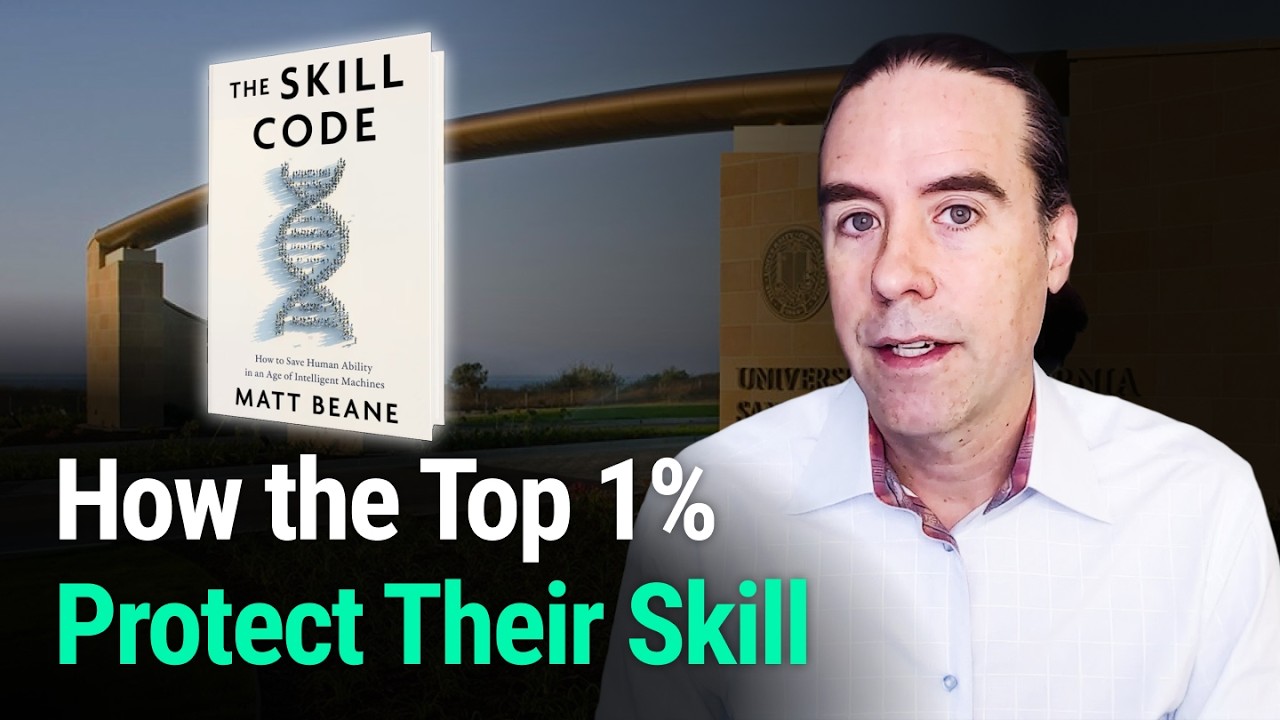
Matt Beane, associate professor at UC Santa Barbara and CEO of Skill Bench, argues that 2026 marks a shift from AI experimentation to accountability, warning that unrestrained AI use produces a flood of “B+” work that erodes human skill and judgment unless leaders actively protect the conditions for expertise.
The B+ Trap and the Trillion-Dollar Deskilling Risk
AI makes it effortless to generate competent-but-mediocre output, and without deliberate restraint, people and organizations will default to volume over quality.
Jensen Huang’s token-burning metric ($250K tokens per $500K engineer) exemplifies the danger: activity is mistaken for value, and “burning tokens” becomes the goal rather than producing A+ results.
If you haven’t learned to think, write, or code at an expert level yourself, you cannot detect the quality flaws hidden inside AI-generated work, so you silently accept B+ output and stop improving.
This creates a slow, subtle deskilling: individuals lose the ability to judge quality, the next generation never builds deep capability, and the economy suffers a trillion-dollar hit in a few years.
Healthy organizations reward people for stopping B+ ideas — cash, promotion, or visible recognition for saying “this isn’t good enough” — so that only A+ work moves forward.
Shadow Learning Reveals What Skill Development Actually Requires
Beane’s 2018 research on robotic surgery (extended across 35+ occupations) found that when new technology lets experts work independently, novices lose the on-the-job participation that builds most skill.
A rare few “shadow learners” bypass broken pathways through norm-bending, sometimes rule-breaking methods: operating without supervision, consuming 100× more video content, finding deviant ways to practice.
These behaviors are not models to copy — they are diagnostics. Shadow learners fight to protect three things that the formal system no longer provides: challenge, complexity, and connection.
The Skill Code: Three C’s That Build Expertise
Challenge — Work at the Edge of Capability
Skill grows when you operate close to but not past your limit: intense, slightly stressful, performing a bit below your best because you’re straining.
An expert’s presence is critical to frame the inevitable small failures as progress (“last week you couldn’t even attempt this”), preventing frustration from becoming discouragement.
Complexity — See the Whole System, Not Just the Focal Task
A surgeon learning only suturing misses the nurse coordination, supply chain, IT systems, and hospital finances that determine real outcomes.
Engaging with the broader system builds adaptability and surfaces novel ideas; individuals must carve out reflection time, but leaders can institutionalize this through job rotation.
Example: two warehouses, same pay and title — one rotates workers across line positions for resilience and quality detection; those workers become far more adaptive.
Connection — Trust and Respect as Functional Infrastructure
The deepest learning experiences are almost always tied to a specific person who trusted you, gave hard feedback, and made you want to earn their respect.
This bond is bidirectional: juniors push harder to honor a mentor’s trust; seniors find meaning in developing juniors and earn trust in return.
Practically, connection gates opportunity — the senior who trusts you gives you the next stretch assignment and helps you through it.
What Leaders Must Do Now
Learn in Public — Model the Messy Reality of AI Adoption
Effective leaders spend significant hands-on time with advanced AI tools, building real things and showing their failures to the organization.
Reporting “I tried this with AI and it was terrible” signals that no one has mastered this yet, normalizing experimentation and reducing performative token-burning.
Hire Juniors and Build Inverted Apprenticeships
The current trend — freezing junior hiring to retain seniors — is short-sighted; AI-native juniors can do astounding things even without professional experience.
Inverted apprenticeship: bidirectional learning where seniors teach judgment and context, juniors teach AI fluency and fresh perspective.
Healthy organizations accept a short-term productivity hit to build long-term resilience; general-purpose technology transitions are inherently messy, and no one gets it right alone.
The Long Horizon: AI May Surpass Humans at Everything
Beane takes seriously the possibility that within 3–40 years, AI exceeds human capability at all tasks — empathy, judgment, creativity included.
Institutions (government, education, organizations) are unlikely to adapt fast enough even on a 30–50 year timeline, meaning disruption will be painful unless we act now.
The goal: a future where we are grateful AI arrived because everyone is better off, not just a few — which requires immediate, collective action to make AI part of the solution rather than the source of the crisis.