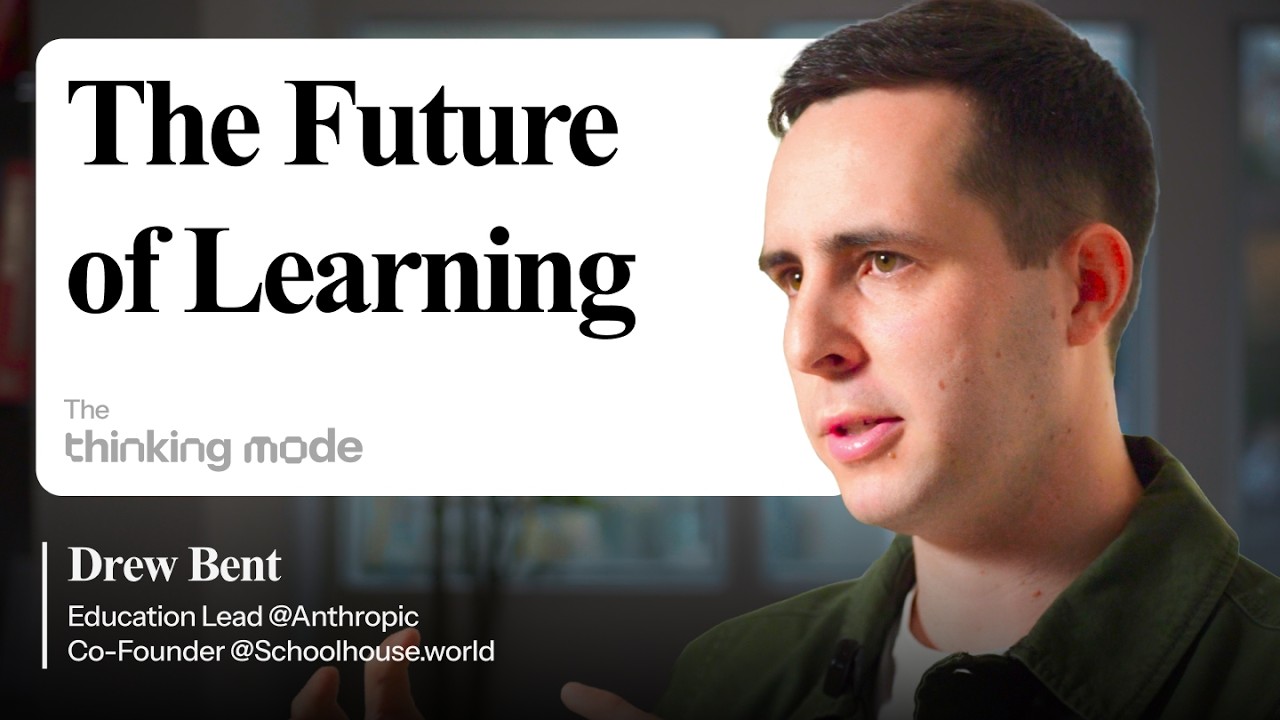
Drew Bent, who leads education at Anthropic and has spent his career in tutoring and education, argues that most people dramatically underestimate what AI can do today—and that the key to using AI well is not following rigid prompt recipes but treating AI as a collaborative colleague, giving it rich context, and constantly pushing it to its limits.
He draws on his experience as a high school math teacher, founder of a tutoring nonprofit, and builder of AI tutoring tools to explain how the top 1% of learners use AI not as a shortcut but as a thinking partner that makes them smarter.
The central tension he explores: AI can either cause skill atrophy (when used transactionally to get answers) or dramatically accelerate learning (when used as an inquiry tool to wrestle with harder problems). The difference is entirely in how you engage.
Most People Use AI Like It’s 2022
People who adopted AI early often still treat it as a simple assistant because they anchor to what the models could do last year, while AI-native users—those whose first digital tools outside of phones were AI—treat it as a powerful collaborator from the start.
This misjudgment of current capabilities leads people to give AI trivial problems when it could handle far more complex, ambiguous, and high-level tasks.
The fix is to constantly raise your ambition: try things that aren’t quite possible with today’s models, so that when the next model arrives, you’re already at the cutting edge.
AI capability is growing exponentially, not linearly, which is hard for humans to internalize—your AI colleague may have doubled in ability since last month.
How the Top 1% of Learners Use AI
An Anthropic study on coding education found that students who used AI tools completed assignments faster but scored 17% worse on a subsequent assessment without AI—they understood the concepts less because they hadn’t had to internalize the work.
However, a subset of AI users who engaged in an inquiry mode—probing, asking questions, wrestling with problems rather than just extracting answers—performed just as well as the non-AI group.
The critical distinction: are you using AI to get the task done as fast as possible, or are you using it to get better and smarter while doing the task?
Best practice is to bring the problem, not the solution—come with what you’re wrestling with rather than a narrow question designed to get a specific answer. Today’s models are strong at helping you reason through open-ended problems.
Context Is the Biggest Differentiator
The gap between excellent and mediocre AI users comes down to how much context they provide before asking anything.
Drew spends most of his time with AI feeding it background: documents he’s written, his company context, his stream of consciousness on a topic—so the model can reason within his actual frame of reference.
AI can synthesize enormous amounts of context, but it cannot reason its way through a problem with almost no information about how you think.
This shifts the skill from technical prompt engineering to something more like a social skill: communicating context, intent, and constraints the way you would with a knowledgeable colleague.
The Chatbot Is Not the Endgame
Most people imagine AI learning happening inside a chatbot, but Drew argues we need to think 10x beyond that format.
Claude Code, Anthropic’s coding agent not designed for education, is being repurposed by learners as a coach—they build memory and context files about who they are and how they learn, and the agent becomes a personalized learning companion.
This points toward a future where interfaces are much richer than text chat, and the AI knows your curriculum, your progress, your school context, and your personal learning style.
Using AI for learning may actually take more time right now than doing things by hand—this is expected and acceptable as R&D. The time investment today pays off as the tools improve.
The 2030 Classroom: Invisible Technology, Human-Centered Learning
Drew’s vision for 2030 is a classroom where you walk in and don’t see the technology at all—it operates behind the scenes while teachers and students focus on human-to-human interaction.
Teachers are already building custom tools with Claude: flashcard apps, formative assessments, personalized lesson plans—things that used to take a year of curriculum development now take a morning.
AI handles personalization and logistics (grouping students, tailoring lesson plans), freeing teachers to do what humans do best: build relationships, inspire, and hold students accountable.
He emphasizes that school is not just about learning algebra—it’s about learning to interact with fellow citizens, colleagues, and friends. AI should deepen human connections, not replace them.
Scaling Tutoring: AI Plus Human Connection
Drew co-founded Schoolhouse, a peer-to-peer tutoring platform where anyone worldwide can receive free tutoring or volunteer as a tutor, demonstrating that global learning communities create unexpected connections—students from Russia, Colombia, the US, and China learning together on the same call.
He’s known Sal Khan since high school and shares the vision of scaling one-on-one tutoring, but insists the personal dynamic—someone who cares about your progress and holds you accountable—is equally or more important than the AI component.
The future of education combines AI tutoring with human mentorship, not one replacing the other.
Collaborating With AI Is a New Social Skill
We spent 15+ years in school learning to interact with humans; now we need to learn how to collaborate with AI as a new type of being that shows up as a coworker in Slack or a classmate in school.
The era of technical prompt engineering is over. What matters now is treating AI as a colleague: understanding its capabilities and limitations, giving it context, and engaging in a dialogue similar to human collaboration.
This skill develops through practice and reps—spending time with AI, experimenting, and treating the interaction as a relationship rather than a transaction.
Drew runs a marketing operation with 40 AI agents and a $500/month AI bill that replaced what would have been $50,000/month in contractor costs, illustrating the scale of what’s possible when you build AI collaboration as a core professional skill.
AI Is Underhyped, Not Overhyped
Despite the hype, Drew believes AI is way underhyped—most people are using it for perhaps 1% of what it can do.
Building AI agents is becoming a fundamental professional skill on par with knowing spreadsheets, and will define careers for the next 30 to 40 years.
The opportunity is not to use AI for the tasks you already do, but to reimagine what becomes possible when you have a team of AI collaborators that know your context and grow with you.