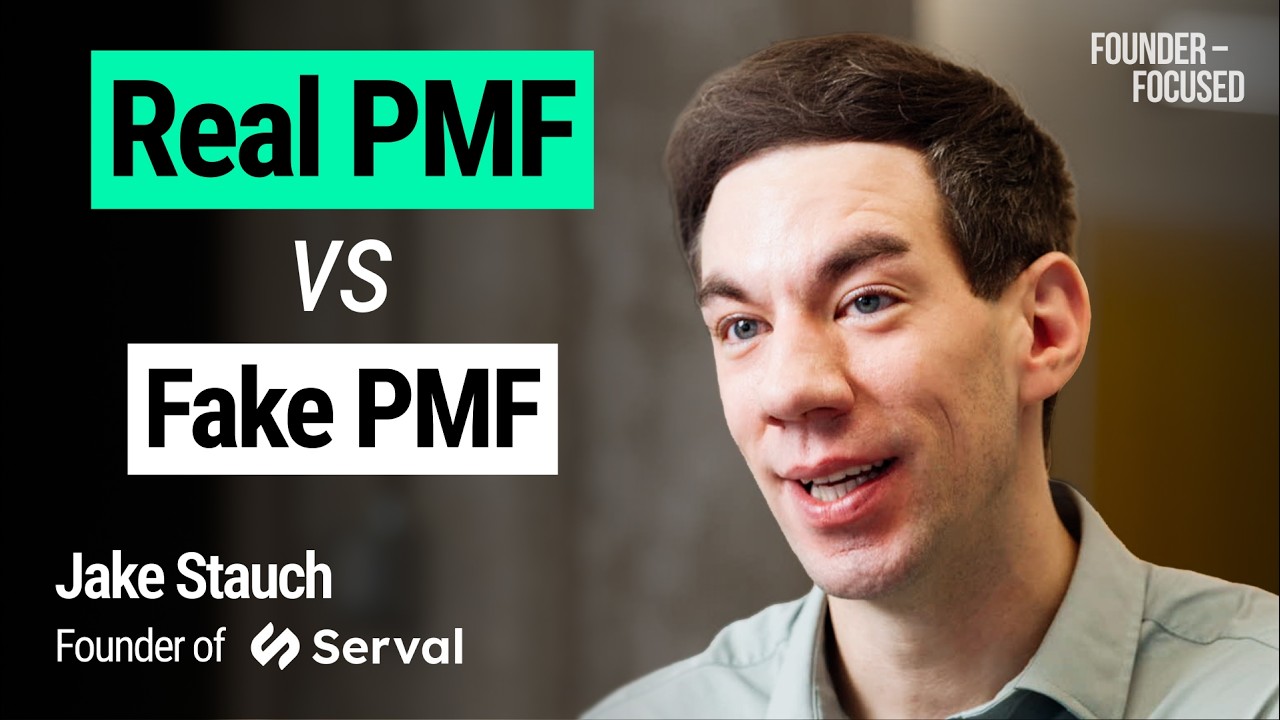
Jake Stauch is co-founder and CEO of Serval, an AI-native platform that automates corporate IT work (help desk requests, onboarding, offboarding, access management). Serval raised a $75M Series B at a $1 billion valuation from founding in just 18 months. The episode traces how Jake’s experience of mistaking fake product-market fit for real at his previous company, Neuroplus, shaped the disciplined, customer-embedded approach he took at Serval — and how recognizing the difference between the two is the central skill of building a consequential company.
The Neuroplus Lesson: Why Fake PMF Feels Identical to Real
Jake dropped out of Duke (where he was studying neuroscience) to start a company using brain scans to test advertising. A customer asked to use the headset to monitor his son’s ADHD, which led Jake to pivot into building Neuroplus — a consumer hardware/software product for kids with ADHD.
Neuroplus had rabid fans, a successful Kickstarter, and steady growth. Jake believed he was on the verge of massive scale. In reality, the market was tiny and the early adopters were too unusual to represent a broader customer base.
He didn’t realize how far from real product-market fit he was until a year or two after winding the company down. The experience taught him that early enthusiasm from a small, atypical group can create a convincing but false signal.
Key signals that Neuroplus never had real PMF:
Early customers shared strange, unique traits that didn’t generalize to a larger market.
There was no natural gradient from early adopters to mainstream buyers.
Jake was always chasing “one more thing” that he believed would unlock the next stage of growth — a pattern that can sustain a small business indefinitely but never produces breakout scale.
His takeaway for first-time founders: be ruthless in judging whether you’ve truly found PMF. One or three good customer conversations isn’t enough. You need enough conversations to deeply understand the problem and confirm your solution works for a meaningfully large market.
Seeing Real PMF at Vicata Changed Everything
After Neuroplus, Jake joined Vicata (a computer vision company) as an early employee running marketing, recruited by a college friend. He walked into the office and immediately felt the difference — the energy, the momentum, the way customers responded.
On one early sales call, the demo went poorly — the sales rep fumbled, got details wrong, and the customer seemed confused. Jake thought the call was a disaster. At the end, the customer said, “Sounds good — send me a quote. We’ll probably buy 30 cameras next month.”
That moment crystallized real product-market fit for him: when customers are pulling the product out of you despite imperfections in sales, demo, or even the product itself. The rest of the business can be messy, but if the market pull is strong enough, everything else falls into place.
This experience became the internal benchmark he carried into Serval.
Building Serval: A Year of Skepticism Before the Cascade
Serval is an AI platform for employee support — automating IT help desk requests, password resets, application access, onboarding/offboarding, and similar tasks. Jake’s theory was that success required a full platform combining ITSM, AI-native workflow building, access management, and help desk automation — not a point solution.
For the first year, Serval had no market traction because the platform wasn’t built yet. Every customer conversation revealed a long list of missing features. Jake had to maintain conviction that the full platform was the right product to test, even without any proof it would work.
He stayed neutral to individual customer feedback — not letting great calls inflate him or bad calls deflate him. He took five to six customer calls per day, treating them not as discrete interviews but as ongoing relationships built over time.
He embedded himself in customers’ Slack channels, talked to them daily, and built intuition about their problems, pains, and workflows that no formal interview process could replicate. The key is genuine interest in making their lives better, which drives the relationship and yields real product insights.
The turning point came in April–May 2025. After closing the first few deals, a cascade began: more customers, better feedback, faster iteration, better product, more deals. Within weeks, the tenor of conversations shifted from “this is interesting, keep us posted” to “how much does it cost and how do we get started?”
The Bet on AI Model Improvement
Building an AI product requires a difficult judgment call: are you building for how models work today, or for a future where they’re significantly better?
In Serval’s early days, the workflow builder couldn’t automatically build automations from plain descriptions — it required iteration, prompting, and behind-the-scenes orchestration. Jake bet that between Serval’s own engineering improvements and the rapid advancement of underlying models, the product would deliver on its vision.
The risk is twofold:
Building too far ahead of current model capabilities can leave you with a product that doesn’t work and no customers.
Waiting for models to improve before building means you’ll be too late when the capabilities arrive.
Jake’s approach: embrace challenges that are almost possible today, where a small leap of faith suggests they’ll be viable soon. But don’t bet the entire company on models getting better — that’s just another form of the “one more thing” delusion he fell into at Neuroplus.
Broader Views on AI and Enterprise Software
Jake is bullish that future software companies will be broader in scope but expects more of them, not fewer — because customers will demand more from each platform. He doesn’t see consolidation; he sees rising expectations.
The core principle that has guided him across companies: focus on product experience first. Build something customers want and love, and the rest of the organization falls into line. Without product-market fit, nothing else can be fixed.