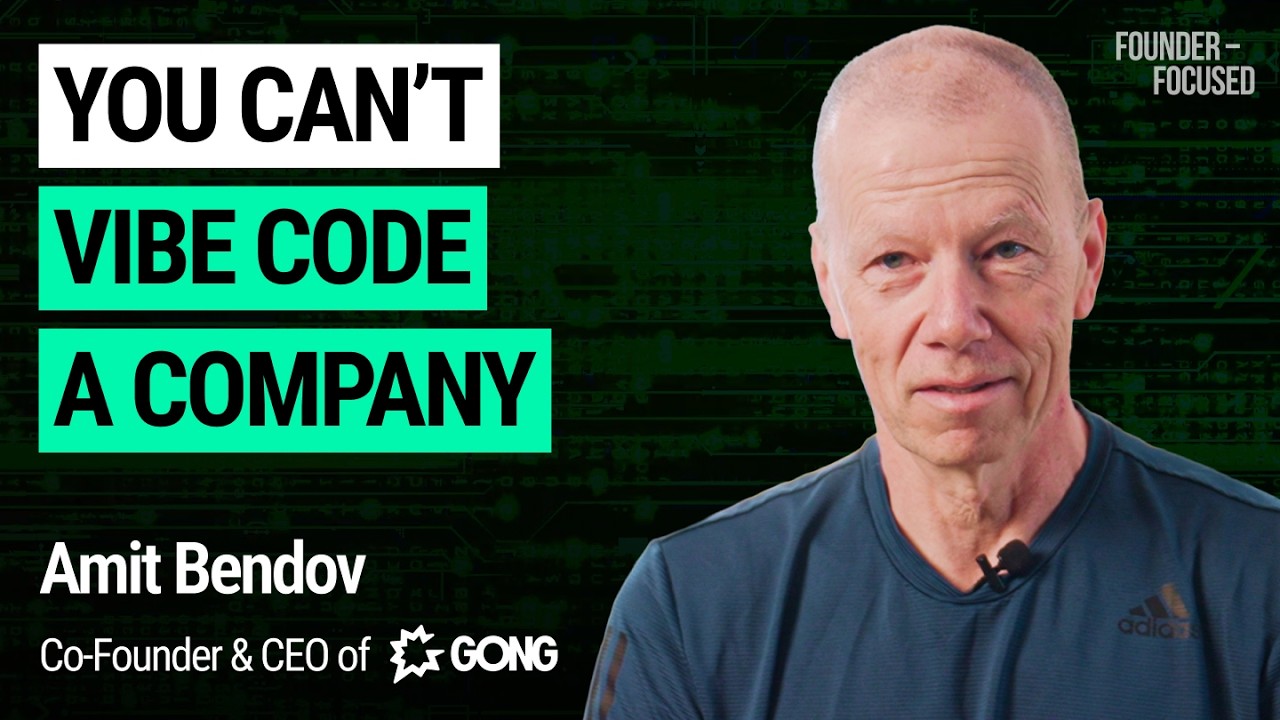
Amit Bendov, co-founder and CEO of Gong, shares the story of building a $7B revenue AI company — from a childhood in Israel with no family history of higher education, through early career as a retail audio equipment seller and engineer, to founding Gong in 2016 (before AI was mainstream) and navigating the challenges of creating an entirely new product category, surviving a rough competitive patch in 2023, and ultimately building one of the fastest-growing enterprise SaaS companies with 50%+ quarterly growth for nearly 12 consecutive quarters.
The Origin of Gong
The insight came from Bendov’s time as CEO of Sisense, a business intelligence company, where he discovered that CRM systems — supposedly the “single source of truth” for managing customer relationships — were essentially empty: only about 1% of relevant sales information ever made it into the CRM, because it relied on people manually entering what happened.
Half of salespeople miss their quotas, and 9 out of 10 lost opportunities are never understood by the company — the real reasons live in people’s heads, not in any system.
The idea: build an autonomous system that captures conversation context automatically and uses AI to turn it into insight and action — inspired by the same moment AI was beating world champions at Go (AlphaGo/DeepMind).
Early product innovations that are now industry standard: meeting markers and topic tracks (inspired by SoundCloud’s waveform and GarageBand’s multi-track layout), listen-to-talk ratio (first application to measure how much a rep listens vs. talks), and automatic competitor tracking during calls.
Fundraising Struggles and Early Skepticism
Raising money was extremely difficult — investors thought salespeople would hate Gong (“big brother” surveillance), that Google and Amazon would dominate the space, and that the AI technology wasn’t mature enough.
Eventually secured funding from a couple of believers, and the company was able to start and grow from there.
The “Raving Fans” Operating Principle
Gong’s #1 operating principle is creating “raving fans,” not just happy customers — the analogy: a chair that unexpectedly gives you a back rub at the right temperature is the level of surprise and delight that gets people talking.
Two North Star metrics guide product development: (1) remove non-productive work from sellers’ days (75% of their time is spent on CRM updates, forecasting, training, list-sifting), and (2) help sellers be better at their actual job during customer conversations.
The goal is to consistently deliver “wow” moments — the product should surprise users in ways that exceed expectations, converting initial reluctance (“is this invasive?”) into enthusiasm.
Surviving the 2023 Competitive Crisis
Post-COVID hangover hit hard: customers had over-hired and faced financial stress, leading to higher churn; a competitor acquired several rival products and consolidated them into a single (inferior) offering that looked attractive on a spreadsheet comparison.
Growth slowed substantially — “not existential, but not fun days.”
Gong’s response: they had raised significant cash and barely touched it, giving them the confidence and runway to invest aggressively in engineering while competitors struggled.
Bendov’s philosophy during downturns: “step on the gas pedal” — when everyone is exhausted from market headwinds, that’s the moment to attack. He uses an amateur cycling analogy: on a climb, when everyone is suffering, you accelerate — it psychologically breaks competitors who can barely keep up.
Competition should be “an Easter egg hunt, not a football match” — in early-stage markets, there are so many possibilities that trying to one-up a competitor play-by-play is the wrong game. Go where others aren’t going.
Market Selection as the Most Important Decision
The single most important factor in company success is which market you play in — more than anything else. If the market is too small, you hit a “local optimum” (climbing a hill and reaching the top, but it’s not the mountain): you might get to $50–100M but never $1B.
Gong recognized they were in a trillion-dollar opportunity — if they failed, it would be their own fault, not the market’s.
Category creation: Gong had to create the “revenue AI” category from scratch — there was no existing budget line for it, no established buying behavior. Categories only form when a unique product succeeds and others follow. Bendov’s advice: don’t start by trying to create a new category; start by understanding whether you’re stuck because of a market-size problem or a temporary execution problem.
Small + competitive is the worst combination — “five hungry dogs fighting for a very small piece of meat.”
Why AI Won’t Easily Disrupt Incumbents
Current market fear: “If AI can write code, what’s the moat?” Bendov argues this is a massive overreaction.
Writing code is only one part of a software company — running it in production, security patching, 3 AM incident response, driving adoption, and supporting enterprise customers at scale are extremely hard and not solvable by vibe-coding.
Even if Salesforce’s code were open-sourced, it would be nearly impossible to compete with them — CRM and HR systems are incredibly complex.
Sales is particularly hard for AI because it’s asymmetrical: buyers lie, hide budgets, misrepresent decision-making power, and don’t disclose what competitors they’re evaluating. AI needs excellent context to navigate this.
AI struggles with ambiguity, reading the room, political power dynamics, and creative judgment — it’s trained on plausibility, but the best sales moves are sometimes implausible ones that happen to work.
Gong’s architecture was designed like Tesla’s self-driving levels: they built the full framework (revenue graph as sensors, AI layer, application layer) even when the underlying technology was only at “level 1,” so they could plug in better capabilities as AI matured.
Layering Revenue for Sustained Growth
From the outside, growth looks smooth, but internally it requires layering multiple S-shaped revenue curves — each product line eventually hits a ceiling, so you need to start building the next one 2–3 years before you need it.
Gong has built and consolidated multiple products (now around four), staying ahead of competitors who tried to consolidate the market with inferior bundled offerings.
Bendov’s Core Advice
“Who do you cater to and what do you offer?” — if you can distill everything to one question, this is it.
Ignore the noise around AI — current market emotions are exaggerated, like “hormones thinking versus the brain.” The dust will settle. If you have a direction, keep going.
Don’t be competitor-obsessed — most companies say they’re customer-obsessed but are really watching competitors. That’s the wrong game, especially in early markets.
Real estate is a trap — Gong has operated from WeWork since day one, keeping leases short (2–3 years), because fast-growing companies either outgrow offices or get stuck paying for empty space. Invest in people and engineering, not offices.